


 Francais
 Deutsch
 Italiano

Refine Your Search
Kodiak Alaska USA 1953 stock footage and images
- Showing 511 to 516 of 25628 results more
 Hide
Color Sound
U.S. aviators are welcomed at different places during their journey around the world.
A flight around the world. A globe rotates. U.S. President Calvin Coolidge bids goodbye to army airmen. The President and Major General Mason Patrick and the fliers on a lawn of the White House, Washington DC. The journey starts from Seattle, Washington. Douglas World Cruisers ( DWC ) in flight. The DWCs parked in a bay. A forest in the background. They arrive at Chignik Bay, Alaska. The aircraft in flight. An iceberg. Lieutenant Lowell Smith stands on one of the pontoons and works with propellers on his DWC. The DWCs in flight from America to Asia. The aviators are welcomed by Japanese officials in Yetorufu, Japan. Japanese children playing in a school yard. A child has a Japanese and a U.S. flag, one in each hand. They reach Hong Kong, China. A fleet of native junks to welcome them. In Calcutta, India , a DWC taxis on water. A large number of people gather around a DWC. A crane lifts a DWC out of water. The aviators land in Constantinople. People around the aircraft. They reach Paris, France.. Aerial views of the city. Mrs. Maclaren congratulates the airmen in London, England. The crew of USS Richmond cheers the aviators. The aviators board their aircraft from a small boat. People watch as the aircraft land in Labrador, Canada. The DWCs are anchored in a bay and the aviators are brought to the shore in a boat. Naval officers greet them. The aircraft in flight over the Boston skyline. A motor launch in Boston Harbor. The DWCs land on water. The aviators arrive at the dock in the motor launch and are greeted by officials. They fly over New York. A large crowd greets the aviators at Mitchel Field, Long Island. They arrive at Bolling Field in Washington and are congratulated by President Coolidge and U.S. Secretary of War John Wingate Weeks. The three DWCs are followed by an XNBL-1 Barling bomber in flight in Dayton. Lt. Jack Harding is welcomed home. The world flight ends in Seattle, Washington. Photographers click pictures as a DWC lands. Major Martin greets aviators standing beside a DWC.

U.S. developments in defense against intercontinental ballistic missiles
Actor Raymond Massey standing in front of color map of North America, speaks about U.S. measures to defend against potential enemy intercontinental ballistic missiles. Aerial view of one of the largest radar antennas in the world being set up in Greenland and Alaska, and another planned for Great Britain, all part of the BMEWS (Ballistic Missile Early Warning System). A teletype machine printing information transmitted by the BMEWS system. View of technicians working in BMEWS communications circuit vault. More views of BMEWS radar antennas. Animated diagram of earth with early warning satellites orbiting to provide instant notice of missile launch. Views of U.S. Army Nike-Hercules missiles being tested, before development of the Nike-Zeus versions.
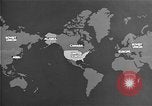
Air Defense warning systems of the United States extend far abroad during the Cold War
Animated map of world highlights the continental United States, Alaska, the Soviet Union and Europe. Circumferential rings illustrate the scope of radar coverage by America's various air defense installations in the world. A radar installation in a desert. Camouflaged radar installation at a remote airfield where U.S. aircraft are parked. An army camp ow tents and sandbags, containing a large radar array. Views of several radar antennas rotating in various places as narrator explains function of radar systems. View of "Radio Jim Creek," Naval Radio Station very low frequency (VLF) radio antennas at Jim Creek near Oso, Washington State. . The transmitter, itself, is located at Arlington,Washington State. Views inside the transmitter facility, where sailor technicians monitor various instruments and are seen at various work stations. (Note: this army production fails to mention that this Naval Radio Station's primary mission it to communicate with submerged U.S. submarines.)

Various trees in the garden and fruits on them during autumn season at the Oval Office in the White House, Washington DC.
The U.S. President Richard Nixon signs S-1081 Trans-Alaska Pipeline Bill at the Oval Office in the White House, Washington DC. The Oval Office and the South Lawn in White House. Various trees in the garden and fruits on them during autumn season. Leaves fall from trees in the South Lawn.

Conservative demonstrators from Young Americans for Freedom protest Richard Nixon's planned trip to China
Young demonstrators from the group "Young Americans for Freedom" (YAF) display protest sign to U.S. President Richard Nixon during his visit to Montana, Portland Oregon, Washington state, and Alaska. Address "623 SW Oak St" visible on a building as two men get into a car in front of it. A large group of young conservative demonstrators protest peacefully. Some stand atop school buses. Oregon mountains visible in the background. The crowd is carrying posters, banners and placards. The banners protest Nixon's planned visit to China, e.g., "Don't Shake the Bloody Hand of Mao" and "Y.A.F. says Stay Home." Also "Reconsider Richard Nixon for 1972." Another is "McGovern for President." Still another is "Sign the draft law and prove you're a liar." Also some banners speaking about the economy say "I am a Keynesian now." Many others protest the planned trip and diplomatic efforts with China.

United States Army Airborne worldwide activities in the 1950s, following the Korean War
U.S. airborne troops training in hand-to-hand combat; scaling obstacles; crawling under barbed wire; and parachuting from C-130 aircraft. Paratoopers jump from aircraft and view of sky filled with parachutes and aircraft. Paratroopers landing on the frozen tundra in Alaska, and jumping from U.S. Air Force C-124 Globemaster aircraft, over the ice cap in Greenland. In February, 1956, U.S. Army paratroopers jump from Air Force C-119 aircraft during SEATO Operation "Firm Link," in Thailand. Civilians in Thailand watch the demonstrations, in which one of the paratroopers is forced to use his auxiliary chute when his main chute fails. Military General officers of Southeast Treaty Organization nations watch the demonstrations. U.S. Army airborne units practicing assault resupply techniques with NATO forces in Germany, supported by helicopters and light utility airplanes. Supplies being airdropped with parachutes to the resupply location. At Fort Bliss, Texas, a radio controlled drone plane equipped with a parachute (possibly a Radioplane OQ-14 or similar from slightly later generation), acts as a target for tank crews. When hit, the drone parachutes to earth. A different U.S. Army reconnaissance drone is launched from a catapult as a U.S. Army soldier stands nearby controlling its ascent with remote control joystick. Aerial footage shot by the drone is shown, revealing scenes on the ground useful to field commanders. The drone, with it's camera, returns to base and gently parachutes to be recovered.
CRITICALPAST.COM: About Us | Contact Us | FAQs - How to Order | License Agreement | My Account | My Lightboxes | Shopping Cart | Advanced Search | Featured Collections | Website Terms & Conditions | Privacy Policy ©2026 CriticalPast LLC.
License Agreement |
Terms & Conditions |
Privacy Policy
©2026 CriticalPast LLC.