


 Francais
 Deutsch
 Italiano
Refine Your Search
Kodiak Alaska USA 1953 stock footage and images
- Showing 529 to 534 of 25600 results more
more Hide
Hide
U.S. Navy ships of Task Force 58 fight against Japanese Kamikaze attacks and repair battle damage during Okinawa campaign, WW2
Opening scene shows Landing Ship Tank USS LST 1006, with her front doors open after delivering her cargo at shore of Okinawa, during World War 2. Resupply operations are seen with landing craft shuttling between transport ships. Landing ships delivering supplies and equipment directly to the shore. An Army truck drives down the ramp of a Landing Ship Tank. A huge crane installed on a vessel behind LST 633 on the Okinawa waterfront. Vehicles driving from ships to the shore from a Landing Ship Dock (LSD). Landing Ship Tanks (LSTs) numbers 606, 30, and 559 are parked at the shore, delivering vehicles to Okinawa. Suddenly Japanese Kamikaze aircraft begin attacking. View from ship in Navy Task Force 58, as its gunners shoot down a Kamikaze that crashes into the sea. View from island of an aircraft carrier, as all the anti-aircraft guns along the side her flight deck fire continuously raising lots of smoke from the gunfire. A Kamikaze plane speeding across the water at low altitude. Closeup of Navy ship gunners firing. View from a ship's deck of sky filled with tracer rounds the strike a Kamikaze airplane. It explodes into flaming pieces that fall into the ocean close to the ship. Navy gunners firing twin Bofors anti aircraft guns. Sky filled with black flak clouds and tracer bullets. A Japanese Kamikaze aircraft (Kawasaki Ki-61) hit and diving straight down into the water where it explodes raising a large cloud of smoke and water. Aircraft carrier gunners firing at a low flying Kamikaze plane that passes the USS Alaska (CB-1) in the foreground and strikes an Essex-class U.S. aircraft carrier. Views of sailors on her flight deck fighting fire. Bow view from nearby ship of heavy smoke billowing from the carrier. Side view of the same. Closeup of sailors cutting holes in her flight deck to allow firefighting hoses to reach fire below. A welder using cutting torch to clear jagged pieces of metal. Firefighters hosing down the deck with foam. A Kamikaze crashes close to another Essex-class carrier, exploding at her waterline. Views of firefighting aboard that ship. Men hauling fire hoses onto the flight deck to bring ocean water up for firefighting. View from above of sailors pouring water below decks. A welder repairing a damaged stanchion. Gunners firing from the ship's superstructure as Japanese aircraft continue to maneuver among ships of Task Force 58. Streams of tracer rounds tracking a Kamikaze plane. View from above of sailors spreading foam over the flight deck. Firefighters playing hoses on pieces of destroyed Douglas Dauntless aircraft on the flight deck. External view of the severe waterline damage to the carrier. Welder working on deck. Landing officer with paddles directing a Douglas Dauntless aircraft landing on a carrier. Sailors carrying an injured flight crew member, across the flight deck on a litter. Dead covered in white shrouds laid out on the ship's deck, for burial at sea.
Seventh U.S. Army soldiers prepare for the Allied Invasion of Southern France during Operation Dragoon of World War 2
From a 1952 U.S. Army television program titled The Big Picture. U.S. troops in a fox hole in Korea. A U.S. tank carrying many GIs in Germany.US ski troops in Alaska. Amphibious training on beach in Puerto Rico. United States Army Sergeant James Mansfield introduces the story of United States Seventh Army in the Allied Invasion of Southern France, "Operation Dragoon." Army Colonel William Wilson Quinn seated in office, with army rifle on his desk. He refers to the "Blue Badge" which is the Army infantryman's badge. Then he introduces the story of the Seventh United States Army: On 14 August 1944 Bay of Naples is seen as an open air Marshalling area. Barrage balloons float above the area. Large landing ships sit at dock with their front loading doors open. 3rd,45th and 36th division combined into 7th United States Army. Mechanized war equipment being loaded and checked off the loading chart. 7th army soldiers march through streets. Red Cross workers distribute donuts. Soldiers board ships. Ships leave harbor to join convoy. Ships docked at the West Coast of Corsica. Officers meet for conference aboard ship. Men attend last minute details. Some pray. Animated map depicts the route of the advancement by the troops. Port Cros and Levant : French commandos landed on these islands. U.S. B-25 bombers in flight drop bombs. Fighting ships take their positions. Navigators, gunners and signal men alert. Soldiers prepare for fight. Army Air Forces C-47 aircraft fly in formation. A B-24 bomber over mountains. B-25s in flight.509th Parachute Infantry Battalion being inspected at airport. Paratroopers get into aircraft. Aircraft taxis and takes off. United States Army Air Force C-47 Skytrain and C-54 Skymaster military transport aircraft in flight toward Southern France. Paratroopers descend to ground and advance. Gliders land. Soldiers unload and ready artillery. Aerial view of rugged terrain. Ships underway at sea. Officers look through binoculars aboard ship.
U.S. Engineers work to construct supply routes throughout the world during World War II.
PBY Catalina aircraft seen inflight above an Allied convoy of ships at sea. Closeup of British flag displayed at stern of one ship. A destroyer escort in the convoy. U.S. Army engineers creating a road in an area of wilderness. A steam shovel empties its bucket into a truck. A surveyor taking readings with a transit. Two graders moving side-by side as they level a new road A tractor pulling a drum compactor. A vehicle drives on a mountainside road built by Army engineers. Snow covered mountains seen in background. Animated map showing far flung places where military supplies had to be delivered during World War 2. An open Army truck carrying American troops on Guadalcanal in the Pacific. U.S. soldiers walking on a pier at Attu in the Aleutian Islands of Alaska. American soldiers arriving at a pier in Accra, Gold Coast. Soldiers hold the American flag on a hilltop in Casablanca, French Morocco. Chinese Generalissimo Chiang Kai-shek and Madame Chiang, in Chungking. American troops in foul weather gear neat tents in Kiska, the Aleutians. Troops offloading from a troop transport ship in Cairo, Egypt. Troops in Algiers, and in Sicily. Troops hitting the beach in an amphibious assault.
African American soldiers engaged on all fronts in World War 2
Film opens with map of the world showing the various theaters of operation in World War II. Narrator refers to Allies liberating town after town, as they advance. View of American troops being welcomed in a European town during an advance (probably Italy in 1944). Next, African American troops are seen boarding troop transport ships. A huge convoy of ships is seen from the air. Huge piles of war materiel on a dock. Ammunition being delivered by landing craft from the transport ship USS Hunter Liggett (APA-14) to American troops at a beachhead in the Pacific. An African American sailors directs the lowering of a piece of artillery from a ship into a landing craft. Construction equipment being used to clear the way for a new landing field. Docks, roads, and bridges being built as the Allies advance. American troops in the swamps of the South Pacific. American Army engineers clearing trees to build the Alaska Highway (ALCAN Highway) in 1942. Corps of Engineers building the Ledo Road (from India to China) during the war. African American soldiers building a bridge across a river in Europe. A U.S. Army truck under fire, driving along a dirt road in Europe as shells burst all around it. U.S. troops firing various kinds of field artillery and tank guns. U.S. infantryman using a flame thrower. Closeup of African American soldier using a bayonet and others firing small arms. A tank being blown up by artillery fire. A Japanese Mitsubishi A6M3 Zero aircraft maneuvers overhead in the Pacific theater. An African American soldier runs to man his Browning .50-caliber, water-cooled antiaircraft machine gun, and begins firing as the Zero fighter plane strafes his position. Closeup of Japanese pilot in his cockpit and his machine guns firing from leading edges of his plane. His rounds strike all around the U.S. gunner, who turns and follows him with more fire. His tracers show behind the plane. Closeup of the African American gunner as he continues firing. View of the Japanese airplane rolling over and diving. Next the Japanese plane, aflame, crashes on a tropical island and explodes. (Note: It is apparent that some of these combat scenes have been made up of clips from other sources, edited into this film.) (World War II; WW II; World War 2; World War Two)
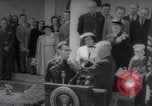
President Harry S Truman presents Medal of Honor to First Lieutenant Lloyd Burke, USA, Corporal Rodolfo Hernandez, and USA Technical Sergeant Harold E. Wilson, USMC
April 11, 1952 First Lieutenant Lloyd Burke, USA, Corporal Rodolfo Hernandez, USA Technical Sergeant Harold E. Wilson, USMC Scene is the portico of the White House, by the Rose Garden, in Washington, DC. President Harry S. Truman is placing the Medal of Honor, around the neck of First Lieutenant Lloyd Burke, U.S. Army. Members of his family stand behind, along with General Omar Bradley, Chairman of the Joint Chiefs of Staff. Closeup of photographers taking pictures. Next, the President presents the Medal of Honor to Corporal Rodolfo Hernandez, U.S. Army as a relative watches. Finally, the last recipient, Technical Sergeant Harold E. Wilson, U.S. Marine Corps, receives his medal from the President, as family members stand nearby . Closeup of President Truman shaking hands at once with the three honorees at the same time. All of them smile. View from several feet away, as the President, flanked by the medal recipients, makes a few remarks from a podium. A group of cinematographers takes motion pictures. Closeup of the Presidential Seal on the podium. Closeup of Lieutenant Burke. Closeup of Corporal Hernandez. Closeup of Sergeant Wilson. Closeup of the Medal of Honor worn by Corporal Hernandez.
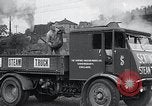
A new high capacity steam truck demonstrated at Bluefield in West Virginia, USA.
A new high capacity steam truck demonstrated at Bluefield in West Virginia, USA. The manufacturer's name, ' THE SENTINEL WAGGON WORKS LTD, SHREWSBURY, ENGLAND ' written on the truck. The loaded truck moves uphill. Additional information on this truck: This is the Sentinel S4 steam waggon, Number 9095. Built 1933 by Sentinel Waggon Works, Shrewsbury, England and exported as a demonstration vehicle to the USA with a works driver. Within a short time the vehicle was involved in an accident and overturned, requiring it to be returned to the UK. Many of the salvageable parts, especially those used to convert it to left hand drive were then fitted to a 6 wheel waggon No 9142 which was sent as a replacement. This vehicle was later purchased by the Pocahontas Coal Company of New Bedford. After a very short working life it was displayed at the Long Island Motor Museum, and Steamtown before being reaptriated to the UK in 2003.
CRITICALPAST.COM: About Us | Contact Us | FAQs - How to Order | License Agreement | My Account | My Lightboxes | Shopping Cart | Advanced Search | Featured Collections | Website Terms & Conditions | Privacy Policy ©2026 CriticalPast LLC.
License Agreement |
Terms & Conditions |
Privacy Policy
©2026 CriticalPast LLC.