


 Francais
 Deutsch
 Italiano

Refine Your Search
Leipzig Germany 1945 stock footage and images
- Showing 91 to 96 of 10470 results more
 Hide
Color Sound
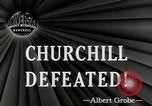
Prime Minister of UK Winston Churchill and U.S. President Harry S Truman attend the Potsdam Conference in Germany.
Prime Minister Winston Churchill gets a defeat in the 1945 United Kingdom General Elections. Past events show Prime Minister of UK Winston Churchill, U.S. President Harry S. Truman and other delegates attending the Potsdam Conference in Germany.
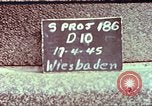
Views of Wiesbaden and Mainz, Germany, at end of World War II in Europe. German soldiers being relocated.
Opening slate reads April 17, 1945, Wiesbaden, Germany. A brick building in Wiesbaden with large arrow pointing downstairs, labeled "LSR", meaning Luftschutzraum (Air-raid room). Signpost in front of a building with damaged roof reads, "Radfahr-weg" (bicycle path). Below it an American army sign reads "WP-Water Point." U.S. soldier directs military vehicles, carrying surrendered German soldiers, as they cross the Rhein (Rhine) river, from Wiesbaden to Mainz on a pontoon bridge. The dome of Christuskirche (Christ Church) across the river, dominates the skyline
General Jacob Devers and other U.S. Generals seated with German delegates at a surrender conference in Haar Germany.
German Surrender Delegation conference at the Thorak Estate in Haar, Germany, to accept the surrender of German Army Group G, towards the end of World War II. United States Army officers at the surrender conference include General Jacob "Jake" Loucks Devers of United States Sixth Army, who says "This is an unconditional surrender" while seated at a table with German and U.S. officers. Other U.S. Generals included in the delegation are: General Alexander McCarrell "Sandy" Patch; Lieutenant General Wade Hampton Haislip; Major General John W. "Iron Mike" O'Daniel; Brigadier General Reuben E Jenkins; Brigadier General William S Ott; Brigadier General Pearson Menoher. German delegation includes: Delegation head, Lieutenant General Hermann Foertsch, Commander of the 1st German Army; Colonel Hermann Zolling; Major Foeker; Major Coelle; Major Murray; Captain Behrendt; Captain Cartellieri and 1st Lieutenant Von Weber. Lt. General Foertsch signed the surrender document, effective 12:00 the next day (May 6, 1945). U.S. Army First Lieutenant John H. Brunswick is seated left of Foertsch. Lt. Brunswick translated General Dever's terms and statements, including "unconditional surrender," into German.
Bombed out ruins of Berlin, Germany, seen at end of World War II in Europe
Bombed buildings in Berlin, Germany shortly after the end of World War II in Europe. Berliners walking along sidewalks past skeletons of bombed out buildings in Berlin, in July, 1945. Rubble has been cleared from sidewalks and streets, but is piled up alongside. Two women ride in a horse-drawn wagon, carrying what appear to be household goods. The damaged Potsdamer Bahnhof railway terminus station. People in the foreground. Ruins of damaged buildings in the area of Potsdamer Platz. Lettering atop the railroad station building reads 'Potsdamer Bahnhof'. Rubble strewn on both sides of the street, and pedestrians pass by along with a few horse drawn wagons. No motor vehicles are seen.
Internees from Brussels at the Buchenwald concentration camp interviewed in Germany.
Internees at a concentration camp in Buchenwald, Germany. Jean Blume, leader of socialist national movement against occupation in Belgium, shares his experiences of the days spent as a prisoner at Breendonk concentration camp in Belgium. He expresses joy at being liberated by American Army from Buchenwald concentration camp. (Note: Jean Blume was a Resistance Leader during the Nazi occupation in World War 2. The Gestapo arrested him on January 19, 1943 and he was imprisoned in Breendonk. In May 1944, he and many others, were sent to Buchenwald. They were released on April 11, 1945.)

Dutch Jewish internee of Buchenwald concentration camp interviewed in Germany.
Internees at a concentration camp in Buchenwald, Germany. Serge Kaplan, Jewish internee from Eindhoven Netherlands speaks about the difficult conditions at various concentration camps which made life difficult for the internees and also led to death of many people. He states that he was in a concentration camp in Poland and came to Buchenwald in January 1945. He expresses his joy on being set free by the American Army.
CRITICALPAST.COM: About Us | Contact Us | FAQs - How to Order | License Agreement | My Account | My Lightboxes | Shopping Cart | Advanced Search | Featured Collections | Website Terms & Conditions | Privacy Policy ©2026 CriticalPast LLC.
License Agreement |
Terms & Conditions |
Privacy Policy
©2026 CriticalPast LLC.