


 Francais
 Deutsch
 Italiano
Refine Your Search
Leipzig Germany 1945 stock footage and images
- Showing 7 to 12 of 10461 results more
more Hide
Hide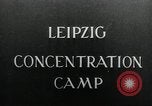
Dead bodies near live wire fence at Leipzig concentration camp in Germany during World War II.
A film about the conditions at Nazi German concentration camps in Europe during World War II. Leipzig concentration camp in Germany. Camp area with buildings. A dead body on ground with mutilated face. Dead bodies near a live wire fence. Dead include Russians, Poles and Czechs. A Russian woman liberated from a slave camp look at the dead.
American soldiers enter city of Leipzig, Germany, and take prisoners of war, during World War II.
American forces in Leipzig, Germany near the end of World War 2 in Europe. Landmarks include the heavily damaged New Town Hall, Burgplatz, and a church. At start of film, German civilians are seen running along railroad tracks, past war-damaged platform, to reach a train. Hungry German civilian men wrestle with a man on a sidewalk holding a large piece of meat. American soldiers walking across a city square in single file. Two Sherman tanks move across city square following the tracks of a tramway. The overhead electric wires for the tram are visible. More views of American soldiers walking and some in jeeps. A tilted view of the Reform Evangelist Church. Then camera straightens out and shows it properly. In front of the church, two American soldiers sit on a half-track with M45 Quadmount (Maxson) Anti-Aircraft guns installed on it. Back of the half-track has "660 AAA" stenciled on it. Many Jerry cans are held in racks along the sides of the half-track. Scene shifts to a formation of German prisoners of war with their hands over their heads. Close-up views of faces of German soldier prisoners of war. Camera pans across them, closeup. They carry all their personal gear, including bed rolls, but no weapons. View from behind them. Wider glimpse of the prisoners under guard. The severely damaged 1928 Kroch Building (Krochhochhaus) is seen in the background. Several German prisoners sit in a jeep, guarded by an American soldier with an M3 .45-caliber sub-machine gun ("grease gun"). At the end of the film, the bomb damaged 1905 New City Hall (Neues Rathaus) is seen in the background.
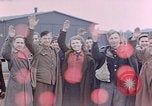
Captured German troops are assembled and moved by U.S. soldiers, near Leipzig, Germany.
U.S. troops move captured German troops at end of World War II near Leipzig, Germany. Many liberated Allied prisoners of war are also seen. Sikh soldiers from India wave. Other Allied soldiers wave and smile. Repatriated English soldiers. German prisoners lined up. German prisoners enter a cage. German prisoners ford the Mulde River. Location is Wurzen, 25 km east of Leipzig, Germany.

Monument to the Battle of the Nations in Leipzig, Germany, seen during final days of World War II in Europe
Opening scene shows the Monument to the Battle of the Nations erected in Leipzig, in 1913, commemorating the 100th anniversary of the epic battle of Leipzig, and the defeat of Napoleon by a coalition of allies arrayed against the French. Notable are images of Teutonic knights standing guard around the upper periphery of the monument. Closeup of the base of the monument and entranceway. Some signs of war damage are visible. Camera pans upward. An American soldier is seen in lower left foreground, manning an M45 Browning .50 caliber Quadmount anti-aircraft gun. Camera continues to pan over details of the monument. (World War 2; WWII; WW2)
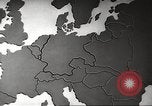
Dead bodies at Leipzig Concentration Camp in Germany.
Nazi concentration camps in Germany during World War II. Animated map of Europe shows locations of concentration camps in Austria, Belgium, Bulgaria, Czechoslovakia, Danzig, Denmark, France, Germany, Isle of Jersey, Latvia, Netherlands, Poland and Yugoslavia. Dead bodies at Leipzig Concentration Camp. Living Russians, Czechoslovakian and French prisoners narrate horror stories. Bodies of prisoners who the Nazi German guards had placed in a building and then set on fire. Dead bodies of those who fled and escaped from the burning building, but were then either shot by the guards while fleeing, or electrocuted by live wire fence. Russian woman looks at dead bodies through a fence.
United States and Soviet soldiers meet at the Elbe River during World War II.
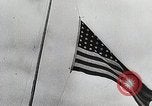
U.S. flag being lowered as bugler sounds and narrator alludes to the death of U.S. President Franklin D. Roosevelt, near the end of World War II. American troops and tanks rolling through German cities identified by narrator as Madeburg, Nuremberg and Leipzig, at end of World War 2 in Europe. U.S. troops cleaning out last vestiges of resistance in street fighting. Numerous German citizens lining sidewalks in city and waving white flags. On April 25, 1945, U.S. Army Second Lieutenant William Robertson with soldiers Frank Huff, James McDonnell and Paul Staub, meet Soviet Lieutenant Alexander Silvashko and several Soviet soldiers on the remnants of the Elbe bridge of Torgau. A U.S. Army Brigadier General mingling with Soviet officers. On April 26,1945, Major General Emil F. Reinhardt Commander of the U.S. 69th Infantry Division, walks with Soviet Major General Ruskovof the Soviet 58th Guards Rifle Division near Torgau. They are accompanied by other U.S. and Soviet officers. U.S. and Soviet officers exchange mutual salutes. U.S. and Soviet soldiers mingle, as a Soviet soldier plays accordian and some drink toasts, smoke cigarettes, and pose together. View of the Nazi party rally grounds in Nuremberg where a U.S. soldier is seen near the huge Swastika atop the Zeppelin Grandstand. Flashback views of Nazi rally there. Heinrich Himmler, Adolf Hitler and Viktor Lutze at the rally. Three American soldiers walking along the same walkway in the rally grounds. Explosion seen as the Nazi swastika symbol atop the Zeppelinfeld grandstand in Nuremberg is blown up by American troops.
CRITICALPAST.COM: About Us | Contact Us | FAQs - How to Order | License Agreement | My Account | My Lightboxes | Shopping Cart | Advanced Search | Featured Collections | Website Terms & Conditions | Privacy Policy ©2026 CriticalPast LLC.
License Agreement |
Terms & Conditions |
Privacy Policy
©2026 CriticalPast LLC.