


 Francais
 Deutsch
 Italiano

Refine Your Search
Leipzig Germany 1945 stock footage and images
- Showing 217 to 222 of 10470 results more
 Hide
Color Sound
German officers surrender to Allied Forces at end of World War II
Film begins with nighttime bombardments of rockets and artillery. Then at one minute after midnight, on May 9th, 1945, the guns stop. Next, a day earlier, German Field Marshal Wilhelm Keitel enters a conference room on May 8th, accompanied by German staff officers. He salutes with his Marshal's baton and takes a seat. He signs surrender document. Soviet Marshal Georgy Zhukov stands before being seated. British Air Marshal, Sir Arthur Tedder, is seen signing the document along with Marshal Zhukov. General Carl Spaatz, Commander of Strategic Air Forces in Europe, shakes hands with Marshal Zhukov. Several scenes of battlefield cemeteries are seen next. German officer prisoners are seen from the back as they walk with hands behind their heads. Views of Surrendered German senior military officers, including: German Admiral Erich Raeder; German Marshal Walter Model; German Marshal Wilhelm Keitel; and Marshal Hermann Goering (being disarmed).
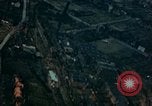
American aircraft attacks town and factory area.
American aircraft in flight strafing factory area and town through clouds and attacking railroad marshalling yards, in 1945, near end of World War II in Europe.
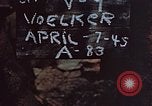
Activities of U.S.airmen in 323rd Bomb Group, at Denain Airbase (A-83) near end of World War II.
A number of Martin B-26 Marauder aircraft of 323rd Bombardment Group (9th Air Force) are lined up for takeoff. As they taxi past camera, tail number of one: 43-34344, is visible. All aircraft display the distinctive White Tail identifying the 323rd BG. (The Group is known to some as Wood's Rocket Raiders, so-named for their Commanding Officer, Lieutenant Colonel Wilson r. Wood.) The location is Denain Airfield (A-83), near the City of Valenciennes, France. The time is April, 7,1945, a month before VE Day. Several airmen are pitching horseshoes, while others watch. They use a shoe to measure how close one came to the pin. Two airment use a two-man saw to saw a timber while a third sits on it to hold it still.
German Luftwaffe fighter aircraft strafing Allied bombers and other aircraft (WW2)
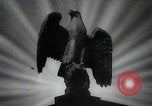
German Luftwaffe pilots prepare to fly early in the morning of January 1, 1945 during World War 2. Luftwaffe fighters taking off from an airfield. A group of fighters in flight. Luftwaffe pilot pushes the remote button for machine gun. Fighter propeller moving. Cockpit view of German aircraft strafing Allied bombers on the ground. Allied aircraft being attacked as seen from target. German pilot looks on inside aircraft. Dogfighting between the Luftwaffe fighters and Allied bombers. Luftwaffe fighter aircraft in flight. An Allied bomber catches fire from strafing. Fighter machine gun strafes the wings and body of Allied aircraft. A group of Messerschmitt Bf 109 fighters in flight. German fighter pilots in cockpits. German fighters strafe Allied planes, sustaining significant damage. Flames in damaged bomber from Luftwaffe strafing. The German Reichsadler eagle.
German actor Paul Wegener speaking; Hitler Youth celebrate Winter Solstice (WW2)
Scene from a movie production showing German actor and film pioneer Paul Wegener as he dumps a sack on the ground. Paul Molander talks in one of the scenes from the 1945 German film “Der Fall Molander” (“The Molander Case”). Scene changes to Hitler Youth members skiing downhill in the dark with torches in their hands as they celebrate the German folk festival Winter Solstice in World War II. A Hitler Youth stops at the bottom slope and lights a bonfire with his torch. Crowds of Hitler Youth gather by the bonfire with their torches at night. Hitler Youth leader Baldur von Schirach is seen in the event.
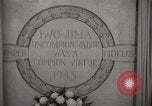
Dedication of Marine Corps War Memorial at Quantico Virginia, and sculptor Felix de Weldon working on sculpture for Arlington location.
The U.S. Marine Corps War Memorial original statue during its unveiling ceremony at the Marine Corps base in Quantico, Virginia on November 10, 1951 (This is after the statue had been moved from its original Constitution Avenue location in Washington DC in 1947, and subsequently renovated under sculptor de Weldon's supervision while it was in Quantico.). A sign on the memorial reads "Uncommon valor was a common virtue, 1945." Next scenes show sculptor Felix de Weldon as he works to build the larger Marine Corps War Memorial in Arlington, Virginia, which was dedicated in November 1954. Felix de Weldon measuring a model of the flag raising on Iwo Jima made by him. de Weldon and others on his team work to carve the large war memorial in plaster before it is cast in bronze. Views of the sculpted faces of the six Marines who raised the flag on Iwo Jima: Faces of John Bradley, Rene Gagnon, Ira Hayes, Franklin Sousley, Harlon Block and Michael Strank. Brief glimpse of the original flag raising scene on Mount Suribachi in February 1945. Next scene, circa 1954 or 1955, shows the completed Marine Corps War Memorial in bronze, in Arlington Virginia, with Washington Monument and Lincoln Memorial landmarks of Washington DC in the background. Close-up views of faces of a young boy, an elderly woman, and a middle aged man who removes his hat. American flag fluttering in the breeze atop the war memorial.
CRITICALPAST.COM: About Us | Contact Us | FAQs - How to Order | License Agreement | My Account | My Lightboxes | Shopping Cart | Advanced Search | Featured Collections | Website Terms & Conditions | Privacy Policy ©2026 CriticalPast LLC.
License Agreement |
Terms & Conditions |
Privacy Policy
©2026 CriticalPast LLC.