


 Francais
 Deutsch
 Italiano

Refine Your Search
Leipzig Germany 1945 stock footage and images
- Showing 379 to 384 of 10470 results more
 Hide
Color Sound
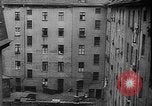
Idle children in Germany before Hitler's rise to power; Adolf Hitler speaks to a crowded stadium in Germany.
Changes in Germany before during Adolf Hitler's leadership. View of German youth idle and in poor slum housing areas during great depression years of hyperinflation between the wars, and before Hitler's rise to power. German boy children stand outside their houses and are seen idle. They run in an abandoned warehouse. Scene shifts to Hitler youth marching in front of a camp in 1935, holding Nazi flags. Adolf Hitler speaks to a crowd in an outdoor mass meeting (likely 7th Party Congress in September 1935). A large crowd assembles at a stadium. Sign for a Adolf Hitler Jugendherberge (youth hostel). Girls and young women of Hitler youth dance in pairs in traditional German clothing. Tents in the background for the girls camping. Views of a boys encampment for Hitler Youth with tents in the background. Boys in uniform gathering in camp, shining shoes, and working. Children work seated on ground. Workers enter industrial factories. Young men working in a factory producing goods in Germany using machines. Young men of the Reich Labour Service (Reichsarbeitsdienst or RAD) march in formation carrying shovels.

Emaciated and unburied corpses on the grounds at Bergen-Belsen camp depicts Nazi atrocities in Germany.
Allied forces advance deeper into Germany after crossing the Rhine. Bergen-Belsen Nazi concentration camp in Germany during World War II. Allied planes in sky. Allied troops advance in Germany after crossing Rhine River. U.S. soldiers held prisoners by Germany are liberated from a POW camp by British forces. Scenes of jubilant freed American prisoners cheering their British rescuers and having food and drink. Some of the freed prisoners hold a newspaper announcing the death of U.S. President Franklin Roosevelt. Displaced civilian persons walk on roadways as refugees carrying few possessions. They had been slave laborers for the Germans. Some walk along slowly with no shoes. Prisoners freed from Belsen concentration camp by the British 11th Armored Division. The German prison Camp Commandant, Josef Kramer, seen under guard by British soldiers. Emaciated and unburied corpses on the grounds of Bergen-Belsen camp. Emaciated man seated. Emaciated corpses being thrown into a mass grave. German women made to view the atrocities are seen crying and weeping. Prisoners behind barbed wire. Medics tend to a prisoner. Various views of different concentration camp victims. U.S. planes in flight.

The outgoing President Harry S Truman and the President-elect Dwight D Eisenhower.
President Harry S Truman holds his last official cabinet meeting in Washington DC. The President with his cabinet team seated around a table. He is presented with a chair at the head of the table. Plate on chair reads 'The President April 1945.' New York: President-elect Dwight D Eisenhower with his future official family poses for pictures. The future President with his cabinet seated and standing.
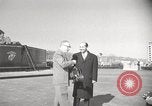
President Eisenhower and Vice President Nixon at the dedication ceremony of the Iwo Jima Memorial in Virginia, United States.
Dedication ceremony of the U.S. Marine Corps War Memorial (The Iwo Jima Memorial) in Arlington, Virginia, United States. Sculptor Felix de Weldon and photographer Joe Rosenthal shake hands with the statue of flag raising in the background. Chaplain says a prayer at a ceremony. Spectators seated with their hats off. President's car comes own the drive way followed by others. U.S. President Dwight D. Eisenhower walks with Navy personnel. Vice President Richard Nixon talks to a Marine who raised the flag at Iwo Jima. Nixon poses with the three survivors of the original flag raising at Iwo Jima. Statue of the flag raising at Iwo Jima. A sign at the base of the statue reads 'Felix de Weldon 1945-1954'.
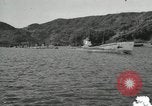
Operation "Road's End" and preparations for destruction of the Japanese submarine fleet moored in Sasebo Bay, Japan
Views from U.S. boat moving among Japanese submarines in Sasebo Bay, Japan, during Operation Road's End, involving the scuttling of the Japanese submarine fleet. Seen are submarines: I-47; I-162; I-156l;n-203;I-158;I-103;107;I-58. An American launch pulls up to I-58 (the sub that sank the USs Indianapolis on July 31, 1945, in the Philippine Sea).Vice-Admiral Robert M. Griffin, Commander of U.S. Naval Forces, Japan, climbs aboard the sub, followed by other members of his party. Admiral Griffin walks the deck of the submarine, followed by a Rear Admiral, who points out some features of the boat to Admiral Griffith. View of the group standing on the deck of the I-58.
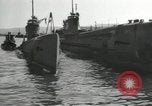
Operation Road's End, preparing to destroy Japan's submarine fleet. Crews decorate their submarines with cherry blossoms
Operation Road's End. Inspection of Japanese submarines,moored in Sasebo Bay, Japan, that are scheduled for destruction, after World War 2. View from a boat passing several of these submarines. One has a group of U.S. Naval officers and others on its deck. View of Japanese submarines I-366 and Number 107. Japanese sailors are decorating the submarines with branches of cherry blossoms. A Japanese officer looking down from boat I-402, as the camera passes below. Closeup of him posing on his boat for the camera.. Captain Atogi Nakamura, Lt. Tashio Tanaka and crew members posing aboard Japanese submarine I-58 (that sank the USS Indianapolis on July 30, 1945 with torpedos fired by Lt. Tanaka).
CRITICALPAST.COM: About Us | Contact Us | FAQs - How to Order | License Agreement | My Account | My Lightboxes | Shopping Cart | Advanced Search | Featured Collections | Website Terms & Conditions | Privacy Policy ©2026 CriticalPast LLC.
License Agreement |
Terms & Conditions |
Privacy Policy
©2026 CriticalPast LLC.