


 Francais
 Deutsch
 Italiano

Refine Your Search
Leipzig Germany 1945 stock footage and images
- Showing 403 to 408 of 10470 results more
 Hide
Color Sound
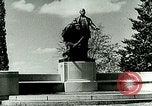
Contributions of African Americans in various fields in the United States.
(See also clip 65675078146 from different film transfer). Famous African American men and women citizens in the United States. Clip opens with of Booker T. Washington at Tuskegee University. Scene in a laboratory with African American scientist and inventor George Washington Carver, as an elderly man, working with another scientist in the laboratory. African American judge of New York city court. African American explorer Matthew Henson is seen looking at a globe (he was with Admiral Peary planting the American flag at the North Pole in 1909), and an unnamed African American surgeon at work in an operating room in New York. Next scene shows famous "father of the blues" musician and composer W.C. Handy (William Christoper Handy) smiling. Next is seen the financier and publisher of the Amsterdam News, Dr. C.B. Powell (Clilan Powell) greeting three uniformed African American women during a World War 2 war bond drive, and handing them a check (close up is shown) for 25,000 dollars, dated January 4, 1942, for the war bond drive. It is from the account of the Victory Mutual Life Insurance Company which Dr. Powell also owned. The check is signed by C.B Powell and Philip M.H. Savory (Dr. Savory was co-owner of the New York Amsterdam News). The next scene shows Elise Johnson McDougald, better known as Gertrude Elise Ayer, who was the first black full-time public school principal after the consolidation of New York City schools in 1898. She was also a noted woman writer during the Harlem Renaissance. She is seated in her office at her desk, likely in P.S. 119 in Harlem, since this is approximately year 1945 and she was at P.S 119 at that time. Her name plaque is visible on the front center of the desk. Principal Ayer smiles as a woman delivers a document to her. Next is seen the African American historian, author, and professor, Lawrence D. Reddick, serving in his role as the curator of the Schomburg Collection of African American Literature. In an art studio is seen the famous African American sculptor and painter Charles Alston, at work on a sculpture. Next scene shows the famous African American contralto singer, Marian Anderson, receiving a bouquet of flowers and smiling after a performance. This transitions to a view of African American orchestra conductor Dean Dixon leading an orchestra in a performance of Beethoven's 9th Symphony. Several views of different sections of the orchestra performing under Dixon's direction. Clip closes with brief shots of campuses of several historically black colleges and universities in the United States like Howard University, Hampton, Tuskegee, Fisk, Prairie View. An American college football game underway at the stadium of one of the colleges.

Farmers work on field,Henry Gurney visit people and British soldiers, check ID cards of people in Malaysia
The film titled 'How to fight a guerrilla war' about guerrilla war for independence fought between Commonwealth armed forces and Malayan Communist Party in Malaysia. Soldiers wade across a stream. Soldiers advance through a jungle. An aircraft in flight drops bombs. A helicopter takes off. 1945: jungle on a mountainous area. Aerial view of a sea coast. Houses on the coastal area. Farmers work on field. Women use mortar and pestle to crush. Chinese men smoke pipe. A woman works on a sewing machine. Children sit on ground. Farmers work on field. European people carry water through poles on their shoulders. A woman takes out rubber from a tree. Rubber sacks pile up. Water being sprayed on field by a pipe. Equipment hooked in a crane. Animation of a map shows Malaysia. Burning houses and jungles. Men inspect area near a derailed train. Dead bodies in water. Burned tin mines and other plants. Workers outside their houses. A girl stands on doorway. A child cries. A family evacuates the place on a truck. A man puts a light on pole. A soldier near a power grid. A soldier on guard atop a hill. Soldiers walk through a jungle. Men carry water containers. People get themselves registered. Identity cards of people on table. A soldier puts mark on nail of a woman. A soldier signs on an ID card. British High Commissioner in Malaya Henry Lovell Goldsworthy Gurney disembarks a vehicle. He meets people. People come out of a truck. People get registered. People take oath. They learn military tactics.
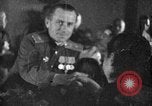
Russian officers speak and Korean people exchange gifts with Soviet soldiers in Korea.
Two years before the Korean War: Russian soldiers are honored before leaving Korea. Officials at a mass meeting. The wall behind the speaker's stand is decorated with pictures of Kim II Sung and Joseph Stalin with dates 1945-1948. Russian officers speak and receive gifts from the people of Korea. Korean boys exchange gifts with Russian girls. Girls present flowers to Soviet fliers. Two Soviet aviators hold Korean children. A line of Soviet Yakovlev Yak-3 interceptor aircraft. A pilot prepares and takes off in one of the Yak-3 aircraft. The girls wave to the fliers. Soviet Yak-3 aircraft in flight.
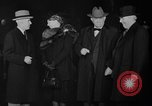
Activities of Eleanor Roosevelt in post-World War II period
December, 1945, former First Lady, Eleanor Roosevelt, now appointed by President Truman, as a delegate to the United Nations, is seen with other members of the U.S. Delegation. She is seen speaking while serving as chairman of the UN Committee Three, dealing with human rights. She recognizes the delegate from the Soviet Union, as the committee addresses issues of refugees. (The USSR insists that displaced persons be returned to their original homelands.) As chairman, Mrs. Roosevelt, rules a USSR proposal out of order, causing the USSR representatives to leave the room. A glimpse of Eleanor Roosevelt at a microphone during debate over the issue with the USSR, before the full General Assembly, where she successfully argues to allow refugees to make their own decisions about repratriation. She is seen sitting next to delegate,Senator Arthur Vandenburg, at the forum. Eleanor Roosevelt being greeted by U.S. Army officers as she steps from an airplane in Europe. She is seen mingling with persons in Europe, displaced by World War II. Back in the UN forum, she extols the International Declaration of Human Rights as an "International Magna Carta of men everywhere," and goes on to compare it with similar charters of history. She is seen at a Pan American World Airways terminal, preparing to board a flying boat (unseen). Several scenes show Eleanor Roosevelt visiting with people in various parts of the world, with particular attention to children. She speaks of her candid nature in a broadcast.
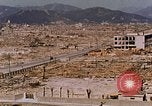
Buildings destroyed on an island between Motoyasu and Tenma rivers in Hiroshima, Japan as a result of the atomic bomb explosion.
Physical damage caused due to atomic bomb explosion in Hiroshima, Japan on August 6, 1945. Bridge across a river as vehicle moves over the bridge. Island between Motoyasu and Tenma rivers. Rubble spread all over the area with wooden huts. Buildings partially damaged by the atom bomb explosion. (World War II period).

Views of the United States. Farms, cities, highways, and beaches. Destruction in Japan by atomic bomb. U.S. infantry in combat
Farmers harvesting grain and corn with machinery on American farms with a narrow tractor harvester. Steel mills and heavy industry and cargo railroads in the United States. Industrial views with smokestacks releasing much smoke and smog (also pollution scenes). Scenes of New York City with busy streets filled with cars, buses, and truck traffic, together with pedestrians. Many varied 1940s and 1950s cars on the roads. Elevated and also aerial views of U.S. highway networks busy with 1940s and 1950s cars. Views of Jones Beach, on Long Island, New York. Scenes of destruction in Japan from the atomic bomb, with sweeping views of destroyed city in Hiroshima or Nagasaki circa 1945 or 1946. U.S. Army infantrymen engaged in house-to-house fighting in Europe during World War II, firing rifles and moving between points of cover in a city filled with rubble.
CRITICALPAST.COM: About Us | Contact Us | FAQs - How to Order | License Agreement | My Account | My Lightboxes | Shopping Cart | Advanced Search | Featured Collections | Website Terms & Conditions | Privacy Policy ©2026 CriticalPast LLC.
License Agreement |
Terms & Conditions |
Privacy Policy
©2026 CriticalPast LLC.