


 Francais
 Deutsch
 Italiano
Refine Your Search
Leipzig Germany 1945 stock footage and images
- Showing 4231 to 4236 of 10461 results more
more Hide
Hide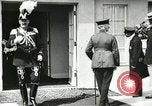
Kaiser Wilhelm II dedicates Germany's new Olympic Stadium on the 25th Anniversary of his Coronation
On June 8, 1913, the 25th anniversary of his coronation, Kaiser Wilhelm II presided over the inauguration of the new stadium (Deutsches Stadion) built near Berlin, to host the 1916 Olympics. These scenes were recorded immediately after the ceremonies. A German Admiral exits from a stadium building in Deutsches Stadion (Deutsches Stadion, Olympischer Platz 3, 14053 Berlin). Soon after, Kaiser Wilhelm II, exits, conversing with German Chancellor, Theobald von Bethmann-Hollweg. The Kaiser is attired in Hussar full dress uniform with fur busby. A German officer salutes and directs the Kaiser to athletes (German Olympic hopefuls) standing to the side, whom he introduces to the Kaiser. The Chancellor turns back into the building, and Empress Augusta Viktoria emerges and stands nearby, as the Kaiser speaks with the athletes and shakes hands with several of them. He chats amicably with the introducing officer, who smiles and salutes. The Kaiser then climbs into a waiting carriage in which the Empress is already seated. She holds a booklet or program in her hand. Attendants place a carriage robe over the Royal Couple and the carriage departs. Spectators watching the Royals are seen behind a railing at the Grunewald Racecourse track (part of the complex). The broad expanse of athletic grounds is behind them. Final scenes show many youths, walking along at the end of the ceremonies. in various uniforms (representing schools or clubs). some carry programs. some wear sashes on their outfits. Family groups are also seen. Stadium seats are seen briefly in the background to the left. A group of girls wearing dark skirts and white blouses with dark ties, are among the various small groups of youth walking together. (Note: The Deutsches Stadion was located in an area reserved as a Peoples' Park, by the Kaiser, in 1904. The property was leased for 30 years, in 1907, by the Union-Klub for the Grunewald Racecourse. But it also continued to serve general sports activities. The stadium was built on the racecourse grounds.)
Tactics of U.S. 8th Air Force fighters for escorting bombers over Germany during World War II.
U.S.Army Air Corps P-47s with engines running, taxiing our for takeoff. Army personnel in Runway control unit with signal light.(Few seconds of film reversed.) Among the aircraft seen is P-47D, number 42-28543 named “Pat” piloted by Capt. Gordon S Stevens,of Smithfield,North Carolina, of the 63rd Fighter Squadron, 56th Fighter Group, stationed in England.(He was killed in action, 18 September 1944.) Views of the P-47s enroute to join up with B-17 bomber formations. P-51s and P-38s taking off. P-51s inflight to relieve P-47s of escort duty.US pilot with mission profile inked on back of his hand. Narrator (Ronald Reagan?) describes the way successive relays of U.S. fighters relieved each other performing bomber escort duties. Scenes from captured German film shows alarm sounding and German fighter pilots scrambling in Me-109s and FW-190s to intercept the U.S. bombers. Escorting U.S. P-51s jettison their long range drop tanks preparing to meet attacking German interceptors. Gun camera footage shows many German fighters being destroyed.P-47s, P-51s and P-38s firing their guns. Several Me-109s in formation. German gun camera clip showing many B-17s being shot to pieces by 22mm gunfire and falling, often in flames.
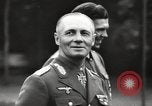
Field Marshal Erwin Rommel and Magda Goebels with her children at her estate in Berlin, Germany during World War II.
German Field Marshal Erwin Rommel visits with Mrs. Goebbels and her children, during a period between command assignments, during World War II. Rommel, standing with aides, in the garden of the Goebbels home in Schwanenwerder, Berlin, smiles as he watches the Goebbels children at play. Magda Goebbels, wife of Propaganda Minister Joseph Paul Goebbels, with her children gathered around a slide in the yard. Rommel watches as Magda helps her youngest daughter, Heidrun, down the slide using a wheeled board and help from another daughter. Field Marshal Rommel looks on and smiles. Rommel along with Magda, return to the house, holding hands with the children. Another view of the activities around the slide. Rommel examines the wheeled board with Mrs. Goebbels, who then helps Heidrun ride it down the slide. Marshal Rommel and Magda Goebbels hold hands with her daughters as they return along a path to the house.
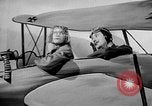
Examples of popular show business entertainment in Germany during World War I.
A woman and a man singing a duet on stage, as they pretend to be in a german warplane,flying over parts of Europe during World War 1. Below their staged airplane the set includes paintings of the Eiffel Tower, a Dutch windmill and other features of European countries. The programs for various musical theater presentations are shown, including one entitled "Die Gulasch Kanone" (The Field Kitchen), a play with music in three acts. A scene from another production is seen, with A newly wedded couple walking to a horse drawn carriage. Women standing near the carriage serenade the couple and spread flower petals at their feet. They enter the carriage.
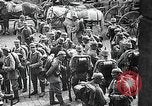
Supplies on vehicles, and German soldiers waving to relatives as they leave for war from Germany during World War I.
The mobilization and deployment of the German Army early in World War I. German soldiers stand with baggage and supplies. Horse drawn carts loaded with supplies. Garlanded trucks leave Berlin carrying newly recruited soldiers. Officers on horses and horse drawn carts ride past a cheering crowd. The soldiers on a railroad station before leaving for war. The cavalry march. German soldiers wave to their relatives from a train before departing for war front. People on platform and the band playing. Verdun : Supplies on rail road cars. Soldiers near a train.
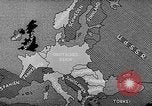
Animated map in Germany shows troop movement and German occupied territories before the attack on Russia.
German aggression during World War II. Animated map shows troop movement and German occupied territories before the attack on Russia. Animation depicts German invasion of Norway and Denmark.
CRITICALPAST.COM: About Us | Contact Us | FAQs - How to Order | License Agreement | My Account | My Lightboxes | Shopping Cart | Advanced Search | Featured Collections | Website Terms & Conditions | Privacy Policy ©2026 CriticalPast LLC.
License Agreement |
Terms & Conditions |
Privacy Policy
©2026 CriticalPast LLC.