


 Francais
 Deutsch
 Italiano
Refine Your Search
Leipzig Germany 1945 stock footage and images
- Showing 4609 to 4614 of 10461 results more
more Hide
Hide
Plans of powder rocket engines by Goddard, Valier, Sander, Eisfeld,Reinhold, and Richard Tiling
Drawings and diagrams of proposed rockets by various scientists in America and Germany, including Goddard, Valier, Sander, Eisfeld,Reinhold, and Richard Tiling. Models of rocket. Two pictures to show contrasting features of rocket models. Various parts of rockets aligned against a scale. An experimental unit. Pictures of rocket in motion. A man stands near a rocket. Labeled drawings of rocket. A man with a long hose pipe. Rocket models of Sander, Eisfield and Valier. A graphical presentation.
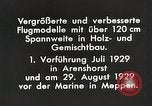
Reinhold Tiling's 120 cm powder fueled rockets test fired in 1929
Testing of Reinhold Tiling's 120 cm model rocket in July, 1929, at Arenshorst and on August 29, 1929, in a demonstration for the Navy, at Meppen, Germany.

Johannes Winkler and the first test of a liquid fuel rocket, in Europe
Views of Johannes Winkler's first prototype (HW1-A) liquid fuel rocket. Preparations in the field for testing the HW1A. Views of Winkler and associates setting up and fueling the prototype. Photographs of The first test of a liquid fuel rocket (Winkler's HW1-A)in Europe, on February 21, 1931, in Dessau, Germany. Sketches of his model HW1-C. Photograph of Winkler sitting next to the HW1-c, on a bench in the laboratory. A so-called Shear diagram pertaining to stresses experienced by the HW1-C rocket.

Work of Rudolf Nebel and Hermann Oberth to achieve controlled burning of Liquid fuel for rockets
July 7, 1930, Oberth and Nebel jointly achieved conrtolled burn with their cone nozzle for a rocket. Diagram of their cone nozzle and view of it being placed in a test frame outdoors. A burn diagram showing steady output. Diagram of the small (mini-rocket) named "Mirak." Views of the test stand set up in Bernstadt, Germany, with instrumentation. Rudolf Nebel standing on a small ladder looking at the rocket. The Mirak in flight. A Mirak explosion. Several buildings comprising Nebel's rocket facilities. Diagram of liquid-fueled rocket motor. Rudolf Nebel and Hermann Oberth at the test stand with their apparatus and views of it in snowy field. Test stand for the burner test in Berlin, 1931 and an explosion that occurred. View of the device with hole blown in it

German rocket pioneer, Klaus Riedel and associates testing an Achenstaber rocket in 1931
First test of a precursor to the Mirak rocket in Germany. Diagram of the so-called Achenstaber rocket.. Rocket pioneer, Klaus Riedel, and an associate, hold the long slender rocket. A barn with sandbagged window is seen behind them. The men lower the rocket through guidance brackets in a wooden pole. The rocket fuse is ignited and the rocket rises fairly high into the sky but tilts over and dives, crashing into the ground. Riedel and associates stand near a truck carrying metal framework designed to guide a rocket.

Some rocket motor designs of 1930s and speculation about future of rocketry
Liquid Rocket motor design drawings of various pioneers in the field, from the American Rocket Society, including: Constantin Paul van Lent (aka Constantin Tselentis,aka Constantin Lent, aka Dr. Constantin Paul van Lent) 1936; Alfred Africano, 1937; Reed,1937; Wild,1938; H.F. Pierce and Nathan Carver, 1938. Slates refer to the post World War I period through about 1938, as the beginnings of rocket flight, and the immediate subsequent period as the second phase of achievement that could lead to high altitude and long range rocket missiles and even manned spaceships. Slate suggests that future of rocketry is limited only by our imagination. Next are imaginary, science fiction scenes like a science fiction movie, showing a major city, in Germany, as a rocket ship travels away from it, and eventually showing Europe, and the earth from outer space, as the rocket travels into the blackness, beyond. Slate comments about eternal longings related to human flight.
CRITICALPAST.COM: About Us | Contact Us | FAQs - How to Order | License Agreement | My Account | My Lightboxes | Shopping Cart | Advanced Search | Featured Collections | Website Terms & Conditions | Privacy Policy ©2026 CriticalPast LLC.
License Agreement |
Terms & Conditions |
Privacy Policy
©2026 CriticalPast LLC.