


 Francais
 Deutsch
 Italiano
Refine Your Search
Leipzig Germany 1945 stock footage and images
- Showing 4681 to 4686 of 10461 results more
more Hide
Hide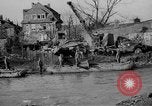
3rd Division fires rocket barrages and First United States Army Infantry advances through German towns east of Inde River
Activities of First United States Army pressing eastward in Germany during World War 2. U.S. engineers and soldiers build a bridge over the Inde River since all nearby crossings had been destroyed by retreating German forces. Army vehicles cross the completed bridge. Soldiers bring heavy artillery and adjust it. View changes to Mausbach area to the South, where rockets are launched by 3rd Armored Division toward the river. Line of 75 U.S. Army rockets seen being loaded by U.S. soldiers and then fired together. Bright flashes and smoke as rockets are fired. Tanks of the 3rd Division moving out from the town. A U.S. vehicle in the advancing column toward Gressenich is hit by German guns. U.S. Army tanks, lined up like artillery, fire on German forces at Gressenich. Continuous line of 3rd Armored Division tanks, armored vehicles, and 6x6 vehicles come to the front and advance on roads of cities and villages moving eastward, and supporting the U.S. First Army Infantry. 1st Army infantry move through Hurtgen forest near Aachen. Ruined German factory is used as an observtion base by U.S. forces to coordinate attack on Gressenich, which was captured on November 19, 1944. 3rd Armored Division tanks move into open fields to continue offensive toward Werth, with U.S. infantry soldiers staying close to tanks for cover. Soldiers carry the wounded U.S. tank commander after German counter fire hits lead U.S. tank in the column. The wounded soldier is dragged to safety. Men of U.S. Army 1st Division Infantry enter town of Werth under German mortar fire and move from house to house clearing enemy snipers and mopping up in the ruins. U.S. Army soldiers guard a column of German prisoners (POW) who surrendered in Werth. View of ruined and destroyed buildings in German towns like Hamich after defeat. U.S. Army soldiers move through the town on foot with a small church in the background. U.S. Army trucks arrive in a rubbled village with food and ammunition for the offensive drive toward the Ruhr.
First phase of munitions manufacture in a German factory during World War I
Munitions manufacture in Germany. A 70 kg steel ingot is heated in furnace. Workers remove it and place it in a 500 ton press. It is then moved to a drawing press reduces its cross section, lengthens it and cuts it into segments. Workers move it to a reheating furnace where many cylindrical pieces are heated until red hot for forging. They are then moved to a drop forge that further shapes them. A woman war production worker wearing a dress is seen operating the controls of the drop forge heavy equipment in the arms factory.
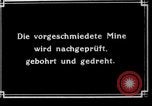
Munitions being manufactured in a German factory during World War I
Munitions manufacture in Germany. Women move newly manufactured heavy munitions casings to a table where they are measured. Worker uses drill press to machine hole for fuse in nose of casing. A woman mounts the casing in a lathe using a chain hoist. She turns (machines ) the outer casing. A small amount of smoke rises from the heat generated at the tool bit. Cutting fluid is poured on the tool bit and casing as it is turning in the lathe. A woman brushes particles from a batch of casings as they are being machined. Men and women perform quality control checks on finished casings. Army representatives perform military acceptance checks on finished casings, using gauges.
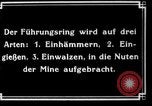
Steps in manufacture of munitions in a German factory during World War I
Munitions manufacture in Germany. Guide rings are formed and fastened into grooves around munitions casing. Casings are stood on their bases in molds. Molten metal is poured into the molds. Casings with molded metal on bases are removed and placed into lathe where guide rings are machined. Metal chips fly off the lathe during this process. The guide rings are further machined with rotary milling machine. A woman grinds casing surfaces in a machine. Casings are given water pressure checks. Water spouts from a defective casing. Munition casings are cleaned and packed.
World hunger problem is discussed in a conference and ration lines for food all over the world.
Post-war starvation, food shortages and hunger problems in the world soon after the end of World War II: Interior of a conference room. U.S. President Harry S. Truman in discussion with U.S. ex- President Herbert Hoover. Seated to their left are ex-Vice President Henry A. Wallace and former Governor of New York, Herbert H Lehman. Emaciated and starving men, women and children seen in villages and cities. The people are probably in India. Food ration lines and queues of British people in England and German citizens in Germany due to post war shortages of food and supplies after end of World War 2. Farm equipment are used in farms harvesting grain. Ships in a harbor with grain being poured into a ship's hold.

American workers and OSS in World War 2 work to estimate the loss of German military manpower in battle.
Film outlines process of U.S. military and War Department to estimate the German military manpower losses from 1939-1943 during World War II. Scenes of German military forces in battle. German tank on the battlefront smashes down a tree and German soldiers follow, running behind it. Dead bodies of soldiers lay on the battlefield. Airplane falling from sky to ground after being hit. German Soldiers fire rifles during battle. German soldiers carry wounded on litters and German medical staff treat the wounded soldiers. A wounded soldier on a hospital bed. Nurse leans over hospital bed and talks to a wounded soldier. A study made to find out the number of soldiers returning to their jobs after being injured. A man reads a magazine which reads: 'Estimate of non battle causalities'. German soldiers march through Arc de Triomphe in Paris during occupation of Paris by Nazi Germany. Headline of a newspaper reads: 'Germans silent on Russian gain'. Brief scene of Soviet leader Stalin speaking at a microphone. Cavalry soldiers, likely Soviet, crossing a battlefield. Scenes of World War I German troops being reviewed by officers. Civilian or OSS men lean over a German map and discuss among themselves. They study the map. Scene of men and women at a German news stand buying German newspapers in order to obtain obituary information. OSS personnel translate casualty reports from German newspapers to help estimate deaths of German soldiers and determine force strength. An operations room with American staff analyzing German newspapers. View of a Boeing 314 Clipper Flying Boat aicraft taking off from water. The reports from World War I and II, allied forces, chart, graphs and NARS computers used to estimate German Army's manpower loss. African American women workers operate keypunch machines recording battle casualty statistics which yield punch cards for further data analysis. Punch cards being created and being loaded in sorting and reading machines bearing brand "International" (for International Business Machines or IBM). A document entitled "analysis of obituaries." Man in an office studying a map and a document. A woman helps him as she enters numbers into a Remington Rand adding machine. They estimate the officers killed in war and the number of the killed enlisted men, in order to estimate the total battle loss. They compare the data of soldiers missing, killed, wounded, and unfit for duty from 1939 to 1943.
CRITICALPAST.COM: About Us | Contact Us | FAQs - How to Order | License Agreement | My Account | My Lightboxes | Shopping Cart | Advanced Search | Featured Collections | Website Terms & Conditions | Privacy Policy ©2026 CriticalPast LLC.
License Agreement |
Terms & Conditions |
Privacy Policy
©2026 CriticalPast LLC.