


 Francais
 Deutsch
 Italiano

Refine Your Search
Leipzig Germany 1945 stock footage and images
- Showing 469 to 474 of 10470 results more
 Hide
Color Sound

Marienplatz, the Town Hall, St. Peters Church, Charles Gate, German Museum and the University of Munich in Munich, Germany.
Famous tourist destinations, landmarks, and architecture in Munich, Germany before World War 2. View of Marienplatz with the Town Hall to its right (Marienplatz, 80331 München, Germany). The Frauenkirche is seen in the background. View of St. Peters Church (Rindermarkt 1, 80331 München, Germany) and the Karlstor or Charles Gate (Karlstor Neuhauser Str., 80331 München, Germany) while looking west on Neubauer Strasse. A tram moves under the gate. Cars and people on a street. Shops on either side of the street including the Hamburg-Amerika Line office. Views of the Former Royal Palace, also known as the Munich Residenz or Munich Residence (Residenzstraße 1, 80333 München, Germany) with streetcar trams, horse carts, and pedestrians in the foreground. The Deutsches Museum or German Museum (Museumsinsel 1, 80538 München, Germany), Ludwig Maximilian University of Munich or LMU Munich (Geschwister-Scholl-Platz 1 D-80539 München) and the National Theater Munich (Max-Joseph-Platz 2, 80539 München, Germany). The east fountain in front of the Ludwig Maximilian University of Munich. A young girl feeding pigeon.

New government formed in East Germany and civilian laborers working under harsh conditions demonstrate.
New government formed in East Germany after the defeat of Nazis in World War II. Early GDR (DDR) Communist Party meeting underway in East Germany in 1949. Attendees applaud as GDR President Wilhelm Pieck, leader of the party, is congratulated. Joseph Stalin reviews parade at Kremlin in Moscow. East German refugees fleeing to the West with their belongings in hand. East German military erecting fence posts for new wire fences to deter escape (which evolved soon after into the Berlin Wall). Watch tower overlooking a border zone between East Germany and West Germany. Socialist meetings in small towns in East Germany. Townspeople marching through towns with party flags. Industry under communist rule, with men and women working at metal and coal factories and at railroads. Citizen soldiers, both men and women being trained and armed with rifles as local militia. They march in a parade with their arms. Children with Bows and arrows follow them. An archery contest for the children with Communist party leaders looking on in approval. A young East German girl shoots an arrow and hits the bulls eye on a target of Konrad Adenauer, leader of West Germany. Soviet military and tanks parade on streets of East Germany.

Hermann Goering gives response to Chief Prosecutor Robert H Jackson during the Nuremberg trials in Nuremberg, Germany.
Hermann Goering questioned by Chief Prosecutor Robert H Jackson during the Nuremberg trials in Nuremberg, Germany. Prosecutor Robert H Jackson questions Goering about the German government. Goering describes the ways and means of arresting people and states: 'The government that Germany had was the only feasible type of government at that time and it succeeded in pulling Germany out of the depths.' Courtroom rises for the recess. Some of the defendants talk during the recess.
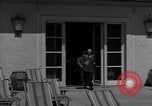
German General Albert Kesselring detained following surrender, and U.S. General Maxwell Taylor in Berchtesgaden, Germany (WW2)
The capture of German General Albert Kesselring in Berchtesgaden, Germany during World War II. General Kesselring and two aides enter the terrace of the Berchtesgadener Hof hotel (present location is now the Haus der Berge, Hanielstraße 7, 83471 Berchtesgaden, Germany) in Berchtesgaden, Germany, where U.S. General Maxwell D. Taylor had arranged for them to stay following surrender at the end of World War 2, in Europe. They sit together at a table and review documents. United States Army General Maxwell D. Taylor and Colonel Ned D. Moore of the 101st Airborne Division leave a building with a 101st Airborne emblem on the doorway and meet Colonel Charles H. Chase.
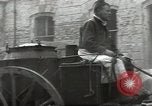
Soviet soldiers and sailors stand before Brandenburg Gate after capture of Berlin, Germany (WW2)
Soviet troops occupy Berlin, Germany during World War II Battle of Berlin. Soviet horse-drawn portable kitchen wagon on street. Soviet flag on top of Borsig Palace (Voßstraße 1, 10117 Berlin, Germany). Gaping hole in the foundation of Borsig Palace. Soviet troops and sailors stand before Brandenburg Gate. Various bombed out buildings of Berlin. Soviet WAC (Women's Army Corps) directs traffic at Brandenburg Gate. View of Adlon Hotel (Hotel Adlon Kempinski Berlin, Unter den Linden 77, 10117 Berlin, Germany). Fire inside a building.
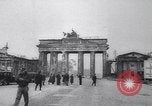
Ruins and damaged buildings in Berlin and Munich Germany at the end of World War II in Europe.
Opening scenes are of ruins in Berlin, Germany at the end of World War II in Europe. Damaged Brandenburg Gate and ruined buildings of Berlin. Damaged building of Adlon Hotel. Allied troops move forward in Germany to complete the Allied occupation of Germany. A truck loaded with Allied troops heads towards Berchtesgaden. Smoke rises from the Berghof, German Chancellor Adolf Hitler's mountain residence (Narrator refers to it as the Eagle's Nest, which is not correct. The Eagle's Nest or Kehlsteinhaus was not bombed and is not shown in this clip). Ruins and damaged buildings in Munich including exterior building facade, and arched stair entrance to festhall, marked with painted lettering by American soldiers, "157th infantry, 45th Division." Interior views of the Hofbräuhaus München beer hall (Hofbräuhaus am Platzl), including interior views of ruins inside its drinking room (trinkstube) with shattered windows and broken furniture. (Narrator refers to this as "the famous beer hall." At least two noteworthy NASDAP formative events occurred there: On February 25, 1920, Hitler presented the Nazi Party Twenty Five Point Program there. On November 4, 1921 the National Socialist party held a large public meeting at the Hofbräuhaus and fighting and protesting broke out after Hitler spoke. The Sturmabteilungen, or "SA", then in its infancy, attacked and ejected protestors.)
CRITICALPAST.COM: About Us | Contact Us | FAQs - How to Order | License Agreement | My Account | My Lightboxes | Shopping Cart | Advanced Search | Featured Collections | Website Terms & Conditions | Privacy Policy ©2026 CriticalPast LLC.
License Agreement |
Terms & Conditions |
Privacy Policy
©2026 CriticalPast LLC.