


 Francais
 Deutsch
 Italiano

Refine Your Search
Leipzig Germany 1945 stock footage and images
- Showing 4783 to 4788 of 10470 results more
 Hide
Color Sound

Paul Joseph Goebbels and other officers inspect bomb damaged buildings after Allied bombings in Berlin during World War II.
Ruins in Berlin, Germany during World War II. Shelled buildings, damaged by Allied bombings. Firemen douse fire. Damaged building by air attack of Allies. Paul Joseph Goebbels, Reich Minister for Public Enlightenment and Propaganda with other officers and inspects bomb damaged site. Civilians move with their belongings. Ruined buildings and debris. Civilians remove debris.

Kaiser Wilhelm II and Empress Auguste Viktoria officially open the Deutsches Stadion in Berlin
Kaiser Wilhelm II and Empress Auguste Viktoria enter an open carriage to take them on a ceremonial ride to the Deutsches Stadion in Westend, Berlin. Kaiser Wilhelm II and his wife officially open Germany's Olympic stadium (Deutsches Stadion, Olympischer Platz 3, 14053 Berlin) on the 25th Anniversary of the Kaiser's Coronation. The Kaiser wears a full-dress uniform and busby hat. He salutes a couple of times as the carriage passes unseen persons. The carriage proceeds followed by a rider on horseback.

Hitler presides over the opening of the 1936 Olympics while U.S. team member Jesse Owens wins events.
The 1936 Olympics held in Berlin, Germany. People gather in a large number in a stadium to watch the matches. Brief view of the Hindenburg airship overhead. German Chancellor Adolf Hitler and other officials arrive in the stadium via motorcade from the Brandenburg Gate. Participants from different countries march in formation in the stadium during opening ceremony. The Nazi flag is seen as the German national anthem is played. Hitler salutes the participants and opens the games. An aerial view of the stadium. Fritz Schilgen runs holding the Olympic Torch. The Olympic eternal flame is lit by the torch bearer, Schilgen. The matches start. Players participate in various sports like javelin throw, high jump and running. View of American Jesse Owens winning the 100 meter sprint. Closeup of Jesse Owens smiling after winning the race to earn the gold medal. Jesse Owens, Ralph Metcalfe, and Tinus Osendarp on the podium receiving their medals for the 100 meter dash.

Fuhrer Adolf Hitler greets Mohammad Amin al-Husseini, the Grand Mufti of Jerusalem, in the Reich Chancellery in Berlin.
Nazi Fuhrer Adolf Hitler of Germany greets Mohammed Amin al-Husseini, the Palestinian Arab Grand Mufti of Jerusalem, mandatory Palestine, in the Reich Chancellery in Berlin. German officers also present. The two leaders shake hands and take their seats. They begin the talks. (World War 2 period.)
M A. Musmanno calls three defendants for trial and B. Ferencz makes his opening speech at The Einsatzgruppen Case in Nuremberg.
The Einsatzgruppen Case in Nuremberg, Germany war crimes trials after World War 2. Judge Michael A. Musmanno announces that three defendants are to be arraigned separately because they were ill when the remainder of the prisoners were arraigned. The prosecutor, Ben Ferencz, makes his opening speech in which he says that the court is not looking for vengeance but rather a plea of humanity to law.
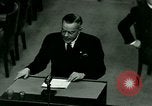
General Telford Taylor in courtroom and prosecution reads, the crimes done by the Einsatzgruppen, during a trial in Nuremberg.
The Einsatzgruppen Case in Nuremberg, Germany. General Telford Taylor in a courtroom. A member of the prosecution reads in part the description of the mass murders committed by the Einsatzgruppen. He also describes how the displaced persons, or DPs, were put into a van and gassed to death. One Einsatzgruppen detachment while making a report states that 121, 817 Jews were killed and that at one place they arrested all Jews over 16 and with an exception of the doctors and the elders all of them were executed. The leader of Einsatzgruppen reports that 15,000 Jews were executed in Schrewindt.
CRITICALPAST.COM: About Us | Contact Us | FAQs - How to Order | License Agreement | My Account | My Lightboxes | Shopping Cart | Advanced Search | Featured Collections | Website Terms & Conditions | Privacy Policy ©2026 CriticalPast LLC.
License Agreement |
Terms & Conditions |
Privacy Policy
©2026 CriticalPast LLC.