


 Francais
 Deutsch
 Italiano

Refine Your Search
Leipzig Germany 1945 stock footage and images
- Showing 547 to 552 of 10470 results more
 Hide
Color Sound
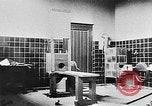
U.S. officials inspect the various torture implements and the possessions of the prisoners at the Ohrdruf camp in Germany.
The different implements and torture devices at the Ohrdruf concentration camp in Germany during World War II. The gas chambers at the concentration camp in Germany. The shower in the bathroom through which the poison gas, Zyklon, used to be inducted when the prisoners shower. The blast furnaces used for cremation of dead bodies of prisoners. The garments of the prisoners being inspected by the officials. Women's clothes, infant shoes, toys and dolls in a room. The storage room in the mills with sacks of prisoners' hair packed. Prisoners' jewelery, watches and wedding rings in the room. The instruments used to pull out the teeth of prisoners. An official holds a prisoner's teeth.
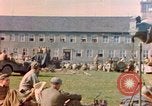
Men sit and listen to Commanding Officer on the Victory in Europe Day at the American airfield in Germany.
Activities on the Victory in Europe Day, World War II at an American airfield in Germany. The Administration buildings at the American airfield in Germany. Men sit and listen to Commanding Officer (CO) on Victory in Europe Day (VE Day). Men seated on grass. Officer speaks on phone. Air force personnel standing at the back. The Commanding Officer speaks over phone. Signboard reads "Spearshaft C P" in the background. Men disperse. CO talks to men over phone.

In war torn Germany, young German boys smoke cigarettes and pose for group photo a field and beside autobahn (WW2)
Activities of children in Germany near end of World War II. German boys from war torn Germany smoke cigarettes in a field. Trees in the background. The boys play and run down a hill. Children lined up beside an autobahn. A tower in the background. German boys in a group pose for photographs. Some children smile; other boys look melancholy and tired.

Soldiers and vehicles of the United States Army USA 104th Infantry Division in Saxony-Anhalt, Germany
American Army soldiers of the 104th Infantry Division, 104th Reconnaissance Troop, drive along a road, deep in Germany, near the end of World War 2 in Europe. According to signposts, they are 3 Km from Bennstedt and 11Km from Halle, in Saxony-Anhalt, Germany. An M18 Hellcat tank destroyer follows behind the jeeps, carrying 4 soldiers atop its turret. Another behind it carries 6 soldiers on it.
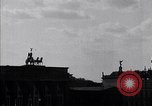
Scenes of Berlin, and its statuary during the Weimar Republic period in Germany, following World War I.
Silhouette of the Quadriga statue atop the Brandenburg Gate (Brandenburger Tor, Pariser Platz, 10117 Berlin, Germany) and the Victory Column (Siegessäule, Großer Stern, 10557 Berlin, Germany) in Berlin, Germany. Then pedestrians and vehicles are seen around the Statue of Frederick the Great along Unter den Linden boulevard. Also seen is statue in Siegesallee created by sculptor Reinhold Begas (and likely August Krauss) in 1900, commemorating German Emperor William I. Bust on the left of the William I statue commemorates Helmuth von Moltke the Elder, and the bust on the right is of Otto von Bismarck. Next, is shown the National Kaiser Wilhelm Monument (Kaiser-Wilhelm-Nationaldenkmal) an equestrian statue of the first German Emperor Wilhelm I, on the west side of the Berlin City Palace (Schloßpl., 10178 Berlin, Germany). View from a camera moving away from the Victory Column on the Königsplatz across from the Reichstag. Final image is an iron Statue of Paul von Hindenburg in front of the Victory Column.

Steel mill operations and output in Germany, and bridges, ships, buildings and industry created with steel
Hot molten steel in a steel mill in Germany. Hot steel rods in process at the factory. Men work outside welding steel girders and beams to create a large steel frame or building structure. Men stand on the skeletons of buildings. Manufacture and launch of a giant German ship involving steel. Various ships and scaffolding at the shipyard. Tall steel girder bridges in Germany are shown. Various views of the Tagblatt-Turm (Tagblatt Tower) building in Stuttgart Germany just a few years after its completion -- an example of early modernism and in stark contrast to other older buildings in the area. A high rise building seen behind an old stone gate structure in Germany. Buildings and houses in the area.
CRITICALPAST.COM: About Us | Contact Us | FAQs - How to Order | License Agreement | My Account | My Lightboxes | Shopping Cart | Advanced Search | Featured Collections | Website Terms & Conditions | Privacy Policy ©2026 CriticalPast LLC.
License Agreement |
Terms & Conditions |
Privacy Policy
©2026 CriticalPast LLC.