


 Francais
 Deutsch
 Italiano
Refine Your Search
Lenglern Germany 1945 stock footage and images
- Showing 13 to 18 of 10471 results more
more Hide
Hide
Opening statement of the prosecution at the Nuremberg Trials; flashback scenes of Nazi crimes and starving civilians in 1945
Events related the Nuremberg Trials held at the Palace of Justice in Nuremberg, Germany. Flashbacks of a variety of Nazi crimes against humanity during World War II. Europe during 1945. War devastation: buildings and cities laid in waste, people in hunger and despair emerge from shelters searching for the causes of the war and of the immediate human suffering. Deprived children and adults weep, starve and beg on the streets. November 21, 1945, Nuremberg, Palace of Justice, seat of the International Military Tribunal. List shows the names of the convicted Nazi criminals. Chief prosecutor from the United States, Robert Houghwout Jackson, makes the opening statement of the prosecution. He presents Count 1 of the indictment a conspiracy to commit war crimes and crimes against peace and humanity. He makes the statement that criminals who have done injustice to the laws of humanity must be brought to justice. Stenographers wearing headphones take down notes. Defendants stand in their dock including Herman Goring, Rudolf Hess, Joachim von Ribbentrop, Wilhelm Keitel, Karl Donitz, Erich Raeder, Baldur von Schirach and Fritz Sauckel. Faces of the convicted criminals. Scenes from mass burial of victims from German bombing of Coventry, England. Scenes from the end of World War 2, with women weeping and civilian victims of war in Europe, including Germany, seen scavenging on streets for food. Women and hungry children scrape out trash cans and metal lids for bites of food. Desperate civilians cut down remaining tree stumps from formerly tree-lined streets to use for fuel. A group of men and women struggle in a food relief line in Italy.
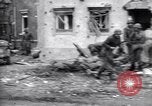
Allied armies including the Ninth United States Army fight and German citizens surrender in Germany.
The Allies invade Germany during period March 1945 - April 1945, during World War II. Animated map depicts Allied invasion of Germany. Ninth United States Army troops and tanks advance in Hanover, Germany. A convoy of military vehicles on a road. Smoke rises from behind a house. Smoke near a tank. Allied M4 Sherman tanks and trucks move at various German fronts. German women wave white handkerchief signifying surrender. Over the border in Overijssel, Netherlands, British Coldstream Guards roll in to Enschede to liberate the Dutch people there, and many Dutch citizens wave and cheer their liberators. A captured train loaded with German V-2 rockets. United States Army Air Force P-47 Thunderbolt aircraft drop bombs on a village. Smoke rise due to explosions. Tanks and troops of Ninth U.S. Army cross a bridge. U.S. Infantry soldiers cross a bridge and run through ruins of bombed buildings in house to house village fighting, working to evade German sniper fire. Some German soldiers seen surrendering to American forces. US Army forces walking single file on both sides of a road as tanks and equipment roll by in Germany.
Allied 9th Army units advance into heart of Germany during World War II
Allied 9th Army advancing beyond Munich, Germany, during World War II. U.S. soldiers firing mortars from a street and a cemetery. Allied troops crossing a pontoon bridge across a river. U.S.soldier, from 102nd Infantry Division, leads line of German civilians to safety, as troops and vehicles enter the town of Erkelenz. U.S. troops fill the streets and sidewalks of the town as they pass through. Prisoners of war and forced laborers are freed by advancing Allied forces. Group is seen wearing berets. One wears a fez. Boxes of Red Cross foods intended for American prisoners are found opened and used by Germans in Eppendorf, Germany. On February 28th, 1945, soldiers of the 2nd Battalion, 413th Regiment, 104th Infantry Division,find the boxes in German military billets and throughout the town. Views of boxes with "American Red Cross Prisoner of War Food Package," written on them. Units of the 1st Allied Army are seen driving directly toward Cologne, Germany. A Sherman tank is seen completely covered by U.S. infantrymen, riding on top. U.S. infantrymen cross stream on makeshift steel bridge. Infantrymen take cover in railroad culvert as tanks of U.S. 3rd Armored Division move forward to deal with intense German resistance. Incoming artillery shell squeals overhead and explodes nearby out of camera view. U.S. troops take shelter behind brick wall. U.S. troops occupy abandoned German trenches. A commanding defensive view from one of the trenches. On March 2, 1945, troops of the 83rd Infantry Division, advancing toward Cologne, pass through town of Neusse. Sign on wall reads: "Mit Hitler zum Sieg." Another reads: "Wir kapitulieren nie!" U.S. troops reach the Rhein River. Telephoto lense view shows city of Dusseldorf and its bridges, spanning the Rhein (Rhine) River.
Civilians place burned bodies of Gardelegen massacre victims on stretchers and carry them to burial grounds in Gardelegen, Germany.
Mass burial at the site of the Gardelegen massacre, in Gardelegen, Germany, late in World War II. View of the barn on the Isenschnibbe estate in Gardelegen where 1016 prisoners had been barricaded by Nazi forces and civilian accomplices on April 13, 1945, and then died after the barn was set on fire. German civilians walking among dead bodies outside the barn. Germany civilians walk carrying stretchers. They place burned bodies of Nazi atrocity victims on the stretchers. They carry the bodies to burial grounds. (Many of the dead were concentration camp prisoners and slave laborers in transit from the Mittelbau-Dora Concentration Camp and the Hannover-Stöcken Concentration Camp. The massacre was discovered by the U.S. Army 102nd Infantry Division when they entered the area on April 14, 1945, finding corpses in the barn and in nearby hastily dug mass graves. The U.S. Army ordered German civilians in the area to transport the bodies and dig graves for proper burial, from April 21-25, 1945.)
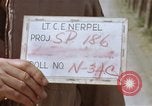
Liberated United States airmen prisoners at Stalag 7A in Moosburg, Germany (WW2)
Liberated United States prisoners (mostly military airmen) at POW camp called Kriegsgefangenen-Mannschafts-Stammlager (Stalag) VII A, located just North of Moosburg, Germany during World War II. The airmen cook food. Several are seen sunning themselves. Airmen seen shaving, shining shoes and cleaning clothes. A group of airmen around sign 'I Wanted Wings' and 'Luft 3'. These are some of the prisoners who were originally held at Stalag Luft III, in German Province of Lower Silesia, near the town of Sagan (now in Poland). (Note: Stalag Luft III is famous because the "Great Escape" took place there in March, 1944. Prisoners were forced to march from Sagan to Spremburg during the coldest winter in Germany in 50 years. There, they boarded a train of boxcars for a 3 day trip to Moosburg in January 1945, because the Russians were closing in. The addition of these prisoners to Stalag 7A, at Moosburg, led to serious overcrowding of the camp. On May 1, 1945, the New York Times reported that "The Fourteenth Armored Division liberated 110,000 Allied prisoners of war at Stalag 7A at Moosburg." This corrected an earlier report that 27,000 prisoners had been liberated.)
Harry S Truman, Joseph Stalin and Winston Churchill discuss the problems related to Germany in Potsdam Conference, Berlin (WW2)
Question marks on screen. Reconstruction of the buildings and denazification in Berlin, Germany after World War II. A factory in Germany. A farmer leads a horse to plow a field. Men at a farm cultivate crops. The wreckage of the IG Farben plant. Men speaking to Hermann Göring. The trial of Norwegian leader and Nazi collaborator Vidkun Quisling. The rail goes on for the criminal. People burn Nazi books and pamphlets in a bonfire. A man burns a pamphlet with a photo of Adolf Hitler. The people stand around the burning books. German civilians read a poster on a wall. General Dwight D. Eisenhower of the United States, Marshal Georgy Zhukov of the Soviet Union, and Field Marshal Bernard Montgomery of the United Kingdom sign a joint agreement. The three of them stand together. The United States Capitol building. Chongqing National Government building in No. 232 Renmin Road, Chongqing (Chungking), China. The Big Ben in London, United Kingdom. Aerial view of the Arc de Triomphe in Paris, France. General Francisco Franco saluting to marching soldiers in Spain. The delegates including United States President Harry S. Truman, General Secretary of the Communist Party of the Soviet Union Joseph Stalin, and UK Prime Minister Winston Churchill seated around a table during the Potsdam Conference in 1945. They discuss the problems. A close up view of Truman looking into some documents. Stalin smokes a cigarette. The delegates discuss problems. The funeral ceremony of President Franklin D. Roosevelt. The soldiers fire guns. President Harry S. Truman attends the ceremony. Churchill salutes from a moving vehicle. Women voting in the United States. Truman gets off an aircraft. Delegates in the Potsdam conference. Newspaper headlines read Russian declares war on the Empire of Japan in 1945. The first atomic bomb explosion over Hiroshima, Japan. The newspaper headlines about the war. Truman, Stalin and delegates at the Potsdam Conference. Soldiers advancing in the battlefield. A flag of the United States and people celebrate the victory. Newspaper headlines feature the surrender of Japan.
CRITICALPAST.COM: About Us | Contact Us | FAQs - How to Order | License Agreement | My Account | My Lightboxes | Shopping Cart | Advanced Search | Featured Collections | Website Terms & Conditions | Privacy Policy ©2026 CriticalPast LLC.
License Agreement |
Terms & Conditions |
Privacy Policy
©2026 CriticalPast LLC.