


 Francais
 Deutsch
 Italiano

Refine Your Search
Lenglern Germany 1945 stock footage and images
- Showing 3829 to 3834 of 10470 results more
 Hide
Color Sound
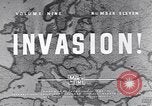
News media military analysts discuss the problems of Allies invading Europe to defeat Germany in World War II
Map of Europe and label "Invasion." Westbrook Van Voorhis leading a panel discussion about the problems arising from the Allied invasion of Europe in World War 2. He introduces panelists: Hanson Baldwin (military editor of the New York Times) Dewitt MacKenzie (Associated Press military analyst), and Paul Schubert (of Mutual Radio Network). He asks Mr. Baldwin about the importance of aerial bombing campaigns. Baldwin also stresses importance of a land invasion of Europe. Relief map of Europe highlighting major German cities. Asked about the merit of invading Italy on the way to Germany, Mr. Schubert cites the problem of the Alps and suggests other more effective invasion routes. Van Voorhis asks Mr. MacKenzie about best route into fortress Germany. He considers the criterion of ease of supply as most important, and suggests the Atlantic coast, near a good port and not far from England. Animated map shows this idea. When asked about this, Mr. Baldwin agrees completely, calling the conflict "a quartermaster's war." He adds, "The problem of victory is the problem of supply."

Ralph Heinzen gives an intelligent analysis of internal conditions in Germany as SS Gripsholm arrives in New York (WW2)
SS Gripsholm (Ship) arrives in New York, United States in World War II. Cameramen take photos as SS Gripsholm as it arrives at New York harbor. The rails are crowded with Americans. She docks at Pier F in Jersey City and ambulances roll away with wounded soldiers. Six hundred and sixty-two repatriates from German internment camps come ashore. S. Pinckney Tuck, excharge d'affairs in Vichy seen. Douglas MacArthur (General Douglas MacArthur's nephew), approaches with his dog. Passengers are happy to come in home. Ralph Heinzen of the United Press gives an intelligent analysis of internal conditions in Germany today. Stalingrad was the turning point, he states. Germany began losing the war with that defeat and Hitler started losing prestige.
Officer points to chalk board maps of Germany and UK during bombing mission presentation.
Officer pointing to various mission items on a chalk board map of Germany. The cities of Emden and Wilhelmshaven are prominently displayed on the bombing mission map. The note "HIT the Target" is seen on the board. A senior officer reads from a paper. A side view depicting planes with targets below is pointed to. A map of the UK and Germany with flight routes over the English Channel is displayed.
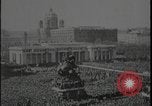
Adolf Hitler’s arrival in Vienna’s Heldenplatz, Hitler’s ceremonial declaration of Austria’s annexation into Nazi Germany (Anschluss)
Adolf Hitler enter Vienna after annexation of Austria by Germany (also known as the Anschluss). Tremendous crowds of Austrians assemble at Heldenplatz, in front of the Hofburg Palace, in Vienna (Heldenplatz - 1010 Vienna). Adolf Hitler’s motorcade enters Heldenplatz. Adolf Hitler gives the Nazi Salute, then does a fist pump, to crowd as he rides into Vienna. Austrians crowd in Heldenplatz, some find space in tree branches and in monument equestrian statue of Prince Eugene of Savoy-Carignano located in the middle of the square. From the balcony of the Hofburg Palace, Adolf Hitler makes a ceremonial announcement of the annexation of Austria (Anschluss) into Nazi Germany. Austrians holding Nazi banners watch the ceremonial announcement in Heldenplatz. Adolf Hitler, Austrian officials and the crowd give the Nazi salute after the official Anschluss announcement.
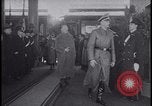
Adolf Hitler arrives in Brenner railway station to meet Benito Mussolini for a brief Germany-Italy dialogue (WW2)
Italian Prime Minister and Il Duce Benito Mussolini welcomes German Chancellor and Führer Adolf Hitler upon his arrival in the Brenner railway station (39041 Brenner, South Tyrol, Italy), the border station of Italy and Austria. Adolf Hitler gives the Nazi salute while Benito Mussolini extends the Roman Salute to honor guards while it snows outside the Brenner station. Italian Foreign Minister Count Galeazzo Ciano and Nazi German Foreign Minister Joachim von Ribbentrop follow behind their leaders. Hitler shakes hands with Mussolini and Count Ciano, greet each other with the Nazi and Roman salutes, before boarding train back to Germany. Joachim von Ribbentrop greets the Nazi salute to Mussolini before the latter shake hands with him. Hitler speaks to Mussolini while leaning on train window before departure. Hitler’s train departs from Brenner station. Mussolini gives a final Roman salute to Hitler as his train departs for Germany. Mussolini, Count Ciano and other Italian fascist officials leave the platform. “Brennero” (Italian for Brenner) station sign in heavy snow. Italian fascist officials salute to Mussolini’s snowy train departing Brenner station after Hitler's visit to Italy during World War II.
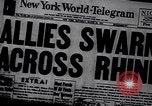
Newspaper headlines as Allies cross Rhine, dead concentration camp victims, German prisoners near end of World War II in Europe
Views of various newspaper headlines during world war 2. Headline announces that the Allies have crossed the Rhine River in Germany. View of U.S. Army soldiers in jeeps and trucks crossing a bridge over the Rhine. Point of view (POV) shot from inside open moving automobile crossing bridge. Dead Bodies of concentration camp victims in a camp following liberation by the Allies. German Army prisoners running in formation with their hands up, under guard by the Allies. Large group of Germany military prisoners in a queue. A young boy German soldier is seen crying. Nazi flag being burned: Flag with swastika mark of Nazis is on fire and seen burning.
CRITICALPAST.COM: About Us | Contact Us | FAQs - How to Order | License Agreement | My Account | My Lightboxes | Shopping Cart | Advanced Search | Featured Collections | Website Terms & Conditions | Privacy Policy ©2026 CriticalPast LLC.
License Agreement |
Terms & Conditions |
Privacy Policy
©2026 CriticalPast LLC.