


 Francais
 Deutsch
 Italiano

Refine Your Search
Lenglern Germany 1945 stock footage and images
- Showing 5509 to 5514 of 10470 results more
 Hide
Color Sound
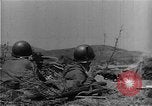
Information about unidentified airplanes is transmitted in the United States.
A public television program by the U.S. Army entitled 'The Big Picture.' U.S. troops are seen hunkered down and looking through binoculars in a defensive position in Korea, during the Korean War. American soldiers riding atop a Sherman tank on a city street in Germany, during World War II. Ski troops moving across snowy hill in Alaska. U.S. Army amphibious assault training on a beach in Puerto Rico. Army Master Sergeant Stuart Queen, narrator, speaks about America's defense against threat of atomic attack in these times of lukewarm peace. View of mountainous region in Alaska. A cluster of Cup'it Eskimo dwellings is seen on Nunivak Island, in the Bering Sea. Several of the local inhabitants are fishing through holes cut in the ice. Vapor trails are seen from Soviet aircraft flying at high altitude. A sign on a tarpaulin displaying logo of the Army Signal Corps, reads,"Alaska Communication System, Long Distance Commercial Telephone-Telegraph." A tracked vehicle carries a soldier to a facility posting a sign reading, "Alaska Communications System Receiver Station." Several tall antennas loom above the site. The soldier, dressed in arctic gear, steps from the tracked vehicle and walks past several snow shoes, standing upright in the snow, to enter a white wooden building. Inside, a man in civilian clothes works at a battery of telecomunications equipment. He transmits a message about the aircraft sighting, to the Alaska Communication System facility in Fairbanks Alaska (briefly shown) by means of a telegraph key. From there it is relayed to a Signal Corps facility, shown, in Washington, DC. A soldier is seen Inside that facility, in a room filled with computers and telecommunications equipment. A Sergeant handles paper tape messages being sent and received by teletype. Another soldier plugs connections into a communications switchboard. Next, the camera pans over the entrance to the Office of the Secretary of Defense, in the Pentagon. More views of soldiers attending banks of teletype machines. Animated map displays paths of orders being transmitted to U.S. Air Defense Centers in San Francisco, Chicago, Seattle, New York, and Atlanta. View from control room, of several U.S. Air Force F-94 Fighter Interceptor aircraft on an airfield ramp. A controller activates a Klaxon horn and pilots on alert, in the Fighter Interceptor Squadron ready room, jump up and scramble to their aircraft. A pair of F-94s taking off. One is number 51-5385. Next, a U.S. Navy F-9 fighter plane is seen taking off from an airfield. It displays tail code AE. It is followed by another F-9 aircraft.
Launching of Wright Brothers' glider and aircraft in different places in Europe.
The history of aviation. A glider being launched from a hillside in Germany. The glider is parked. Several men stand nearby. The glider in flight overhead. The first flight of the Wright Brothers at Kitty Hawk in North Carolina on December 17, 1903. A still photograph of Wright Brothers' aircraft in flight. The pilot in a prone position while piloting the aircraft. Launching of Wright Brothers' aircraft in France on August 8, 1908. A launching tower, weight dropping and the take off of the aircraft are shown. Spectators in stands watch the air show. Headlines of a New York newspaper proclaim Wright's flight in France.
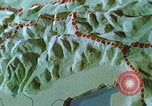
Transportation progress in Europe during the nineteenth century and into middle of 20th century after World War 2.
A model Relief map of Western Europe, with country borders marked in red. Animals used in rural areas. Italian farmers transporting milk cans and other things by donkey. A farm wagon being pulled by a horse. Road through the Simplon Pass, in Switzerland (constructed by Napoleon to transport artillery between the Rhône valley and Italy). Views of the mountainous area. Sketch of early English steam railroad train and of others in other countries, embraced enthusiastically by the local citizenry . Illustrations recording construction of the Britannia bridge across the Menai Strait between the island of Anglesey and the mainland of Wales. (It opened March 5, 1850.) Relief map of Europe focuses on Basle (Basel)in Northwest Switzerland. A modern-day signpost showing directions to France, Germany, and Switzerland. Freight trains arriving and cargoes being transferred by cranes of the Canal Barge operating company, Schweizerische Reederei. View of open storage yards, rail lines and a river. Freight trains carrying various loads to many different European destinations. Wrecked transport facilities left from World War II.
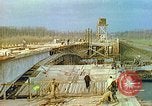
Road transport becomes the dominant mode of transport in post World War II Europe under reconstruction.
Road transportation system in post World War II Europe, supporting reconstruction efforts. European workers work at a bridge being bulit. Workers work on constructing a highway in Belgium. Diesel trailer trucks along with cars and Volkswagen bus or van vehicles move along a road in Germany. A truck stop at a gas station to refuel. Men load a truck with parts for construction of a power plant, and another truck with containers containing refrigerated fish. A truck pulls semi-trailers. A trailer truck loaded with Swedish furniture moves bringing new furnishings to homes in a town on the Polders of Holland. Boom in tourism begins. Signs at a Tourism office in Milan, Italy. European people at a Swiss railroad station. Swedish and Italian International tourism buses traveling in Europe providing a way to tour and sleep without needing to stay in hotels.
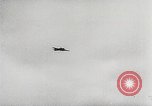
Air Force pilots of the Fascist Republic of Italy are greeted in Italy after returning from a raid on Gibraltar.
Air Force airplanes of the Fascist Republic of Italy return from a raid on Gibraltar during World War II. The airplanes in flight. Airmen and officials greet Italian pilots, in the service of Germany, as they deplane.They are decorated for their service. Torpedo bomber aces Marino Marini (with jumpsuit) and Carlo Faggioni (with white beret) are visible.
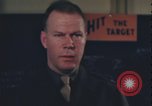
Officer present flight plan.
Closeup views of an officer addressing others regarding a B-17 bombing mission. Officer in front of chalk board gestures with a pointer. The locations of "Norden" and "Leer" in Germany are noted on the board.
CRITICALPAST.COM: About Us | Contact Us | FAQs - How to Order | License Agreement | My Account | My Lightboxes | Shopping Cart | Advanced Search | Featured Collections | Website Terms & Conditions | Privacy Policy ©2026 CriticalPast LLC.
License Agreement |
Terms & Conditions |
Privacy Policy
©2026 CriticalPast LLC.