


 Francais
 Deutsch
 Italiano
Refine Your Search
Lisieux France 1944 stock footage and images
- Showing 8875 to 8880 of 9933 results more
more Hide
Hide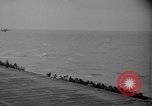
A U.S. Navy F6F Hellcat makes gear-up landing on the deck of USS Essex underway in Manila Bay, Philippines, during World War 2.
USS Essex (CV-9) underway in Manila Bay, Philippines during World War 2. F6F Hellcat of VF-9 flies past the Essex at low altitude for a gear check. Its landing gear is malfunctioning and can't be extended. The pilot is cleared to make a gear-up landing on the carrier. Next he is seen making a well-controlled touchdown near the beginning of the flight deck. Then the aircraft slides along the deck almost halfway, veering slightly to the right as it comes to a halt. It appears relatively undamaged except for a bent prop (and surely some underside damage). Deck crewmen rush to assist the pilot and bring fire extinguishers to bear on areas around the hot engine. An F4F, taking off during the emergency, veers off the side of the flight deck, but manages to continue safely. Meanwhile, deck crews continue to assist the pilot and safely secure the accident site.The pilot, apparently unhurt, is escorted as he walks away from the airplane.
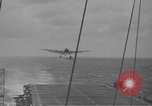
U.S. Navy TBF Avenger gunner from USS Essex is buried at sea with his aircraft during World War II
A Grumman TBF avenger torpedo bomber of VT-15 Torpedo Air Group, approaches and lands on the deck of the USS Essex (CV-9) during the Battle of Manila Bay, in World War 2. Upon landing, Lt. Robert Cosgrove (Pilot) and Sailor Digby Denzek (Radioman) can be seen in their respective forward and middle crew positions. But the rear gunner position, occupied by Aviation Machinist Mate 2nd Class, Loyce Edward Deen (Gunner), has been completely destroyed by Japanese enemy 40mm shell fire, and AMM2C Loyce Deen is dead. As the aircraft is parked among others, with wings folded up, U.S. Navy sailors of the USS Essex take fingerprints and cut dog tags from the body of AMM2C Deen in the gunner position. Captain Carlos W. Wieber, Commanding Officer of the Essex, and her crew, participate in funeral services on the deck. A chaplain conducts the services from beside the aircraft, where Loyce Deen's remains in the gunner's position have been shrouded. Closeup of Rear Admiral Frederick C. Sherman during the service of burial at sea. A bugler plays taps. Beside the bugler is David L. McDonald, who was XO of the USS Essex (and later Chief of Naval Operations in the 1960s). Deen's remains are then buried at sea in the TBF avenger in which he died. The aircraft floats off the fantail for a short time before sinking from view. Two TBF Avengers are seen flying overhead, in tribute. Crew members then disband and return to their duties.
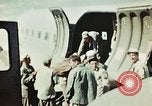
U.S. wounded soldiers transported to North Africa by air evacuation during World War II.
Wounded American soldiers arriving in North Africa, after being evacuated by air from combat zones, during World War 2. U.S. soldiers in fatigues, offload wounded troops, on litters from a U.S. C-47 air evacuation aircraft, and place them into an Army ambulance that drives away. The unloading soldiers wait for another ambulance. Several airmen sit in a jeep with a woman in a blue flight outfit, wearing a headscarf. They are facing away from the camera and watching patients being transferred. The tail of the C-47 can be seen in the background. It displays the tail code "N." Numerous closeups of wounded being moved on stretchers from the aircraft to ambulances.
A patrol sergeant inspects military policemen before they leave for town patrolling in the United States (WW2)
A training film 'Military Police Town Patrolling' on functions of military policemen during a town patrolling in the United States during World War II . Soldiers wade ashore. Smoke from firing and bombardment on a battlefield. Soldiers aboard Jeeps and trucks. A military policeman directs traffic. MPs handle prisoners of war. The prisoners are marched. They guard supplies in a supply line. They also patrol captured towns. Buildings along a street side. Vehicles drive past on the street. Men playing on a field. Houses in the background. MPs stand in a line. An officer inspects them. He inspects their uniforms. The officer talks to a military policeman. They march. The MPs are headquartered in a local police station. The MPs enter the police station. Interior of the police station. A desk sergeant at work. The MPs with a criminal. The desk sergeant takes information from him. The criminal is then put behind the bars. The MPs stand in a line at attention in the police station. A patrol sergeant inspects them. He instructs them about town patrol. He says that they should help soldiers whenever they need help and should maintain order and should coordinate with them.
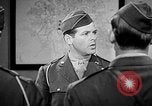
MPs work on posts which were assigned to them in the United States.
A training film on functions of military policemen during town patrolling in the United States. An officer instructs the MPs. The MPs stand at attention in a line. A wall map in the background. The officer assigns posts to the MPs. He points to places on the map. The MPs come out of building and walk. They board a military vehicle. People walking on a street. Some of the MPs are assigned fixed post. These are places like rail road terminals and places of large gathering of soldiers. Spots which could be in trouble are the fixed posts. The MPs serve as information bureau. Soldiers coming to the place for the first time are given information by the MPs. Information about arrival and departure of trains and several other things is given. The working of a roving patrol. Men in a jeep. A motor patrol. MPs in a jeep moving along a street. Buildings along street sides. Working of a foot patrol. The patrols take charge of accidents in which military vehicles are involved. Traffic control by a patrol. They see that roads do not become congested. They take full account of accidents. People walking on a street. An MP talks on a radio. If the car is not equipped with a radio, several public phones are available on the route. (World War II period).
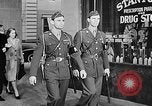
A foot patrol works and talks to soldiers in the United States.
A training film on functions of military policemen during town patrolling in the United States. The working of a foot patrol. MPs walk on a street. Buildings along street sides. Vehicles moving past. Bullying is not allowed for the MPs. They should not accept gifts from anyone. A soldier wearing his uniform in an incorrect way. The MPs talk to him and tell him to correct his mistake. They talk to him in a good manner and the soldier obeys them. Other MPs scold a soldier for wearing his uniform in an incorrect way. This is the wrong way of talking to a soldier. Two soldiers fight. The MPs handle the situation. Two MPs standing outside a building. A board on the building reads: 'Service men's lounge'. People walking on the street near the building. (World War II period).
CRITICALPAST.COM: About Us | Contact Us | FAQs - How to Order | License Agreement | My Account | My Lightboxes | Shopping Cart | Advanced Search | Featured Collections | Website Terms & Conditions | Privacy Policy ©2026 CriticalPast LLC.
License Agreement |
Terms & Conditions |
Privacy Policy
©2026 CriticalPast LLC.