


 Francais
 Deutsch
 Italiano

Refine Your Search
Lisieux France 1944 stock footage and images
- Showing 181 to 186 of 9966 results more
 Hide
Color Sound
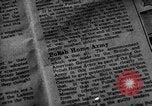
Warsaw bombed by Germans in retaliation to 1944 uprising, various scenes of Warsaw before WW2
Newspapers around the world reporting on the bombing of Warsaw by Nazi Germany as retaliation for the Warsaw Uprising during World War 2. Newspaper headlines read, "Poles Fighting Inside Warsaw," and "Warsaw Being Razed by Hitler's Order," and "Warsaw's Plight" and "Warsaw Poles Fight Tanks in Streets." Scenes of Warsaw in flames as buildings are being bombed by German forces. Montage depicting Warsaw on fire. Scenes of Warsaw before WWII, including scenes such as the Warsaw Old Town Market Square (rynek Starego Miasta, 00-279 Warszawa, Poland), the column of Sigismund III Vasa (plac Zamkowy, 00-001 Warszawa, Poland), the Royal Palace (plac Zamkowy 4, 00-277 Warszawa, Poland) and the Lazienki Park, before World War 2. Statue of King Jan III Sobieski in Lazienki Park. Men strolling near a palace. Baroque gates in park.
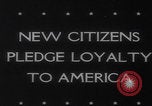
Newly naturalized Americans recite the Pledge of Allegiance during the 1944 “I Am An American Day” (WWII)
More than a million people attend the “I Am An American Day” citizenship ceremony in Central Park in New York City, during World War 2. Over 150,000 people attended the ceremony as newly naturalized American citizens. Native American Indians in traditional dress and women and men in military uniform attend the ceremony. Flags of various nations are flown. Wounded Army soldiers and wounded Navy sailors arrive as guests of honor. New York City Mayor Fiorello LaGuardia shakes hands with servicemen, giving tribute to their heroism during World War II. Immigrants stand up to recite the Pledge of Allegiance to the United States of America as part of the naturalization ceremony. Speaker recites the Pledge of Allegiance, which predates the inclusion of "under God" which was added later in the 1950s.

Activities of Free French Forces in France during World War II
French General Marie-Pierre Kœnig and his staff (plus a civilian official) review U.S. Army troops in Paris, before they depart, after the liberation of Paris,in 1944, during World War 2. General Koenig has been appointed by General Charles de Gaulle to consolidate French control and administration in Paris. In the opening scene, He and the group are seen walking past the U.S. troops as they stand at attention. Later Koenig and the others stand at attention as the American troops march past, on parade. Views of the U.S. troops marching out of Paris, past landmarks and along the Avenue des Champs-Élysées and through the Arc de Triomphe de l'Étoile (Arch of Triumph). Complete change of scene, shows an American armored personnel carrier moving through a French town and an M3 half track firing at a building. Then U.S. infantry spread out as they attack the area. Next American jeeps are seen traversing a steep bridge. Winding roads in rugged country are seen. A GI using binoculars. American artillerymen firing M116 75mm Pack Howitzers, including some under camouflage nets. Soldiers working to repair and strengthen a timber bridge. A truck carrying Free french soldiers who climb down and receive small arms from another French soldier in a jeep. Camera pans over the boots worn by the French soldiers. Closeups of two. Change of scene shows Free French troops in snow at an Alpine location, where they set up military equipment. French soldiers scanning mountain peaks. A soldier on skis. The soldiers responding to a whistle signal from an officer. They take up positions and fire weapons.
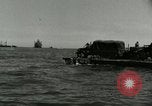
A Rhino barge and other vessels during invasion of France in World War II
A large military barge, marked "US RHF-25" (Rhino Ferry) passes camera viewing from a boat in the water (unseen). Large transport ships seen in background. The barge is filled with military equipment including trucks, construction equipment, and soldiers. As it proceeds, the camera reveals a large transport ship behind it. Closeup of soldiers standing among the cargo on the barge. Landing ship Tank, (LST 499) flanked by a tug boat. Barrage balloons aloft. Closeup of LST 499 port bow. A transport ship in the background. (Note: on June 8th, 1944, LST 499 struck a mine while backing away from Utah Beach, loaded with wounded and medical personnel. Fourteen Crew members were lost, and an unknown number of casualties among the wounded passengers and medical personnel.)
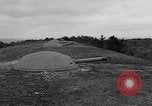
Americans capture Fort Obergentringen and turn its guns on Germans in Thionville, France, during World War II
American soldiers of the U.S. 90th Infantry Division, walking atop captured Fort Obergentringen, Near Thionville, on the west side of the Moselle River, in World War 2. Next, the Fort's German Krupp 105mm guns are seen firing numerous shells at German positions in Thionville, east of the river. American soldiers with binoculars observe the shell strikes from the fort. Smoke rising from the shelling. [Note: A September 17, 1944 wireless report about the fort's capture , to the New York Times, by Frederick Grahamby, stated that "The fort's name is Gingringen and from 1870 to 1919 it belonged to Germany." However, it is actually Fort Obergentringen (Fort Guentrange) on the hills of Guentrange, overlooking Thionville, and built in 1899.]
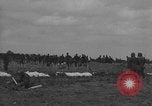
Graves being prepared for fallen U.S. troops at the temporary American St. Laurent Cemetery, in France, during World War II.
German prisoners of war at work digging graves for fallen American soldiers, at the temporary American St. Laurent Cemetery, established by the U.S. First Army on June 8, 1944, shortly after the D-Day invasion of Normandy (Operation Overlord). This is the first American cemetery on European soil in World War II, and located on a cliff overlooking Omaha Beach and the English Channel, east of St. Laurent-sur-Mer and northwest of Bayeux in Colleville-sur-Mer. (It is now the Normandy American Cemetery and Memorial.) Vertical posts with dog tags attached, mark the gravesites of the fallen troops. American soldiers sit near covered dead bodies of the fallen and perform tasks of identification and grave assignment. Covered remains of one soldier are carried across the field on a stretcher. Barrage balloons are seen in the sky overhead.
CRITICALPAST.COM: About Us | Contact Us | FAQs - How to Order | License Agreement | My Account | My Lightboxes | Shopping Cart | Advanced Search | Featured Collections | Website Terms & Conditions | Privacy Policy ©2026 CriticalPast LLC.
License Agreement |
Terms & Conditions |
Privacy Policy
©2026 CriticalPast LLC.