


 Francais
 Deutsch
 Italiano
Refine Your Search
Lisieux France 1944 stock footage and images
- Showing 205 to 210 of 9934 results more
more Hide
Hide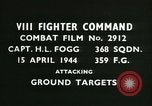
Gun camera views from P-47 flown by Captain HL Fogg of U.S. 8th AF, VIII Fighter Command, 359 FG, 368th Fighter Squadron
U.S. Army Air Forces Eighth Air Force, VIII Fighter Command operations in Germany during World War II. Gun camera views from 15 April 1944: Captain HL Fogg of the 359th Fighter Group 368th Squadron attacking ground targets, in one of their last combat missions in P-47s. (The unit converted to P-51s in April, 1944.) Captain Fogg strafes a train and an oil well. White smoke arises due to the firing and bombardment. An electric tower. The aircraft in flight over a field.
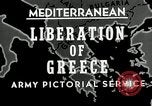
Celebration of liberation from German forces, and enthusiastic welcome of Prime Minister George Papandreou and British Armored unit in Athens Greece.
Liberation of Athens Greece during World War 2: Animated map of Athens, Greece. German forces end more than 3 years of occupation by withdrawing from the capital of Athens at end of October 1944, as British Allied forces near the city. Scenes of a ceremony by German troops before leaving, and then German army forces in trucks and armored vehicles leaving the city. Celebration: Greek boys ring bells and smile on departure of German forces. British troops dock in Greece and march into Athens. They are joined by partisan greek soldiers such as those from the ELAS and EAM. Close-up view of ELAS and EAM (National Liberation Front) Greek soldiers in uniform. Workers carry boxes of water. Narrator states that half of Greeks are for victims of malaria or tuberculosis. Boxes of water displayed. Shows the return of Prime Minister George Papandreou on October 18, 1944. Large crowd welcomes and cheers the Prime Minister George Papandreou and display banners for liberating their country. Prime Minister Papandreou puts the wreath on grave of unknown soldiers. British Lt. General Ronald Scobie salutes. General Scobie and Prime Minister Papandreou honor the two unknown soldiers. British Armored unit receive enthusiastic welcome. Sign of 'The Greek People Welcome EAM', and 'Welcome Great Allies KKE'. Greek people welcome the National Liberation Front (EAM) and Communist Party of Greece (KKE). Citizens buy food with inflated currency. Inflation causes citizens to hand over large amounts of currency for small purchases like bread and basic produce.
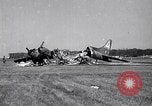
Wreckage of crashed B-17 aircraft at an Air Force base in England.
Remains of B-17, tail number 42-37789, which crashed during a post -maintenance test flight on April 24, 1944, at Grafton Underwood Airfield in Northampshire, England. The Aircraft belonged to the 544 Bomb Squadron of the 384th Bomb Group and was flown by Lieutenant Colonel Alfred Nuttall, who survived the crash and went on to lead a number of bombing missions thereafter. The aircraft was destroyed by fire that ensued after the crash. Firefighting foam residue can be seen covering the wreckage. This scene was filmed on April 29, 1944, five days after the crash. (World War II period).
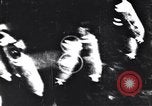
United States 8th Air Force Division bombs Merseburg and Offenburg in Germany during World War 2
United States 8th Air Force Division's B-17 bombers attacks oil refinery storage center in Merseburg in eastern Germany on November 2, 1944 during World War II. Ball turret gun camera footage as B-17 aircraft drop bombs on the target. German aircraft shoots down an U.S. Army Air Force B-17. American B-17 in flames and descending. In Offenburg American B-17 aircraft bomb a marshaling yard on November 22, 1944. Bombs impact and smoke rises.
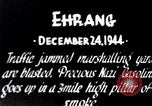
United States 8th Air Force using B-17 bombers attack Ehrang and Bingen in Germany during World War 2
United States B-17 aircraft drop bombs to destroy railroad marshalling yards in Ehrang,Germany on December 24, 1944. Bombs impact causing a pillar of smoke to rise up from oil storage center. B-17 bombers unload bombs over marshaling yards in Bingen on December 30, 1944. Large area is covered with flickering light of bomb strikes seen from gun camera.
Allied troops fighting toward and entering Rome, Italy during World War 2
British and troop patrols converge on the road to Rome, in the beginning of this film. Soldiers of the 1st Canadian Infantry Division and 5th Canadian Armored Division are seen next, mopping up after breaching the Hitler Line, on 24 May 1944. They are seen leaving the area to advance further. Brief view of soldiers tending to a tank and marching past an abandoned anti-aircraft gun. Captured German prisoners march rearward along a road as a camouflaged (with foliage) Canadian M4 Sherman tank advances along a road. It carries many infantrymen riding along atop it. (Narrator states they are en route to Pontecarvo.) Allied artillery pounds the ruined streets of the city. Canadian troops are seen next,entering the destroyed town of Aquino. British Hawker fighter planes flying over water in trail formation, behind the camera plane. Allied patrol from the Anzio front engages a German strong point, using bazookas and small arms. Glimpse of burning German armored vehicle. Polish troops are seen entering the village of Piedimonte. They pull a German from his hideout in a trench. German prisoners marching under guard. Stretcher bearers carry wounded to an open field where they are being tended. Polish forces hold a ceremonial parade where British General Sir Harold Alexander decorates a Polish soldier. Brief closeup of General Alexander. June 4, 1944, American troops enter Rome. German Sturmpanzer (panzer) IV "Grizzly Bear" tank abandoned on the street. U.S. troops walking about in the city and in area of Piazza Venezia. Altar of the Fatherland in background. Local inhabitants cheering the Americans. Italians mob the local fascist controlled radio studio and force occupants to leave the building, abusing some as they depart. Views of happy crowds. Some showing newspapers announcing the arrival of the Allies.
CRITICALPAST.COM: About Us | Contact Us | FAQs - How to Order | License Agreement | My Account | My Lightboxes | Shopping Cart | Advanced Search | Featured Collections | Website Terms & Conditions | Privacy Policy ©2026 CriticalPast LLC.
License Agreement |
Terms & Conditions |
Privacy Policy
©2026 CriticalPast LLC.