


 Francais
 Deutsch
 Italiano

Refine Your Search
Lisieux France 1944 stock footage and images
- Showing 229 to 234 of 9966 results more
 Hide
Color Sound

A V-1 rocket launch and Argus engine start (WW2)
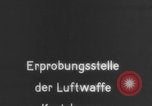
Title card says “Geheime Kommandosache” (“Secret commando operation” in English). “Erprobungsstelle der Luftwaffe Peenemünde- West” (“Test site of the Peenemünde-West air force” in English). “Flakzielgerät 76 Schnittautnahmen 11.1.1944” (“Anti-aircraft target device 76 cut recordings 01/11/1944” in English). A World War II V-1 glide bomb launch as viewed from immediately behind launch ramp. Views of Walter catapult ramp used to launch the buzz bomb. Close up of Argus pulse jet engine starting and running, with intake flap valve system closing between pulses. Close up of spring actuated launch controller.
V-1 glide bomb catapult and horizontal stabilizer details seen (WW2)
Title card says “Erprobungsstelle der Luftwaffe Karlshagen” (“Test site of the Air Force Karlshagen” in English). “Flakzielgerät 76 Schnittautnahmen 9.2.1944” (“Anti-aircraft target device 76 cut recordings 02/09/1944” in English). Close up rear view of Walter catapult showing piston insertion point at Air Force Karlshagen in Germany during World War II. Rear underside view of V-1 glide bomb horizontal stabilizer, showing elevator actuation.
Animation shows how steam launches V-1 glide bomb via catapult (WW2)
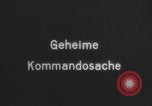
Title card says “Geheime Kommandosache” (“Secret commando operation” in English). “Erprobungsstelle der Luftwaffe Karlshagen” (“Test site of the Air Force Karlshagen” in English). “Flakzielgerät 76 Schnittautnahmen und Trick 6.+9.1.1944” (“Flak target device 76 cut recordings and trick 01/6-9/1944” in English). Close up of Argus engine on V-1 glide bomb as it starts, with variable intake compensating between jet pulses. Animation demonstrating how steam propels the V-1, with arrow pointing at the piston being pushed by steam within the Walter catapult. Various views of the Walter catapult ramp, including an unusual view from below the launch ramp as a V-1 buzz bomb is launched during World War II.
Allied bombing missions to destroy railroads and marshaling yards in occupied France and Germany during World War II
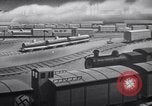
Cartoon representation of German rail yards and war factories, opens the film. Cities of : Anklam; Bremen; and Frankfurt are highlighted as critical factory and railroad junctions. Animated map shows Allied air strikes against French marshaling yards in Spring of 1944 in preparation for the invasion at Normandy. In February, 1945 Allied officers use large wall map to discuss and plan the destruction of all railroad operations in the Ruhr and surrounding areas. View of U.S. bombers in formation (with fighter cover overhead) on bombing missions in Operation Clarion, against all small and medium rail junctions in Germany. View from Allied bomber of Bombs falling and exploding at a rail junction. More aerial views of bombs exploding in numerous places during this operation. An American B-17 Flying Fortress bomber dropping bombs on a railroad marshaling yard. Aerial view of bombs exploding on targets in Essen. Views of wide destruction wrought at German railroad facilities. A US Army Air Forces P-51 fighter plane descending to strafe a target. Gun camera views of aircraft strafing lines of communication in Germany, including road and barge traffic. Closeup of runs firing from P-51 aircraft. Railroad trains being strafed and dramatic explosions at target rail sites.
Liberation of several French cities from German Nazi troops in World War II.
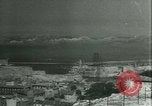
Marseilles: View of the French port. British, French and American Naval officers examine German demolition of the port town. Officers survey unfinished U-Boat pens. Toulon: Destroyed German ships in the harbor. Bologne: German coastal guns in ruins. Destroyed artillery. Le Havre: Destroyed buildings and ruins in the town. Unfinished German U-Boat pens. Destroyed artillery. Brest: Destroyed buildings and ruins. German soldiers wave a white flag of surrender on September 18, 1944. U.S, Army Major General. W.M. Robertson , 2nd Infantry Division discusses the surrender with German Colonel E. Pietzonka of the 7th German Parachute Regiment. German soldiers assemble in the main square of the city during the surrender operation.
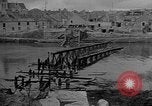
U.S. Army XX Corps units crossing pontoon bridge across Marne River, during World War II
View of bridge across the Marne River destroyed by retreating German soldiers. View shifts to U.S. Army XX Corps troops, trucks, jeeps, halftracks and tank destroyers crossing a pontoon bridge erected by Army Engineers nearby, at the bridgehead captured on 27 August 1944, during World War 2. French civilians watch from the bank of the river and wave as troops pass through their village. Using this crossing, the XX Corps continued its advance on Rheims.
CRITICALPAST.COM: About Us | Contact Us | FAQs - How to Order | License Agreement | My Account | My Lightboxes | Shopping Cart | Advanced Search | Featured Collections | Website Terms & Conditions | Privacy Policy ©2026 CriticalPast LLC.
License Agreement |
Terms & Conditions |
Privacy Policy
©2026 CriticalPast LLC.