


 Francais
 Deutsch
 Italiano
Refine Your Search
Lisieux France 1944 stock footage and images
- Showing 289 to 294 of 9934 results more
more Hide
Hide
U.S. Army Air Forces employ air power in the India-Burma theater during World War II. Chinese troops are equipped and trained by U.S. soldiers.
Camera pans across scenes showing masses of Chinese. Narrator cites their large population as a war asset. Lt Gen. Daniel Sultan Commander of US Forces, India–Burma Theater (USFIBT) describes the Allied mission as simply "placing guns in the hands of men in order that they can kill our common enemy." He describes Japan's 1942 strategy of completely isolating China from outside help. Animated map shows Japanese forces attacking China from bases in Thailand and advancing north, driving British forces into India, and leaving Burma in Japanese hands.Glimpse of Japanese troops occupying Burma. Views of American troops evacuated to India. View of Chinese soldiers boarding U.S. Air Transport Command C-46 transport planes for flights from Kunming to Dinjan and Chabua, India. Closeup of some troops inside the cabin of a plane. Chinese soldiers await transport as a C-47 aircraft takes off in the background. Aerial view of two C-47 planes in formation. View from the air of high cloud covered mountains. Storm clouds over the mountains. Downward view from an aircraft flying over the Himalayan Mountains (called flying the "hump" by U.S. pilots). View of Chinese soldiers inside a transport plane. View out the window of a transport plane landing in India. A C-46 airplane taking off. A large formation of Chinese troops seen after more were brought from China to India, later in the war. American soldiers training troops of the Chinese 38th and 22nd Divisions. General Sultan speaks of the need to build up the U.S.Air Transport Command. Two C-47 airplanes on the ground. One named "The Joker." View of sky filled with B-24 Liberator bombers. Sky filled with C-47 transport planes. Chinese soldiers training in Kunming, climbing out of trench in live fire exercise with machine guns firing over their heads and explosive charges detonating near them. Air frame of a P-47 aircraft being loaded and several of Bell P-39 Airacobra aircraft being loaded aboard ship bound to strengthen the U.S. Army 10th and 14th Air Forces in Burma, in 1944. Covered P-47 aircraft without engines being towed by jeeps along a street in Burma. A large airfield with many U.S. fighter planes parked on its ramps. Engines being installed on P-39 aircraft. A flight line filled with P-40 aircraft displaying Chinese roundels. Some fly over a flight line of U.S. Army Air Forces P-39 aircraft. Glimpse of a fighter plane escorting a transport aircraft. A formation of B-24 Liberator bombers dropping bombs and exploding on Japanese ground targets. Workers are seen unloading large amounts of cargo from a B-24 bomber. Workers rolling a large bomb from the plane onto the tailgate of a truck.
Allied troops capture Myitkyina, Burma, and Japanese 15th and 33rd Divisions counterattack British Forces at Imphal in India (WW2)
At opening, film shows U.S. Army Air Forces Bell P-39 Bell Air Cobra aircraft dropping bombs on on Japanese held northern airfield of Myitkyina, which was later captured by the 3rd Battalion Merrill's on July 26, 1944. Aerial view from U.S. aircraft bombing the Japanese occupied city of Myitkyina, on the west bank of the Ayeyarwady River, in Burma. Heavy smoke rising from bombs striking targets at the river's edge. (Narrator states, "the siege lasted 78 days.") Next, a regiment of Merrill's Marauders marches unopposed into the city. Animated map shows Japanese forces (15th and 33rd Division troops) attacking British-held town of Imphal, Burma. Ensuing scenes show well entrenched British forces in battle, with British soldiers firing heavy artillery, mortars, and Vickers machine guns. Glimpse of shells striking in hills. Momentary glimpse of Allied aircraft above the hills. (Narrator states the British "chewed up a couple of Jap divisions"," and the Allied rear lines of communication remained secure.) Animated map shows Chinese forces attacking Japanese forces west of the Salween River. View from a high position above the river bank. Rubber rafts line the shore and troops are assembling on the land. Next, troops are seen wading neck deep crossing the river with supplies floating along with them. Some paddle a jeep across the river on a makeshift raft. A truck at the edge of the river. Soldiers pulling together on a long rope line. Others crossing with hands on a line to support them as they wade in the water. Trucks bogging down in deep mud are helped by tow lines to others, ahead. Troops in a village where the road is inundated by rain waters flowing across it as a jeep goes past. Vehicles of all kinds sidelined by flooding waters. Jeeps speeding through water in some places and moving very slowly in the center of a muddy road where troops make their way on either side. Chinese soldiers scaling the stone wall of a fortress using ladders they made for the purpose. Troops firing a small artillery field piece and then charging towards battle-damaged buildings. Several are seen using flame throwers, that set building afire. More views of Chinese soldiers firing artillery and heavy machine guns. (World War II period)
People pray to Mother Mary and demonstrate with the statue and Mount Vesuvius erupts in Naples, Italy.
The eruption of Mount Vesuvius in 1944. Lava in the city. Smoke rises from lava. People pose. Crowd gathers near lava. Civilians kneel in prayer as church services are held before an outdoor shrine. The crowd praying around a Virgin Mary statue. Candles lit in front of statue and priest speaks. Lava flow interrupts services. A man pushes lava rock with a stick. The crowd breaks up and carries the shrine forward. Men carry statue and priest go with them. View of city with cloud of smoke in the background.
German pilot, Hans-Ulrich Rudel, in hospital recovering from wounds, receives Germany's highest award and is promoted, during World War II
Germany's most famous pilot of Stuka dive bombers (Junkers Ju 87) Hans-Ulrich Rudel, seen in hospital, after being wounded in the thigh, during World War 2. His doctor visits and asks how he is doing. He replies "ausgezeichnet" (excellent). His wife comes to the bedside and speaks with him briefly. Rudel's hospital chart is seen, with his rank shown as Oberst (Colonel).This is notable, when downed in November, he had been a Lieutenant Colonel with Schlachtgeschwader 2 "Immelmann" (Battle Squadron 2 "Immelmann.") Another German officer sits at his bedside and inquires about his experience. Colonel Rüdel explains how he was downed by flak while attacking Soviets tanks on the Eastern Front. He speaks about his comrade fliers. Next, the award of "Knight's Cross with Golden Oak Leaves, Swords and Diamonds"is shown. (This award was created by act of the Reichstag, solely for Rudel, on December 29, 1944. He was also promoted to Colonel, the same day.) The film concludes with additional comments by Colonel Rudel.
Saga of a U.S. Navy Task Group, the USS Guadalcanal and escorts, that captures the German U Boat (U-505) in World War 2
Historic U.S. Navy capture of German submarine (U-505) during World War 2. Crew assembles on flight deck of the USS Guadalcanal (CVE-60). Its Captain, Daniel V. Gallery, looks out from deck above. A Task Group of the Atlantic Fleet, consisting of the Guadalcanal, and five Destroyer escorts: the Pillsbury, Chatelain, Pope, Flaherty and Jenks, proceeds to operate against German submarines West of the Cape Verde Islands. Aboard the Guadalcanal, men train to capture a submarine, intact, if possible. The boarding team includes: Chief Photographer's Mate, Clifford Werler; Chief Pharmacist, Raymond Jackson; LTJG Mylo Keck; Ensign Fred Mittaugh; and Electrician First Class, William Stein; Ensign James Griffin; Machinist Mate 2nd Class, Walter Waller and Commander Earl Torcino. On June 4, 1944, the USS Chatelein makes sound contact with a submarine. The Task Group attacks it and forces it to surface under heavy gunfire. The German crew is rescued. Task Force boarding party successfully occupies and prevents the U-505 from sinking.
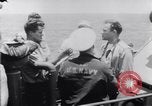
U.S. Navy Task Group led by USS Guadalcanal (CVE-60) tows captured German submarine (U-505) to Bermuda
A Task Group of the U.S. Atlantic Fleet captures and tows a German Submarine (U-505) to Bermuda. Views of captured German crew members being rescued. Destroyer USS Pillsbury passing a line to the U.S. boarding party aboard the U-505, which then collides with the Pillsbury, damaging her hull, and must be cut loose. Because a destroyer appears unable to tow the sea laden submarine, the USS Guadalcanal (CVE-60) does so herself. Views of captured German crew members exercising and bathing on deck of the Guadalcanal. View of the U-505 flying the American flag and entering harbor in Bermuda, on June 19, 1944..
CRITICALPAST.COM: About Us | Contact Us | FAQs - How to Order | License Agreement | My Account | My Lightboxes | Shopping Cart | Advanced Search | Featured Collections | Website Terms & Conditions | Privacy Policy ©2026 CriticalPast LLC.
License Agreement |
Terms & Conditions |
Privacy Policy
©2026 CriticalPast LLC.