


 Francais
 Deutsch
 Italiano
Refine Your Search
Lisieux France 1944 stock footage and images
- Showing 4255 to 4260 of 9964 results more
more Hide
Hide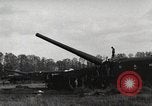
U.S.Navy gunners manipulate a 14-inch 50 caliber railway gun in World War I
Two U.S. Navy 14-inch fifty-caliber guns are seen installed on railway carriages in France, during World War 1. U.S. sailors manipulate the elevation controls on one in the foreground. On Navy gunner stands atop the rail car looking down at the elevated barrel, as others, on a platform, turn the elevation control crank. Scene shifts to inside the rail car where the breech of the gun is shown. Navy gunners open the breech, wipe it briefly, and then close it. One touches a lever and the breech closes, by itself, rapidly. View of breech open with shell loaded. Gun crew elevating the barrel as gunner standing atop the rail car checks its position. (World War I; World War 1; WWI; WW1)
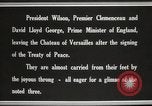
President Wilson, Premier Clemenceau and David Lloyd George leave the Palace of Versailles after signing the Peace Treaty.
American President Woodrow Wilson in France for signing of Treaty of Versailles following the Armistice in World War 1. President Wilson and Mrs Wilson arrive at the Palace of Versailles during the signing of Peace Treaty between Germany and Allies at the end of World War I. President Wilson, Premier Clemenceau and David Lloyd George, Prime Minister of England leave the Palace of Versailles after signing the Peace Treaty. Huge Crowd waiting outside the Palace cheers as dignitaries come out.
Armistice celebrations of the U.S. 5th, 89th and 92nd Infantry Divisions, at end of World War I.
Troops of the U.S. 92nd and 5th Infantry Divisions celebrate the Armistice in France at the end of World War 1. Several look at their wrist watches awaiting the stroke of 11AM when the Armistice is to go into effect. An army officer unfurls the United States flag as African American U.S. Army troops stand by. An African American soldier sits at a keyboard musical instrument. A close view of a field wrist watch shows time as quarter to eleven. The soldiers gather and read time on their wrist watches. At 11:00 O'Clock, the troops cheer and raise hands in celebration. Four army officers in a discussion. Troops of the 340th Field Artillery Regiment (89th Division) prepare to fire celebratory last round, from their French 75 field artillery piece.
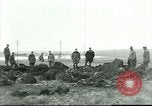
U.S. soldiers of the 18th Infantry examine huge bomb crater. U.S. occupied trenches and defenses.
Elements of the U.S. 18th Infantry in France during World War I. Soldiers gather around huge bomb or shell craters. A soldier inspects the crater. Barbed wire barriers. Troops in lattice-reinforced trenches and dugouts. A soldier stands in trench. An alarm bell seen next to him. (World War I. World War 1. WWI. WW1)
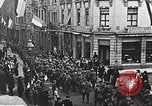
AEF cheered by French civilians as they are deployed during World War I.
U.S. Army soldiers of the American Expeditionary Forces, in France during World War 1. American Army troops in battle gear march along a street, watched by cheering French.civilians.. Soldiers move along the streets and pass through an archway. Soldiers waving as they move in convoy of army trucks. Columns of American soldiers march uphill and over a bridge bear two American soldiers washing at the river under the bridge. The troops at their camp. (World War I; World War 1; WWI; WW1)
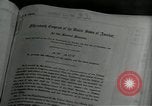
America embraces marksmanship training after Spanish-American War. American troops fire weapons in World War I
The uses and importance of weapons since ancient times in the United States. Pages showing U.S Congress Act creating the National Bureau for the Promotion of Rifle Practice, 1903. Exteriors of the 71st Regiment National Guard Armory building in New York City at Park Avenue and 33rd Street. People enter the building. German troops on parade circa 1914. American troops mobilized for World War 1, and traveling on troop trains in 1918. Troops moving along a muddy road, with military supplies in wagons being pulled by horses. American soldiers firing their 1903 Springfield rifles, from a bunker in France. Americans firing a M1914 Hotchkiss air-cooled machine gun and another U.S. gun crew firing a Browning M1917 water-cooled machine gun. U.S. troops wearing gas masks, firing a trench mortar. American gun crew firing a 155mm howitzer (as some hold their ears).French troops walk past destroyed buildings above which a blimp is seen flying with French observers in a gondola suspended underneath.
CRITICALPAST.COM: About Us | Contact Us | FAQs - How to Order | License Agreement | My Account | My Lightboxes | Shopping Cart | Advanced Search | Featured Collections | Website Terms & Conditions | Privacy Policy ©2026 CriticalPast LLC.
License Agreement |
Terms & Conditions |
Privacy Policy
©2026 CriticalPast LLC.