


 Francais
 Deutsch
 Italiano

Refine Your Search
Lisieux France 1944 stock footage and images
- Showing 43 to 48 of 9966 results more
 Hide
Color Sound
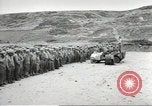
U.S. 1st Army conducts memorial ceremony, at site of first U.S. cemetery, Omaha Beach, Normandy, France, in World War II
Memorial Ceremony (including Roman Catholic Mass) for fallen U.S. troops, held on June 10, 1944 during World War 2. The location is Omaha Beach, St. Laurent sur Mer, Normandy France, where the U.S. 1st Army established the first American military cemetery in France, during World War II. U.S. troops line the area. An altar is set up on the hood of a jeep parked in the sand. An Army Colonel standing in rear of the jeep reads from a notebook. Soldiers all stand with heads bowed. Among them are African American soldiers of the 320th Battalion. A Chaplain's assistant sits at a keyboard instrument next to the jeep. A Roman Catholic Army Chaplain in white clerical robes conducts a mass. Numerous grave markers can be seen in the distant background marking graves of soldiers who died in the invasion of Normandy. Several French civilians stand with the soldiers, who bow heads in prayer. The Chaplain administers holy communion to kneeling soldiers. A French civilian woman places flowers near recent temporary grave markers of U.S. fallen (stakes bearing their dog tags). A color guard stands with American flag, as squad of riflemen fire gun salutes. Three French civilians stand by the flowers. U.S. Army bugler blows taps. All present salute the fallen. Some individual soldiers walk to the markers of their friends.
German spy Josef Wende is executed by U.S. Military Police firing squad in Toul, France, during World War II.
Execution of a spy in Toul, France, during World War 2. A slate reads Graham (presumbly cameraman) Execution. Military Policemen (MPs) lead a single spy, Josef Wende, to the execution location in the farmyard of a farmhouse in Toul, France. A Catholic Priest in black accompanies the MPs. At the execution point, a Lieutenant Colonel and two other officers stand with the Priest as he speaks with the prisoner. The Priest offers prayers for the German spy, who was a Pole drafted in the German Army and caught behind American lines posing as a Polish slave laborer. The face of Wende is covered using a cloth. The MPs tie the legs of the spy. The firing squad fires at Wende from a distance. The body of Wende leans forward and falls to the ground after it is hit. Afterwards The Lieutenant Colonel returns with a medical corpsman who checks bullet wounds on prisoner's chest and checks for a pulse. MPs pick up the dead body of the spy, cover it with a white sheet and carry it on a stretcher. The Priest prays as MPs pass carrying the body. (Note: Reportedly, Lt. Col. Elbert L. Nelson, Headquarters Third Army, was assigned to head a contingent of several soldiers to witness this and another execution at Toul, on November 11, 1944. He is likely the Lieutenant Colonel seen in this sequence.)
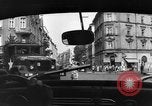
U.S. Military police (MP) direct trucks, tanks, amphibious vehicles at beachhead in Normandy, France, in World War II.
Activities of the U.S. Army Military Police. (Introductory scenes, from 1950 : A U.S. Army truck collides with a VW Beetle automobile in Europe. Local onlookers speak with the man and woman from the car. Local police arrive on scene. U.S. Army Military Police arrive and help resolve the matter with local police. ) U.S. Army Military Police insignia of two crossed flintlock pistols. A Military Policeman at attention. Military Police (MP) directing trucks and amphibious vehicles at a beachhead in Normandy, France, in 1944. U.S. Landing Craft at the beachhead. MPs directing military traffic in Town of Canisy, France.

Aerial view of Avranche, France and surrounding countryside in Normandy (WW2)
Aerial view of Avranches, France on August 6, 1944 (World War 2). Aerial view of the city center of Avranches. The Basilica of Saint-Gervais of Avranche is seen (Basilique Saint-Gervais d’Avranche Place Saint-Gervais, 50300 Avranches, France). Surrounding countryside shows craters formed from aerial bombing.

Rouen Cathedral Bombing in Rouen, France (WW2)
Rouen Cathedral (Cathédrale Notre-Dame de Rouen Pl. de la Cathédrale, 76000 Rouen, France) in Rouen France bombed heavily by British bombers taking several direct hits that narrowly missed destroying key pillars. German troops putting off fires from the smoky ruins using water hoses. The 151m tall central spire is easily visible. Shows three men passing by the smoking debris. April 1944. (World War II period).
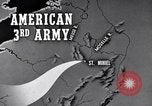
U.S. 3rd Army crosses Meuse River, advances through St.Mihiel, and crosses Moselle River in France, in World War II
Animated map showing American 3rd Army advance toward St. Mihiel, France, during World War 2. Advance elements of General Patton's U.S. 3rd Army cross Meuse River in a French civilian's barge and proceed through town of St. Mihiel. A U.S. Army combat photographer is seen taking pictures at bank of river. U.S. Infantrymen make their way through virtually deserted town of St Mihiel. U.S. field artillery fire on German positions along the Meuse. U.S. infantrymen lying prone beside a large barn.US soldier photographing others as they rest on a sidewalk.Two U.S. soldiers running up and over a wooden bridge.American forces driven back by heavy German resistance and then resume advance after U.S. artillery fire neutralizes defending German forces. However, still under heavy fire, American infantrymen carry small boats to cross the Moselle River. U.S. troops paddle across the river in a boat at Dornot, France, September 1944. Railroad pedestrian crossover bridge visible. (Note: Unit making the river crossing was 5th Division, 11th Infantry Regiment, 2nd Battalion, E and F company.Lieutenant Colonel Kelly B, Lemmon Jr. was battalion commander.)
CRITICALPAST.COM: About Us | Contact Us | FAQs - How to Order | License Agreement | My Account | My Lightboxes | Shopping Cart | Advanced Search | Featured Collections | Website Terms & Conditions | Privacy Policy ©2026 CriticalPast LLC.
License Agreement |
Terms & Conditions |
Privacy Policy
©2026 CriticalPast LLC.