


 Francais
 Deutsch
 Italiano
Refine Your Search
Lisieux France 1944 stock footage and images
- Showing 487 to 492 of 9934 results more
more Hide
Hide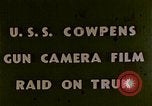
United States aircraft from USS Cowpens attack the Japanese Sendai class light cruiser Naka during World War II
17 February 1944, during World War 2, off the coast of Truk Island in the Pacific Ocean. U.S. aircraft from the USS Cowpens (CVL-25) attack the Japanese Sendai class light cruiser Naka. Scenes of the bombing attack on the Japanese cruiser. Explosions on and around the Naka, which turns to starboard in an evasive maneuver.
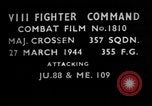
U.S. gun camera footage of American fighter firing at German bomber and fighter during World War II.
U.S. Army Air Forces VIII Fighter Command Operation in the European Theater during World War 2. Gun camera footage from P-47 (or possibly a P-51) flown by Maj. Crossen from 357th Fighter Squadron, 355th Fighter Group. He attacks German Junkers JU 88 bomber and a Focke Wulf Fw 190 fighter aircraft. (Note: The 355th Fighter Group transitioned into P-51s from P-47s during Spring of 1944)
The funeral of German General Günther Korten, Chief of the General Staff of the Luftwaffe
A contingent of German soldiers stand at attention in the Tannenberg Memorial, as an honor guard, during the funeral of General Günther Korten, Chief of the General Staff of the Luftwaffe, who died from injuries suffered in the assassination attempt on Adolf Hitler, July 1944. Six soldiers stand near his flag-draped coffin. Two hold black displays on which the General's medals are pinned. Closeup of one soldier. Closeup of General Korten's medals. View from above and behind the coffin, as Marshal Hermann Goering stands, in front of it, and salutes with his baton. Goering expressing his condolences to the widow and relatives of General Korten. Goering at a podium delivering a eulogy. Field Marshal Wilhelm Keitel, Grand Admiral Karl Dönitz, and other senior military officers are seen at the funeral. Views of the courtyard of the Tannenberg memorial with members of the family and assembled participants listening to Goering. Eulogy finished, Goering now stands, saluting with his baton, and lays a large wreath by the casket. Helmet and dagger are seen atop the casket. The attending officers all salute, as pallbearers carry the coffin at shoulder height, and proceed to carry it into a tomb. View from inside the tomb as the casket is carried in. (World War II period).
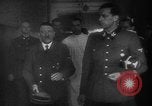
Hitler visits German officers, hospitalized for injuries from bomb plot against him. He also meets Nazi officials, in World War II
Adolf Hitler visits German military officers, at a military hispital in Rastenburg, during World War 2. They were injured in the July 20th assassination attempt against Hitler. He visitis and speaks with: Major General Walter Scherff; Navy Captain Heinz Assmann; Rear Admiral Karl-Jesco von Puttkamer; and General Walther Buhle. As he leaves the building, women nurses outside, give Nazi salutes, and cheer him. Change of scene shows Hitler, at the Wolf's Lair compound, near Rastenburg, East Prussia (now Poland). Among those he greets are: Walther Funk, Reich Minister for Economic Affairs; Reich Minister Albert Speer; and Reich Minister Hans Heinrich Lammers, President of the Reich Cabinet. Next scene shows Heinrich Himmler, chief of the Nazi Gestapo, speaking with General (Generaloberst) Ferdinand Schörner. Hitler strolls with Hermann Goering, and is then seen, from behind, as he greets Reich Minister of Propaganda, Joseph Goebbels and General (Generaloberst) Heinz Wilhelm Guderian, Chief of Staff of the Army. The Nazi top leaders stand and converse. Goebbels speaks with Martin Bormann and General Alfred Jodl,who was also injured during the July 20, 1944 bomb plot against Hitler. (Jodl's head is bandaged.)
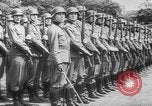
Army Major Otto Remer, Commander of the Berlin Guard Regiment, who thwarted attempt to overthrow Hitler in World War II
Major Otto Remer,Commander of the Berlin Guard Regiment, who prevented plotters from succeeding in bid to overthrow Hitler in World War 2. (Following the 20th July, 1944 bomb Plot, Hitler personally telephoned and ordered him to take charge of all troops in Berlin and apprehend conspirators.) Major Remer inspects his regiment, drawn up in formation, and then addresses them, emphasizing the Unity of the Nazi party and the German Army. His Regiment then parades past, as he reviews them.
Red Devil paratroopers of British 1st Airborne Division, drop into Holland to outflank the German Siegfried Line in World War II
At start, the film shows a formation of American C-47 transport aircraft with paratroopers starting to jump from them during World War 2. Viewed moments later from the ground, the sky is filled with trooper' open chutes, descending. An animated map shows Netherlands, Belgium, Luxembourg, and Germany. It shows location of the Allied paratroopers drop in Holland, intended to spearhead a drive around the Main River into Germany. The map then shows German forces encircling the paratroopers and the Second British Army heading North to the rescue. Next, a huge number of American Soldiers are seen assembled out of doors in England. Closeup of General Dwight D. Eisenhower speaking in a microphone to the assembly. Closeups of soldiers including some who are American Army Air Corps pilots, and other aircrew members, mostly Lieutenants. Senior Paratrooper officers stand at attention in front of formation of troopers with American flag beside them.(Narrator says these were the men who made up the "lost division," heroes who fought alone for seven terrible days.) General Eisenhower makes his way between close ranks of the paratroopers. He is followed by Brigadier General and a Colonel. Lieutenant General Lewis H Bereton also makes his way through the ranks. Scene shifts to a base in England where many British Airspeed AS.51 Horsa gliders are seen with paratroopers heading across the airfield to board. American C-47 aircraft are seen in the background. All aircraft are painted with D-Day stripes. Several British and American paratroop officers review a map together. At a tent camp, A military policeman and two U.S. paratroopers checking their weapons and ammunition. Some troopers sharpen their knives. A trooper is issued Dutch and German money. A British and and American trooper in camouflaged helmets, pose before a glider with a huge British roundel on its side. British paratroopers boarding a Horsa glider, named "Gertie." A Horsa glider moving as it is towed by a British Whitley twin-engine bomber. View from side of runway as the bomber takes off with its towed glider behind. (Narrator comments: "Destination, Holland.") Formations of tow planes and gliders in flight. View of pilot in cockpit of a Whitley bomber. Formations of fighter aircraft in flight overhead. View from inside an aircraft as paratroopers exit through a side door. Sky filled with paratroopers in chutes descending. (Note: This Allied thrust into Holland to launch a drive around the German Siegfried Line was known as the Allied joint American-British "Operation Market Garden," which took place 17 to 25 September 1944, the 7 days referred to by the film Narrator. )
CRITICALPAST.COM: About Us | Contact Us | FAQs - How to Order | License Agreement | My Account | My Lightboxes | Shopping Cart | Advanced Search | Featured Collections | Website Terms & Conditions | Privacy Policy ©2026 CriticalPast LLC.
License Agreement |
Terms & Conditions |
Privacy Policy
©2026 CriticalPast LLC.