


 Francais
 Deutsch
 Italiano
Refine Your Search
Lisieux France 1944 stock footage and images
- Showing 5629 to 5634 of 9964 results more
more Hide
Hide
A U.S. convoy heads towards a beach for the D-Day landings on Colleville-sur-Mer, Normandy during World War II.
A U.S. convoy heads towards a beach for the D-Day landings on Colleville-sur-Mer, Normandy during World War II. LCTs (Landing Craft,Tanks), LSTs (Landing Ship, Tanks) and landing crafts loaded with soldiers of U.S. 16th Infantry Combat Team and 5th Engineer Specialist Brigade underway to Omaha Beach.
U.S. soldiers dig in on a beach during the D-Day landings on Colleville-sur-Mer, Normandy in World War II.
D-Day landings on Colleville-sur-Mer, Normandy during World War II. U.S. soldiers of 16th Infantry Combat Team and 5th Engineer Specialist Brigade dig in on Omaha Beach. LSTs (Landing Ship, Tanks) and LCTs (Landing Craft, Tanks) in a channel. A damaged LST in a harbor. A dead U.S. soldier on a beach in the foreground. Smoke rises from the beach. Beach obstacles at Omaha Beach.

United States soldiers bombard La Haye du Puits to capture the town from German forces (WW2)
The capture of La Haye du Puits by United States First Army troops under General Omar Bradley in Normandy (World War 2). An M4 81 mm Mortar Carrier Halftrack vehicle and jeep of the United States First Army driving to La Haye du Puits in Normandy. United States infantry troops travel on foot to capture La Haye du Puits. United States First Army soldiers traversing a meadow, crossing a puddle. United States First Army troops fire artillery under camouflage nets. Soldiers load shells into artillery and fire. United States soldiers fire mortar in a forest outside La Haye du Puits. A soldier fires his rifle through a hedgerow. Soldiers duck while firing mortars. Distant Haye du Puits covered in smoke. A soldier fires a rifle grenade launcher (probably an M7) into the air.
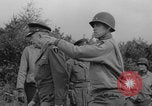
United States Generals Eisenhower and Bradley inspect artillery in Normandy (WW2)
World War 2 United States Generals Dwight Eisenhower and Omar Bradley inspect artillery outside La Haye Du Puits. United States soldiers load shells into a Long Tom 155 mm gun M1 artillery under a camouflage net. General Omar Bradley pulls the lanyard of the Long Tom artillery. General Dwight Eisenhower speaking and shaking hands with a soldier. General Omar Bradley laughs with General Dwight Eisenhower and the soldier. Generals Dwight Eisenhower and Omar Bradley leave on a military jeep.
Villagers welcome Free French 2nd Armored division troops to La Haye du Puits (WW2)
French civilians welcome the arrival of the first Free French troops during the liberation of La Haye du Puits in World War 2. M3 half-tracks of the Free French 2nd Armored division pass by the streets of La haye du Puits. People waving at the soldiers on M3 half-tracks as they pass by the 39 I. Lebarbanchon boulangerie and graineterie (“bakery and grainery” in English). French men and women waving at soldiers in front of the Le Coley bourrellerie (“saddlery” in English) and the Lebarbanchon Boulangerie. Two French women and a man waving happily. Shopfronts are damaged from bombardment. Free French 2nd Armored division truck passes by waving French women and their children in front of the “T LA GNEL”.
Free French 2nd Armored division pass damaged storefronts and waving locals in La Haye Du Puits (WW2)
French civilians welcome the arrival of the first Free French troops during the liberation of La Haye du Puits in World War 2. French boys in bicycles ride past a boarded-up storefront named “M. Gigory Tapisserie Literie …” (“M. Gigorie Tapestry Beddings … “ in English ). The French flag is waving above the storefront. M4 Sherman of the Free French 2nd Armored division pass by the Tapisserie shop, Le Coley bourrellerie (“saddlery” in English) and the Lebarbanchon Boulangerie. Shop windows and buildings show damage from bombings. French men, women and children wave at incoming Free French soldiers. French children waving happily at the soldiers.
CRITICALPAST.COM: About Us | Contact Us | FAQs - How to Order | License Agreement | My Account | My Lightboxes | Shopping Cart | Advanced Search | Featured Collections | Website Terms & Conditions | Privacy Policy ©2026 CriticalPast LLC.
License Agreement |
Terms & Conditions |
Privacy Policy
©2026 CriticalPast LLC.