


 Francais
 Deutsch
 Italiano
Refine Your Search
Long Beach California USA 1960 stock footage and images
- Showing 6463 to 6468 of 27665 results more
more Hide
Hide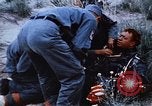
Medics help Captain Joseph out of parachute harness and captain Kittinger boards H-21 helicopter in the United States.
Captain Joseph Kittinger during Operation Excelsior III in the United States. Men running from Piasecki H-21 American helicopter to Captain Kittinger on ground. Medics help Captain Kittinger to come out of the parachute harness. Captain Kittinger smokes. Captain Kittinger boards H-21. H-21 lifting off and in flight.
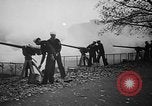
Mohammad Reza Shah Pahlavi and U.S. officers review troops and troops march during his visit to the United States.
Mohammad Reza Shah Pahlavi, Shah of Iran visits the United States. Motorcade of Shah of Iran driving over the Bear Mountain Bridge, in New York and arrives at the U.S. Military Academy in West Point. Artillery fire in salute. U.S. troops standing in attention with flags of U.S. and Iran. Mohammad Reza Shah Pahlavi and U.S. officer salute. Shah Pahlavi gets out of car and is greeted by U.S. General. Shah Pahlavi and escorting General officer enter into building. Shah Pahlavi and the General review parade of the cadets at West Point. Shah Pahlavi shakes hands with West Point cadets, and then enters car and his motorcade drives away.
Mohammad Reza Shah Pahlavi visits the U.S. Naval Academy at Annapolis, Maryland.Welcomed by Admiral James L. Holloway, Jr.
Mohammad Reza Shah Pahlavi, Shah of Iran visits United States Naval Academy, at Annapolis,Maryland. Artillery guns are fired in salute when he arrives. Shah Pahlavi steps from his car and is greeted by the Superintendent of the Naval Academy, Admiral James L. Holloway, Jr. George E. Allen, a friend and assistant to Predident Truman, also arrives to greet the Shah. The Shah, accompanied by officers and officials proceeds to the parade ground, where Academy midshipmen are standing in formation. They parade and pass in review before the Shah. Color guards passing with flags. Shah Pahlavi and Admiral Holloway salute as midshipmen parade past.
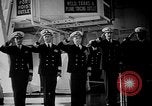
Mohammad Reza Shah Pahlavi reviews troops and aircraft as they take off aboard aircraft carrier during his visit to the U.S.
Mohammad Reza Shah Pahlavi, Shah of Iran, visits the United States. Shah Pahlavi salutes as he is greeted by U.S. Navy officers aboard the aircraft carrier, USS Valley Forge ( CV-45). Shah Pahlavi and Marine Captain review contingent of U.S. Marines, on board. Elevator brings them up to the flight deck of the aircraft carrier. Harry B. Temple, Captain of the USS Valley Forge, escorts the Shah. They talk to a pilot, standing by his aircraft for inspection. A helicopter takes off and lands again. The Shah speaks with a pilot about his flight gear. Douglas AD Skyraider Aircraft takes off and in flight. Aircraft wings fold as it taxis after landing on the carrier. The Shah and Captain Temple look at photo albums of the USS Valley Forge.
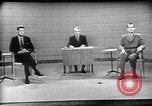
Senator John F. Kennedy and Vice President Richard Nixon face off in their first Presidential debate, in Chicago Illinois.
The first Kennedy-Nixon Presidential Debate in Chicago, Illinois. Moderator Howard K. Smith introduces the candidates-- Republican candidate U.S. Vice President Richard M. Nixon and Democratic candidate Senator John F. Kennedy. He talks about the opening and the closing statements to be given by the candidates. He talks about the questions which the panel of correspondents would ask the candidates. Senator Kennedy begins his statement. Kennedy talks about the direction of freedom for the Americans. He discusses domestic issues and the kind of society people live in. He talks about the strengths and the progress rate of the Americans. He urges people to make their country more powerful in every field. He feels disappointed about the unused steel-mill capacity, low rate of economic growth and poor educational system. He says he's not satisfied when he sees men like Jimmy Hoffa in charge of the largest union in the United States, and still free. He insists on overall infrastructural development and improvement of hydro power production where he says the Soviet Union has a lead. He states that every American should enjoy his full constitutional rights and they should meet their responsibilities. He says African American and Puerto Rican babies have much lower chances in education, work ,and advancement in the United States, and that this needs to change. He states that the government should provide effective programs and social security system for its citizens.
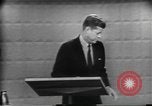
Nixon talks about the increase in GNP and average family income during the presidential election debate in Chicago, Illinois.
The first Kennedy-Nixon Presidential Debate in Chicago, Illinois. Moderator Howard K. Smith invites Republican candidate U.S. Vice President Richard M. Nixon to give his opening statement. Nixon begins his statement. He talks about the huge competition faced by the United States. He states that he disagrees with Kennedy's statement on the poor growth in national product. Instead he states that there has been a 6% growth of Gross National Product (GNP) in the past years. He compares the overall development of the country during the Truman Administration and the Eisenhower Administration. He states that there has been a continuous progress in the field of education, hydroelectric power, hospitals and highways. He discusses the improvement in Gross National Product and the average family income. He discuss effective plans and programs in the every field. He compares the effective styles of spending of the Federal government and the Democratic government. In his final point he states that his disagreement with Kennedy is not about the goals for America but only about the means to reach those goals.
CRITICALPAST.COM: About Us | Contact Us | FAQs - How to Order | License Agreement | My Account | My Lightboxes | Shopping Cart | Advanced Search | Featured Collections | Website Terms & Conditions | Privacy Policy ©2026 CriticalPast LLC.
License Agreement |
Terms & Conditions |
Privacy Policy
©2026 CriticalPast LLC.