


 Francais
 Deutsch
 Italiano
Refine Your Search
Long Beach California USA 1960 stock footage and images
- Showing 9373 to 9378 of 27665 results more
more Hide
Hide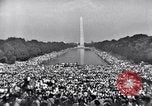
Dr. Benjamin E. Mays delivering benediction prayer at conclusion of "March on Washington for Jobs and Freedom"
Dr. Benjamin E. Mays, President of Morehouse College, leads crowd in benediction prayer at closing of the official program of the March on Washington for Jobs and Freedom in Washington DC, during the Civil Rights movement. Dr. Mays speaking at the Lincoln Memorial (2 Lincoln Memorial Cir NW, Washington, DC 20002, United States). Large crowd of white and African American participants seen near White House.
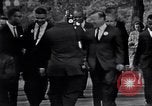
Rev. Martin Luther King Jr, Labor leaders A. Philip Randolph, and Walter Reuther, speak to reporters during "March on Washington"
Rev. Dr. Martin Luther King Jr. walking with organized Labor leader Walter Reuther, and African American leaders including John Lewis, arriving outside the White House in Washington DC. Press and photographers surround them. A. Philip Randolph speaks to the reporters. Mr. Roy Wilkins and Martin Luther King Jr., Walter Reuther, and John Lewis standing nearby. Representative of the Roman Catholic group commission speaks. Labor leader Walter Reuther speaks. Dr. Martin Luther King Jr makes a statement. Black American singers lead the crowd in singing "We shall overcome" in Civil Rights rally at the Lincoln Memorial in Washington DC. Thousands link arms and sing and sway together to the melody (during the March On Washington for Jobs and Freedom).

Four British working men and four American counterparts visit officials concerned with war production, in New York City and Washington DC (WW2)
A British film entitled, "People to People." Four British working men, visiting America, are seen in overcoats on the deck of a ship passing the Statue of Liberty in New York Harbor during World War II. They are accompanied by four American workers who were returning on the same ship, from a similar visit to England. Closeup of the eight men, named by the narrator, who calls them trade unionists on an exchange visit. Brief view of Chiang Kai-Shek, Franklin D. Roosevelt, and Winston Churchill at the Cairo Conference in 1943.Camera pans closeup over Roosevelt and Chiang Kai-Shek. Brief views of Roosevelt, Churchill, and Joseph Stalin at the Tehran Conference in 1943. Closeup of Roosevelt and Churchill, with Anthony Eden standing immediately behind them. Closeup of Stalin and Roosevelt, with U.S. Army Air Force Chief, General Henry H.(Hap) Arnold and British General Alan Brooke, Chief of the Imperial General Staff, conversing behind them. Scene shifts back to the men aboard the ship in New York harbor, with the New York City Manhattan skyline of buildings in the background. Next, the eight men are seen climbing steps to New York City Hall. Inside they are welcomed by New York City Mayor Fiorello LaGuardia. The group is then seen entering a building in Washington, DC, where they sit down at a table with Donald Nelson, Head of the U.S. War Production Board. In the Department of Labor building they meet William Hammatt Davis, Head of the War Labor Board, and also the Secretary of Labor, Frances Perkins. After that they are seen heading into the White House, where they are met by Mrs. Eleanor Roosevelt, who comes out of the White House to greet them on the porch. (Narrator says she later invited them inside for tea.) The men are next seen climbing the Capitol steps. Vice President Henry A. Wallace comes out to greet them and comments about industrial production not only during the war, but in the time of peace to follow.
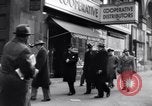
British and American working men on exchange visit meet with labor representatives in the United States (WW2)
Four British working men and their four American counterparts on an exchange visit to the United States enter a building in World War II. They are seen inside, seated at a table opposite representatives of American labor organizations including the American federation of Labor (AFL), the Congress of industrial Organizations (CIO) and the Railroad Brotherhood. During the meeting, one of the American workers states that they had just returned from England. One of the American labor representatives asks the English workers what they think about these exchange visits. They respond in support of them, and note they had an similar exchange with Russians as well. They also discuss international labor unity and its importance in winning the war. The British contingent note that they need more time to meet rank and file American workers to make any assessments. The subject of women filling jobs in war industry was viewed as affecting the lives of all women during the war and afterwards.
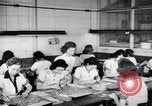
Blind, deaf, disabled and old American workers assisting in the war production effort in Dayton, Ohio, during World War II
Disabled and elderly war production workers contributing to the labor force during World War 2, in Dayton Ohio. Opening scene shows a woman supervisor observing deaf mute women in a lens factory, cleaning segments of bifocal lenses. Closeup of supervisor and one worker communicating by American sign language. A blind man in a shop, using a snap gauge to check finished parts for conformity. A man on crutches taking his place on a war production line. Older men in the shipping department of a factory, packaging and sealing boxes labeled, "Delicate instruments. Handle with care." and placing them on a dolly. Women can be seen at work in another part of the plant. Members of the Dayton Junior Association of Commerce, lined up applying for part-time employment of 4 hours a day, to help the war effort. Students leaving a High School building. (Narrator states schedules were re-arranged for students who would take part-time jobs.)
People from all walks of life switch to war work in Dayton,Ohio during World War 2.
Residents of Dayton Ohio, transfer from ordinary pursuits to perform war-critical work in World War 2. Men and women are seen lined up inside offices of the United States Employment Service (USES) in Dayton, Oho. All prospective male workers are cleared through the USES. Certain occupations are reserved for women only. Women doing needlework in their homes, switch to war work instead. One is seen filing a part in a factory. A soda jerk takes on work in a machine shop. A bootblack shining shoes, ostensibly moves into war work. Back, inside the U.S. Employment Service offices, representatives of defense plants set up tables and hire prospective workers on the spot. Workers leaving a Dayton war plant during a shift change. Cars and pedestrians during regular shopping hours in a local town. View of a downtown commercial district. The Manpower Emergency Committee in a meeting. New Store hours are posted for various businesses. A newspaper announcement of special store night hours for war workers. A company poster listing "Victory Store Hours." Dayton stores and shoppers conducting business after dark on nights when shops were open for war workers. Views of shoppers patronizing various retail stores, including a McCrory 5 and 10 cent store, a market store, and a department store. Late shift workers in line at banks to see bank teller and cash pay checks. A soldier in uniform sitting with a woman shopping for new shoes. Workers in a ladies beauty salon or hair salon, and in a men's barber shop, working during night time hours to serve war production workers. Night time recreation programs for workers show workers with musical instruments standing in line, theatre marquees advertising late night shows and movies, with signs advertising Red Skelton and Eleanor Powell among featured stars. Women bowling at a bowling alley, overhead view of couples dancing the lindy hop while a crowd watches, other scenes of couples dancing on dance floors.
CRITICALPAST.COM: About Us | Contact Us | FAQs - How to Order | License Agreement | My Account | My Lightboxes | Shopping Cart | Advanced Search | Featured Collections | Website Terms & Conditions | Privacy Policy ©2026 CriticalPast LLC.
License Agreement |
Terms & Conditions |
Privacy Policy
©2026 CriticalPast LLC.