


 Francais
 Deutsch
 Italiano
Refine Your Search
Long Beach California USA 1960 stock footage and images
- Showing 11917 to 11922 of 27665 results more
more Hide
Hide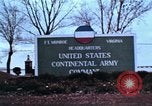
Activities of United States Continental Army Command; U.S. Strike Command; and North American Air Defense Command
Opening scene shows sign at Fort Monroe, Virginia, Headquarters of the United States Continental Army Command. U.S. Army soldiers come pouring out of their barracks and assemble in formation as non-commissioned officers inspect their personal gear. Inspectors look over closely parked armored vehicles.Troops rush to board CH-47 Helicopter transports. Sign identifying Headquarters United states Strike Command. Views of Exercise Delawar, a United States-Iran joint armed forces combat readiness operation conducted in April 1964 in Iran. (Delawar is a Persian word meaning courageous.) Paratroopers lined up and inspecting their gear as they ready to board through rear door of a transport aircraft.View of Pilot and Copilot in cockpit. Paratroopers jumping from the aircraft. Formation of U.S. Air Force C-130 aircraft dropping paratroopers, with chutes clearly visible as they descend. View of troopers exiting rear cargo door of C-130 aircraft. Ground view of paratroopers landing on Iranian desert. Some set up field artillery pieces, others deploy on foot, and some ride in trucks pulling artillery pieces. Change of scene to North American Air Defense Command (NORAD) Combat Operations Center. Inside, General John Koehler Gerhart, Commander of NORAD, sits at a deck in a control room with several other officers. Next, officers and non-commissioned officers, e.g. a Master Sergeant, who regularly work in the center are seen at their stations. Army Air Defense personnel run from their ready room to man batteries of Nike-Hercules missiles. An air defense radar site, part of the early warning system. Missiles of the Nike-Hercules battery being raised to firing positions.
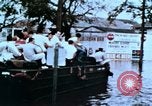
United States Army assists local population following Louisiana Hurricane in 1965
Civilians crowded atop a U.S. Army DUKW (amphibious truck) during Army efforts to help them following the Louisiana Hurricane in 1965. Front view of DUKW moving amidst smaller civilian boats. Men in DUKW distributing bread and other food to local people. Men women and children entering an Army tent to receive food.
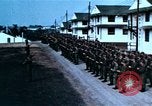
United States Army Reserves train for combat and peace keeping missions.
U.S. Army Reserve soldiers train at regular Army Camps. They are seen in formation outside barracks. Then they participate in bayonet practice. Closeups of Reservists and instructor doing practice moves using rifles with fixed bayonets. Next, Army M60A3 Battle Tanks and M113 APCs (Armored Personnel Carriers) are seen maneuvering in a field. Crew in an M113 APC moving through woods. Reserve infantry moving along a field with smoke rising ahead of them. Troops moving in concert with APCs as smoke rises from explosions nearby. Army ROTC cadets being led in pushups during training. Officer training graduates parade on a field past a military brass band.
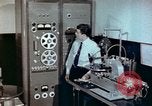
Production process of a RCA records lacquer master, for production of a phonograph record, in New York and in Indianapolis, Indiana
Post production process steps in the creation and manufacture of a phonograph record. Creation of lacquer master in New York, and handling at processing plant for lacquer master disc in Indianapolis, Indiana. View of magnetic tape reel to reel tape machines running after recording a performance. Overview of steps as the sound recording is transferred to record by a recording engineer. An engineer determines groove width according to pitch of the music. Close up view of meters and dials on recording playback equipment in studio. Shows creation of a lacquer master and its positioning on spindle of turntable. Also shows steps in creating mold and finally the stamper format. A woman is shown placing the original recording tape in shelves of a library -like vault area for safe keeping. Shows inspection of record grooves through a microscope, and silvering of lacquer master for creation of metal copies of the master, with layers of silver, nickel, and copper. Record tester listens to a record in audio testing. Nickel stamper is created from mold. Scenes show each step in the record creation process.

Alexander Graham Bell at 1916 ceremony; Telephone manufacturing at Western Electric Company plant in Chicago
A film titled "The world's telephone workshop". Opening scene shows ceremony on March 10, 1916, with Alexander Graham Bell, inventor of the telephone, unveiling a plaque at the invention site of the telephone in Boston, Massachusetts, United States. The plaque, at 109 Court Street, states "Here the Telephone was Born, June 2, 1875" and it notes that it was placed by The Bostonian Society and the New England Telephone and Telegraph Company. Alexander Graham Bell tips his hat to the crowd as they celebrate the unveiling. View of Western Electric Company plant in Chicago as smoke emerges from chimneys. Turbines in coal power plant. Massive group of thousands of American workers gathered together, from all walks of life, who are employed in the telephone industry.
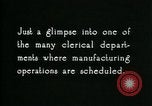
Telephone manufacturing at Western Electric Company plant in Chicago,Illinois
Workers work on various machines at Western Electric Company to manufacture telephone in Chicago,Illinois. Presses,planes,drills and mining machines in operation at the plant. Wires being stranded.
CRITICALPAST.COM: About Us | Contact Us | FAQs - How to Order | License Agreement | My Account | My Lightboxes | Shopping Cart | Advanced Search | Featured Collections | Website Terms & Conditions | Privacy Policy ©2026 CriticalPast LLC.
License Agreement |
Terms & Conditions |
Privacy Policy
©2026 CriticalPast LLC.