


 Francais
 Deutsch
 Italiano
Refine Your Search
Long Beach California USA 1960 stock footage and images
- Showing 1243 to 1248 of 27665 results more
more Hide
Hide
Donald G. Williams speaks about private industry diversification programs and the activities of the people in Richland, Washington.
Activities of the Atomic Energy Commission on the Hanford Project in Richland, Washington. An animation depicts : a plant set up for radioactive material recovery from storage by Isochem Inc. An electronic assembly plant by International Telephone and Telegraph Corporation. A plant for the use of nuclear power in the space by Douglas United Nuclear . The Battelle Memorial Institute scientists work in a laboratory. Computer Sciences Corporation employees work on machines in a Univac computer room, processing data transferred through telephone lines. Workers of the U.S. Casting Company work on machines. Meters and other equipment. Donald G William, the manager of the AEC Richland, speaks about various other organizations involved in the segmentation and diversification program. Various scientists and workers at work in the plant. A barge in a river. The center for graduate study. Visitors at the science center in the Richland administration building. A child stands. Houses and trees in the foreground. Building of the dental center. People on a street in Richland Washington, and view of 1950s and 1960s cars and various automobiles. Homes along streets in suburban neighborhoods of the Richland Washington area. People passing time at a local lake swimming area, with boy and girl children and families enjoying the water. A boat in water. Men water skiing. A U-37 Tri-Cities speed boat leaving dock area and speedboats in a race. An aerial view of the city. Vehicles on a road.
Early Bell Laboratory technology in computer art and computer animation for communication, advertising, motion pictures.
Computer screen showing animation of a silhouette of a man running. Narrator states that the first such image was generated at Bell Telephone Laboratories in New Jersey in the early 1960s. More views of the so called "Olympic Runner" graphic design generated by the Bell Laboratories newest digital computer. Colors like pink, blue and red are used in the early, historic computer art and animation technology. Men seated in a control room, interacting with the digital computer and other animation and recording hardware. Views of computer monitor screens and discussion by narrator about various visual forms created by computers. Various computer generated images are shown on the screen. Engineer stands in front of video tape machine where the images are being recorded. More computer and animation hardware is shown including an Animation Aid. Narrator describes process of photographing analog computer art work onto motion picture film and then enhancing it with color choices. Engineer is seen operating camera, and then a close up view of motion picture film running on machines and on reels. Animation and color consultant in discussion as they stand over some frames of the film that they have isolated. Sample work of early computer artists is shown, with moving animated art seen on screen, combining color and motion in new ways that were not possible before the digital computer. Another view of the video tape machine operating. Narrator discusses use of the computer also in development of computer generated music that accompanies the visual images. Animated clock is seen. Different kinds of animations are seen.
Engineers inspect the disc brake parts on a Pioneer III truck made by The Budd Company in the United States
In the 1960s, the Budd Company produced the Pioneer III electric m.u. coach for intercity travel. Here a prototype Pioneer III rail passenger car is seen, pushed by a Rail Diesel Car (RDC) as the locomotive power. People seated inside the train demonstrate size and comfort. (Mid-1950s automobiles seen parked at station where train arrives.) Engineers inspect the disc brake parts of the truck and a ventilator. The train is then pulled in the opposite direction by the RDC. Close up views of the train wheels near the tracks.
Roy Wilkins addresses attendees at 68th NAACP Convention in United States, where he is honored for his service.
On the assistance by National Association for Advancement of Colored People's (NAACP) lawyers provided to civil rights demonstrators. African American demonstrators on streets and police block their progress during a 1960's civil rights march. Still photo of family and friends crying at the funeral service for slain civil rights activist Medgar Evers. A photograph of Roy Wilkins holding a sign stating "Against Jim Crow Lunch Counters". Roy Wilkins talks. Photograph shows African American people with American flag. Remarks from NAACP leader Benjamin Hooks who followed Roy Wilkins after his retirement as Executive Director. Roy Wilkins addresses at 68th NAACP Annual Convention. Roy Wilkins stands with others.
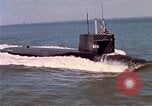
Views of U.S. Navy Fleet Ballistic Missile Submarines preparing to go to sea, and operations while at sea
U.S. Navy Fleet Ballistic Missile submarine activity during the cold war of the 1960s and 1970s. U.S. Navy nuclear submarine USS Thomas Jefferson (SSBN-618) on surface of water, and heading out to sea from a port. Various Navy ships at a port. An officer holds a megaphone. Crew standing on submarine. Brief view of USS Von Steuben (SSBN-632) at port. Submarine at sea. It dives into the sea. Crew members at control panels. Interior views of nuclear submarine. Life and work of U.S. Navy submarine sailors while at sea. Crew members talking with each other. Captain of the crew supervises. A man measures distance between points on a map. A hidden switchboard revealed. Figures seen on a paper. Men testing an instrument. The instrument shows green lines. Crew members at a large control panel. A mechanic testing instrument and another member of crew comes and see him working. Scene of a security area. A sailor does weightlifting exercises by lifting a barbell.
Highway, houses, bridges, waterfront, skyscrapers and cars on roads of Chicago, Illinois United States.
Film opens with hazy aerial views of Chicago Illinois. Scene shifts to views from vehicle driving on Chicago highway. A road sign reads "Des Plaines River Rd exits 1/2 mile ahead." A Boeing 727 commercial airliner is seen overhead with wheels down as it descends to land. Some 1960s cars drive past. 1961 Ford C-Series truck driving. View back, of the airliner descending above the highway, and of truck and cars passing the camera vehicle. Overhead highway road sign reads "Chicago Downtown 15 Miles." View of the Chicago skyline of buildings on Lake Michigan waterfront. View from slow moving aircraft of the Wrigley Building; the Michigan Avenue Bridge across the Chicago River; and the Tribune Tower. Camera continues to pan to East and then at the Kemper Building with "United Insurance" written near its top. Camera then swirls downward to river and bridges directly below and then back up from street and down again, ending on avenue near building displaying two American flags.
CRITICALPAST.COM: About Us | Contact Us | FAQs - How to Order | License Agreement | My Account | My Lightboxes | Shopping Cart | Advanced Search | Featured Collections | Website Terms & Conditions | Privacy Policy ©2026 CriticalPast LLC.
License Agreement |
Terms & Conditions |
Privacy Policy
©2026 CriticalPast LLC.