


 Francais
 Deutsch
 Italiano
Refine Your Search
Long Beach California USA 1960 stock footage and images
- Showing 13453 to 13458 of 27665 results more
more Hide
Hide
An OA-4A flies in fog and pilot seated in the OA-4A talks into microphone with radio operator in the United States.
Coverage of U.S. military aviation progress shows flying through the fog in the United States. Fog-shrouded business buildings. An aircraft, resembles a U.S. Boeing 247, crashed on the side of a snow-covered hill. Several civilians standing around the wreckage. A partially destroyed house and remains of the aircraft which crashed into it. A Curtiss Condor (C-30) passenger plane showing where it crash-landed in the woods. A U.S. OA-4A in flight. Interior of OA-4A cabin with radio operator seated at controls. Pilot's hands on controls of an OA-4A. Pilot seated in cockpit of an OA-4A talks into microphone. Radio operator seated in front of sending and receiving instruments. An OA-4A in flight. Radio operator in an OA-4A. An OA-4A in flight, enters a fog bank. Pilot seated in cockpit of aircraft talking into microphone, while aircraft is in fog bank. Radio operator seated in front of sending and receiving equipment and turning on marker beacon. An OA-4A in flight in a fog bank. The aircraft lands, taxis, and parked.
A-3's in formation flight and B-3A bombs on the ground beside the marked outline of a battleship in the United States.
Army aces bomb land warship during bombing practice in the United States. U.S. Army Air Corps Curtiss Falcon A-3's in formation flight over clouds. Wing of a B-3A in the foreground. Pilot and copilot of a U.S. Army Air Corps B-3A bombers. A B-3A bombardier releases a bomb. Bombs being released. Three bombs drop from a U.S. Army Air Corps B-3A, and pass out lower frame. Bombs dropping and exploding in a large circle on the ground. A-3s in flight and clouds in the background. A B-3A bombardier release bombs. Bomb drops from a B-3A, and descends out lower frame. Bombs descend and explode on the ground beside the marked outline of a battleship. Two B-3A's in flight. Bombs falling from a B-3A and a second B-3A in the background. Bombs drop and explode in the outline of a battleship marked on the ground.
Aircraft radio operator makes contact with ground radio operator while O-39 flies in fog bank in the United States.
Progress of U.S. military aviation in the United States. Two ground crewmen walks toward an aircraft U.S. O-39 minus wheel spats and canopy, parked in front of a hangar. A civilian installs an aerometrogram (an instrument used to record pressure, humidity, and temperature) on the wing of an aircraft O-39 minus wheel spats and canopy. Pilot of the aircraft wearing foul weather face gear. The aircraft radio operator contacts the control tower. He tells them they are going to take off. Aircraft O-39, parked in front of the hangar as engine starts. The O-39 in flight over a weather tower. It flies in a fog bank and disappears. The radio operator contacts the control tower. Ground radio operator verify the contact. Ground radio operator receives a call from the aircraft radio operator. Aircraft radio operator makes contact with the airfield. Fog-shrouded New York Harbor. Statue of Liberty dimly visible. Ocean liners and tugs underway in the fog-shrouded New York Harbor.

Various aircraft perform at an air show and parachutists descend at the National Air Races in Cleveland, Ohio.
Thrills at the National Air Races in Cleveland, Ohio. A V-formation of P-l2s in flight. Crowd-filled stands at the Cleveland Air Races. A formation of U.S. Navy F4B-4s in sets of three in flight Clarence MacArthur flies a 1910 Curtiss pusher-type aircraft. Waco Taperwing aircraft trails smoke in a dive, levels off and climbs. Milo Burcham flies in a P-12 aircraft. Mary Pickford looks up at the sky and points. Two policemen, a civilian and an army officer stand in the background. A crowd-filled grandstand. Milo Burcham in the aircraft rolls over and flies upside down. He flies low over the ground and goes into a vertical climb. People stand behind a fence. A Kinner Bird minus a wheel in flight. Its engine stops. It touches the ground down and skids. Parachutists jump from two Ford Trimotor C-3As. A number of parachutists descend and two of the parachutists land.
USAF Brigadier Generals James Parker and Dale Gaffney are introduced prior to air show in Spokane, Washington, during World War II
At the start of an air show in Spokane, Washington, during World War 2, a U.S..Army Air Force Colonel introduces Brigadier General James G. Parker, Commanding General of the 4th Air Force, headquartered in San Francisco. General Parker says a few words of greeting. People applaud. The Colonel then introduces Air Force Brigadier General Dale V. Gaffney, Commanding General of the Alaska Wing, Air Transport Command. He also says a few words. Then, (sound only) the Colonel introduces a Major, from Spokane, who had survived the Bataan Death March and also successfully escaped from a Japanese prison camp.
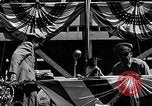
At an Air Show in Spokane, Washington, Major Samuel Grashio, survivor of Bataan Death March, speaks during World War II
Army Air Force Major Samuel Grashio speaks prior to an air show in Spokane, Washington, during World War 2. He is from Spokane, a survivor of the Bataan Death March, and had successfully escaped from a Japanese prison camp. The Major begins to describe his experiences during the fall of Corregidor and Bataan, during the Japanese invasion at the start of World War II in the Pacific. Unfortunately, the sound stops (purposely ?) as he gets into the details of his story.
CRITICALPAST.COM: About Us | Contact Us | FAQs - How to Order | License Agreement | My Account | My Lightboxes | Shopping Cart | Advanced Search | Featured Collections | Website Terms & Conditions | Privacy Policy ©2026 CriticalPast LLC.
License Agreement |
Terms & Conditions |
Privacy Policy
©2026 CriticalPast LLC.