


 Francais
 Deutsch
 Italiano
Refine Your Search
Long Beach California USA 1960 stock footage and images
- Showing 13849 to 13854 of 27665 results more
more Hide
Hide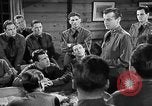
An officer explains different types of platoon formations and its usage and advantages (WW2)
The advantages of the different Platoon formations during World War II. The U.S. Army Sergeants stand around a desk. A Rifle Squad officer talks about the formal formations of the Platoon. He first explains the Platoon Column Formation which is useful at night and during low visibility. Secondly he speaks about the Platoon in Line of Squad Column in which the center is the Base Squad and is useful only when the location of the enemy squad is known. A Sergeant asks a questions and the officer answers. Next is the Platoon in Squad Column formation with center squad back this formation is most useful and widely used. It provides Rifle Squad support and allow use of covered approach terrain further movement in Platoon Column. A Sergeant asks question about the number of squad to be used in the formation. The officer answers. Another sergeant questions him about maintaining contact with security measure. The officer explains this answer with the help of a example.
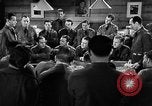
An officer briefs the Sergeants about the wedge and Echelon platoon formations and its usage and advantages (WW2)
The advantages of the different Platoon formations during World War II. The Sergeant seated on a desk. A Rifle Squad officer uses a model to explain them the formations. The officer briefs them with the formation that is platoon wedge the formation of readiness. The Platoon is ready to fight in any direction. A Sergeant questions that why is the wedge formation called the formation of readiness. The officer compares the wedge formation with the platoon column and answers his question. The next formation is the Echelon to the right and left provides good coverage of an area. The officer holds a poster which reads 'Echelon'. It is used by the platoon in approach march when the flank is exposed. He explains the explosion of flank in any conditions.
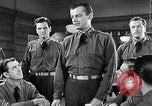
An officer with the help of a model explains when is the Skirmish Line formation used during a battle (WW2)
The advantages of the different Platoon formations during World War II. The Sergeants seated on a desk. A Rifle Squad officer uses a model to explain when is the Skirmish Line used. He starts from the approach march. The model shows the squad breaking into small platoon columns after firing of an artillery. The Sergeants listen to him. He also speaks that the troops are in squad column formation until they reach the particular range of the rifles. He focuses on two things first not to fire from more than 400 yards and do not deploy skirmish until we are forced to fire. He speaks about when and why to deploy skirmishes. He also states three reason for delaying the deployment of skirmishes.
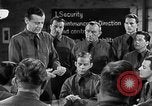
An officer briefs sergeants about the responsibility of a platoon leader, Sergeant during a platoon formation in a battle (WW2)
The advantages of the different Platoon formations during World War II. The Sergeant seated on a desk . A Rifle Squad officer uses a model to explain different responsibility of the platoon leaders, Sergeants and guides at the time of the approach march. He first talks about the job of the platoon leader. He is between the platoon squad and the leading squad. His task is to get the platoon safely forward, maintain contact with his neighbors. The job of the platoon Sergeant. He is in the center of the formation. He goes where he needs to do his job.. Supervises and control the platoon in absence of the platoon leader and acts immediately during any critical situation in the absence. The last is the job of platoon guide. He should fulfill the duty of platoon Sergeant in his absence. He moves in the rear of the platoon and keeps an eye to flank. He duty is to inform about the any unusual event. His job is the toughest one. A Sergeant asks questions to the officer about the platoon Sergeant and he answers.
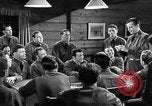
An officer highlights the basic and important points that can be used during different formations (WW2)
The advantages of the different Platoon formations during World War II. The Sergeant seated on a desk. A Rifle Squad officer stands in the center sums up with the highlights that were done in the lesson. He focuses on few big points during the formations they are provide good control, allow and use cover, get forward faster. Deploy skirmishes only when you are forced too. Always adopt a formation that will provide you with support squad. Maintain contact on the units to the right and left. To take up Echelon formation if the platoon leader has an open flank. The Sergeants listen to him.
The demonstration of guns like M-1 rifle and Sherman tank that can help in the war (WW2)
A documentary titled 'How Good Is A Gun' depicts the importance of good guns in World War II. A valley in North America. Damaged buildings. The rubble and dead bodies in the town. U.S. soldiers carrying guns walk on the rubbles. They are seated and talk about the good guns and weapons. The soldiers smoke and drink. The soldiers enter a building and are seated in a hall. Demonstration of various guns that can help the soldiers in different situations. A soldier firing the light carbines. A soldier fires a M-1 rifle. Fire by the machine guns that makes a hole in the 4 inches concrete wall. Troops in prone position and in the same line as they fire from a BAR (Browning Automatic Rifles) five times faster than a rifle. Two troops fire with a 30 caliber machine gun that cuts a tree. Air- cooled light machine gun that can fire within three miles and cuts the hill stone. Soldiers stand around a 60-mm mortar and fire. They put shell in the 80-mm mortar and fire. Smoke arises due to fire. A bazooka rocket powered and a killer tank. Troops pulls a 37-mm anti tank gun, they fire and look through binoculars. The troops around a 105-mm howitzer. The wooden logs arranged in a heap and are put three miles away. Howitzer fires and the heap being shelled. 155 rifle that lifts the roof of a German plant 15 miles away. Soldiers seated around the rifle. The rifle and the damaged German plant. A view of a war at the Italian Front. Troops pull away into positions along with artillery on the Italian front. They move forward along with the Howitzer,rifles and a Sherman tank.
CRITICALPAST.COM: About Us | Contact Us | FAQs - How to Order | License Agreement | My Account | My Lightboxes | Shopping Cart | Advanced Search | Featured Collections | Website Terms & Conditions | Privacy Policy ©2026 CriticalPast LLC.
License Agreement |
Terms & Conditions |
Privacy Policy
©2026 CriticalPast LLC.