


 Francais
 Deutsch
 Italiano
Refine Your Search
Long Beach California USA 1960 stock footage and images
- Showing 15037 to 15042 of 27665 results more
more Hide
Hide
John Snyder states about a government program in Washington DC.
Reconversion Chief, John Snyder gives a statement in Washington DC. He states that government is committed to a program which will provide jobs for all. A microphone is placed in front of him on a table. He reads from a document.
Pacific Battle fleet comes back to United States after victory in World War 2.
The units of Pacific Battle fleet comes back home after victory and end of World War 2. Views in Diamond Head, Hawaii. U.S. Navy sailors aboard ships, returning home from war in the Pacific. Admiral William 'Bull' Halsey speaking to the press. People crowd pedestrian walkway of Golden Gate Bridge in San Francisco to wave welcome to ships in the fleet arriving in San Francisco. Fog partially covers the area. Admiral Halsey on deck of aircraft carrier waving to crowds on bridge. Ships of the 3rd fleet arriving in San Francisco. U.S. Navy Fleet units passing through Panama Canal and stopping to indulge in recreational activities on land in Panama Canal Zone. Sailors on streets of Panama Canal Zone visiting souvenir shops, trying on hats, clowning around, and getting photographs taken. USS Enterprise (CV-6) aircraft carrier leading the fleet and arriving in New York harbor. A view of Statue of Liberty. USS Enterprise at dock. Sailors disembark and walk down walkways to dock. Relatives and families smile and welcome the sailors. People hug each other.
Rodeo competitors between various units of Texas Prison System gather in Huntsville, Texas.
Performers from various units of Texas Prison System gather in Huntsville, Texas. They exhibit their skills against wild rodeo animals in a field. People gathered to watch the event. Spectators seated. Horses fall down. Men on ground. (World War II period).
President Harry S. Truman announces surrender of Germany in World War II. Crowds celebrate in streets of Manhattan
VE Day (Victory in Europe) May 8, 1945. From the White House, in Washington DC, President Truman announces that Germany has surrendered, bringing World War 2 in Europe to an end. Americans are seen celebrating the good news in the streets of downtown, Manhattan, New York City. Crowds on Wall Street and cheering on steps and in front of statue of George Washington at Federal Hall. Ticker tape falls on Wall Street. View of Trinity Church between tall buildings. Cheering crowd fills Times Square. Many in the crowd are soldiers, sailors and other military servicemen in uniform. American flags are seen on buildings and some carried by people in the crowd.
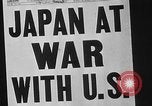
United States declares war on Japan, December 8, 1941, marking U.S. entry in World War 2
New York Daily News headline reads 'Japan at war with U.S.' Journal American newspaper headline reads:'US votes war'. Boxes of M-1 ammunition being off-loaded from a ship by African American soldiers, and placed on a roller conveyer. U.S. Army tank, trucks, and aircraft ready for shipment overseas.
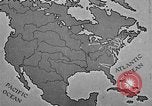
British film intended to acquaint British people with United States landscape, rail transportation, and farming history.
British World War 2 era film showing scenes in the United States from earlier in the 1900s. Film opens showing 19th Century animated map of the United States. It traces the development of the railroads in the U.S. It shows rail lines reaching the Missouri River by the year 1860. (Narrator states this took 250 years to happen.) But in another 10 years, the map shows the Union Pacific and other rail lines extending two the West Coast, and U.S. commerce shifting, from North-South movement, to East-West (with an animated steam locomotive moving across the map). Chicago is highlighted as the greatest railway junction in the world (the "Piccadilly Circus" as the British narrator describes it). View of a late 1800s model steam locomotive train pulling freight railroad cars on railroad tracks in a desert area of the Western United States. Point of view from camera on moving railroad train pointing straight down at railroad tracks moving by at high speed. Landscape and wide views of the arid Western parts of the U.S. Group of Native American Indians watching a railroad train pass. Construction supplies being offloaded from a train. A wind-driven water pump. Buffalo herds affected by the railroads. Wire fencing installed to control cattle on large Western ranches. Large team of horses pulling late 1800s wheat harvesting farm equipment as it harvests wheat in fields. Views of wheat grains being poured at high volume. Cattle roaming in the high country. Views of Chicago stock yards. A man marking in chalk on a Board of Trade chalk board, indicating the prices of farm commodities including wheat, corn, oats, and rye. Various views of steam locomotives pulling trains throughout the rail network, including some 20th century trains near the end of the film, and some close-up views of wheels turning fast on moving railroad trains.
CRITICALPAST.COM: About Us | Contact Us | FAQs - How to Order | License Agreement | My Account | My Lightboxes | Shopping Cart | Advanced Search | Featured Collections | Website Terms & Conditions | Privacy Policy ©2026 CriticalPast LLC.
License Agreement |
Terms & Conditions |
Privacy Policy
©2026 CriticalPast LLC.