


 Francais
 Deutsch
 Italiano
Refine Your Search
Long Beach California USA 1960 stock footage and images
- Showing 16039 to 16044 of 27665 results more
more Hide
Hide
The United States demobilizes following World War II
Opening illustrated slate shows reduction of Amercan Armed forces personnel from more than 12 million in 1945 to only a little over 1 and a half million in 1947. U.S. Navy submarines are seen docked in storage. Men work spraying protective coatings over guns on Navy ships as they are placed in storage in the "Mothball Fleet." A lone sailor is seen on the deck of a ship with vast number of mothballed Navy destroyers in the background. A B-24 Liberator bomber being dismantled and a B-17 parked with engines removed, seen through stack of propellers in foreground. Airman sets a demolition charge. Views of several bomber aircraft being blown up as junk. Stacks of junked and scrapped American war materiel rusting. View inside a mill where molten metal is being processed (ostensibly recycled from junked war materiel). Narrator speaks of beating guns into plow shares. Several views of molten metal being poured into and from ladles. Views inside post-war factories returning to peace-time production, where industrial heavy equipment, railroad wheels, kitchen appliances, home appliances, rubber tires, and new 1946 Ford automobiles are assembled (looking exactly like the 1942 models).
Signing of the NATO treaty in Washington D.C., United States
President Harry S. Truman introduced to foreign ministers of NATO member countries by Secretary of State Dean Acheson in Washington D.C., United States. President delivers a speech on the occasion of signing of NATO (North Atlantic Treaty Organization) treaty. He hopes that members will cooperate in solving common problems and in their efforts of development.
NATO treaty signed in Washington D.C., United States
Representatives of various states sign North Atlantic Treaty Organization treaty (NATO) in Washington DC, United States. Belgian Premier Paul-Henri Spaak, Lester B Person of Canada, Rasmussen of Denmark, Robert Schuman of France, Bjarni Benidiktsson of Italy, Joseph Bech of Luxembourg, Stikker of Netherlands, Halvard M Lange of Norway, Jose Caeiro De Mata of Portugal, Ernest Bevin of England sign the NATO treaty. President Truman shakes hands with Allen W Brakley. Brakley shakes hands with Dean Acheson. Acheson signs the treaty and delivers a concluding speech.
Molten metal used to make 1000 pound bombs in United States
Manufacture process of a 1000 pound bomb shell cases in United States. Metal processed from molten to solid under high temperature conditions. (World War II period).
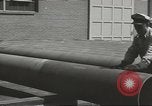
Bombs are machined in United States
1000 pound bomb shell cases cut to size in United States. Workers place shells onto a machine and cut them into size. Metal shells heated and shaped. (World War II period).
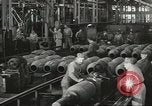
Final assembly and inspection of 1000 pound bombs in United States.
1000 pound bomb shell cases put onto machines and undergo final processing in United States. Rings put around the shells. Bomb shell cases stacked in warehouse where an Army officer inspects them. (World War II period).
CRITICALPAST.COM: About Us | Contact Us | FAQs - How to Order | License Agreement | My Account | My Lightboxes | Shopping Cart | Advanced Search | Featured Collections | Website Terms & Conditions | Privacy Policy ©2026 CriticalPast LLC.
License Agreement |
Terms & Conditions |
Privacy Policy
©2026 CriticalPast LLC.