


 Francais
 Deutsch
 Italiano
Refine Your Search
Long Beach California USA 1960 stock footage and images
- Showing 18787 to 18792 of 27665 results more
more Hide
Hide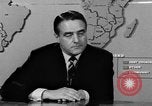
Sargent Shriver speaks about equal enthusiasm of Kennedy and Johnson for the Peace Corps during an interview in Washington.
Robert Sargent Shriver is interviewed by Frank Reynolds in Washington. Television journalist Frank Reynolds interviews Robert Sargent Shriver Jr. , Director of the Peace Corps. A world map on a wall in the background. Sargent Shriver talks about enthusiasm of former U.S. President John F. Kennedy (JK) and U.S. President Lyndon B. Johnson for the Peace Corps. Frank Reynolds questions whether the people of Vietnam can serve in the Peace Corps.
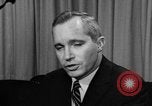
Shriver speaks about the kind of volunteers they need and experiences gained by them during an interview in Washington.
Robert Sargent Shriver is interviewed by Frank Reynolds in Washington. Television journalist Frank Reynolds interviews Robert Sargent Shriver Jr. , Director of the Peace Corps. A world map on a wall in the background. Sargent Shriver is questioned about what kind of volunteers are required. He answers that they are looking for volunteers with qualities required for the work. Frank Reynolds questions what he can offer to the volunteers. Sargent Shriver replies that the Peace Corps offers valuable courses and educational experience by sending the volunteers abroad. He says that the volunteers can learn cultures of different countries.

Sargent Shriver talks about broadening the scope for volunteers as Frank Reynolds interviews him in Washington.
Robert Sargent Shriver is interviewed by Frank Reynolds in Washington. Television journalist Frank Reynolds interviews Robert Sargent Shriver Jr. , Director of the Peace Corps. A world map on a wall in the background. Sargent Shriver talks about broadening scope for volunteers. He tells that the volunteers can learn different cultures and languages. Sargent Shriver talks about progress reports. Frank Reynolds questions about capitalism or communism in various countries. Sargent Shriver replies that the Peace Corps does not make any change in the culture of any country.

During an interview Shriver tells about qualities required in criminals if they volunteer for the Peace Corps in Washington.
Robert Sargent Shriver is interviewed by Frank Reynolds in Washington. Television journalist Frank Reynolds interviews Robert Sargent Shriver Jr. , Director of the Peace Corps. A world map on a wall in the background. Sargent Shriver is questioned whether he wants to admit people having criminal records as volunteers of the Peace Corps. He replies affirmatively. Sargent Shriver answers that he does not have problem to admit people with criminal records, but they should have spirit, internal motivation and personal commitment for life and actions.

U.S. Navy Department develops ships and boats for amphibious assaults during World War II.
Film opens showing the U.S. Capitol building in Washington, DC. Next are views of the U.S. Navy and Munitions building on Constitution Avenue in Washington, DC (Sign on building reads: "Navy Department.") View of Senior Naval officers in a conference room in the building. Next scene shows a group of military planners discussing a three dimensional model of a Pacific island with landing ships and landing craft near the shore. A group of Army and Navy officers discuss documents as they stand in front of a huge wall map of the world. They walk together and point to the Mediterranean portion of the map. A large sign points toward "Naval Research Lab." Inside a Navy Commander and Lieutenant Commander confer over some maps with two civilians. Next, a room full of draftsmen (including a woman) are seen bent over drawing boards. Two engineers bend over an instrumented cutaway of a ship's hull. Senior military officers sit around a conference table. American and British flags are placed at the end of the room. Closeup of two British officer attendees. Civilian engineers and designers gather around a table. Workers at a shipyard gather on and around a Navy ship that displays a battery of four antiaircraft guns. Men in a foundry preparing to pour molten metal from a ladle into a mold. A milling machine taking a deep cut on the edge of a steel plate. A large engine being moved by an overhead conveyor in a factory. Men fabricating boats in a factory. View, from a moving platform, of men painting a newly manufactured Higgins boat (Landing Craft vehicle personnel, LCVP). A new Landing Ship Tank being launched at the Norfolk Navy Yard, Portsmouth, Virginia. USS LSTs 340 and 341 at their launchings in Portsmith.
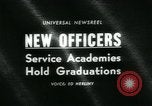
U.S. Army, Navy, Air Force and Coast Guard academies hold graduation ceremonies and the cadets receive diplomas in the U.S.
United States Service academies hold graduation ceremonies in the U.S. At West Point, Annapolis, U.S. Army cadets of academy and officers gather for graduation ceremony. Cadets come to an officer, shake hands and receive diplomas. At U.S. Naval Academy, naval cadets receive diplomas and celebrate. The cadets of U.S. Air Force Academy march and sit in chairs to attend the graduation ceremony. In New London, Connecticut U.S. President Lyndon B. Johnson addresses graduates of the Coast Guard Academy and says that their war potential is far superior to that of Russia.
CRITICALPAST.COM: About Us | Contact Us | FAQs - How to Order | License Agreement | My Account | My Lightboxes | Shopping Cart | Advanced Search | Featured Collections | Website Terms & Conditions | Privacy Policy ©2026 CriticalPast LLC.
License Agreement |
Terms & Conditions |
Privacy Policy
©2026 CriticalPast LLC.