


 Francais
 Deutsch
 Italiano
Refine Your Search
Long Beach California USA 1960 stock footage and images
- Showing 20359 to 20364 of 27665 results more
more Hide
Hide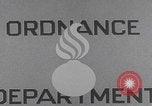
Ordinance Department personnel fits tail on bomb during WWII
Personnel from the Ordinance Department handling and packing bombs during World War 2. An Ordinance Department personnel fits the tail into a 100 lbs. explosive bomb. Nose plug of a bomb. Animation depicting fragmentation, demolition, chemical (except phosphorus) and chemical phosphorus bombs. A hand points to the table of contents of the Ordinance Department Training Regulation. Pen underlines “Quantity-distance tables”. A scene depicting the ideal distances between military establishments, inhabited buildings, railways, public highways and fuzing area for bombs.
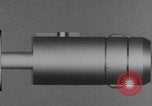
Animation depicts bomb fuse safety, internals of bomb used during World War II
Animation depicting the safety of bomb fuses used during World War 2. An artistic rendition of a bomb’s fuse. Animation depicts the inner parts of the fuse- the pin, striker, arming pin, arming spring, and arming wire. Animation shows the arming wire withdrawn, causing the arming spring to fall and ejects the arming pin. Sheer wire inside fuse is resistant to air pressure but light enough to break upon impact. Pin breaking through the sheer wire upon impact, detonating the fuse.
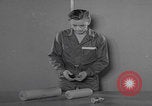
Man assembles a fragmentation bomb during World War 2.
A man assembles a fragmentation bomb used by the United States during World War 2. Man assembles bomb by hand. The man unscrews the screw in the bomb body. Man fastens the parachute container over the fragmentation bomb. The adaptor is screwed and tightened. The man puts down the fragmentation bomb. Man uses a screwdriver to tighten bolt to complete rear assembly. Man proceeds to fuze the bomb. Man removes closure plug, inserts and tightens the M104 fuze.
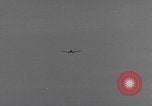
Man assembles a fragmentation bomb; bomber drops bombs during World War 2.
A bomber flying at low altitude. Bomber drops fragmentation bombs in flight. Parachutes delay the descent of fragmentation bombs. Fragmentation bombs fall with parachutes. A man assembles pins on fragmentation bomb. Man loosens a set screw of fragmentation bomb using a screwdriver. The fin assembly is placed into the tail of the bomb body. The fin turns carefully into the bomb body. Man locks the fin and bomb body into place by tightening the set screw.

Soviet and East European affairs specialist Boris Hansen Klosson introduces communist recruitment methods (Cold War)
Title card "Communist Blueprint for Conquest" State Department Foreign Service officer and Soviet and East European affairs specialist Boris Hansen Klosson gives an overview of the recruitment methods utilized by communists during the Cold War. He notes that the communists have "given new meaning to totalitarian rule." Animation depicting the communist symbol superimposed over, a church, government building, factory and school which represents the “spiritual”, “political”, “economic” and “cultural” aspects of society. “What cannot be controlled must be undermined and destroyed” Boris H. Klosson says. Animation depicts working class communists mobilizing under a leader and working underground. A moving analog clock is superimposed on the animation. (Film is example of Anti-communist or so called Red menace propaganda)

Cartoon depicts communist fist wrecking buildings and hitting a worker with a stick.
United States Cold War anti-communist propaganda film. Slate reads “IDEOLOGY”. A cartoon depicting a large hand clenching into a fist- symbol of communist threat. The large communist fist wrecking buildings of institutions such as churches and government. The communist fist hits a scared working-class man with a wooden stick. A communist book with words such as “Enemy”, “Line of Attack”, “Direct Reserves” and “Distribution of force” written over it. (Film is example of Anti-communist or so called Red menace propaganda)
CRITICALPAST.COM: About Us | Contact Us | FAQs - How to Order | License Agreement | My Account | My Lightboxes | Shopping Cart | Advanced Search | Featured Collections | Website Terms & Conditions | Privacy Policy ©2026 CriticalPast LLC.
License Agreement |
Terms & Conditions |
Privacy Policy
©2026 CriticalPast LLC.