


 Francais
 Deutsch
 Italiano
Refine Your Search
Long Beach California USA 1960 stock footage and images
- Showing 199 to 204 of 27665 results more
more Hide
Hide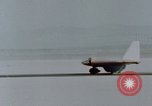
MX-324 flying wing aircraft takes-off at Muroc Dry Lake, California.
The experimental Northrop MX-324, first U.S. military rocket-powered flying wing plane, takes-off during tests at Muroc Dry Lake, California. It makes a short flight, circling to land smoothly with a very long landing roll, disappearing in the distance. (Buildings seen in back ground are at North Edwards Air Force Base.)
Various "firsts" in U.S. aviation history from 1918 through 1924; early history of flight and vintage flight scenes
Shows several aviation "firsts" accomplished by U.S. Army Air Service aviators in the period from 1918 through 1924. A close formation of biplanes in flight. President and Mrs. Woodrow Wilson chat with Major Fleet, Officer in charge, on the occasion of the first air mail flight, inaugurated on May 15,1918 between Washington DC and New York.The mail is loaded into the Curtis JN-4 aircraft. Pilot in the cockpit. The aircraft takes off and in flight. Air Service. Mention of aviators helping spot forest fires. Smoke rising from forest fires and mountain ranges. In 1920, U.S. Army Captain St. Clair Streett is seen with some of his Squadron who flew four De Havilland DH-4 aircraft 9,000 miles, from New York City to Nome, Alaska. Two of the men play with pet dogs. Their itinerary is painted on the side of one of the aircraft, along with the names of pilot and mechanic (C.E. Crumline and J.E. Long). In 1923 the first non stop coast-to-coast flight was made in the Fokker T-2 aircraft. . A sign on the aircraft reads 'Army Air Service non stop coast to coast'.First Lieutenants Oakley O.Kelly and John A. Macready board the aircraft, at Roosevelt Field, Long Island, New York, on May 2, 1923. Their Fokker T-2 in flight. Their arrival at Rockwell Field, on Coronado Island (San Diego) California. In 1924, Lt. Russell Maughan is seen boarding his P-1 Hawk airplane at Mitchel Field, on Long Island, New York, and taking off , bound for Crissy Field at the Presidio, San Francisco, California. His goal is the first dawn-to-dusk, coast-to-coast flight. Views of his P-1 Hawk airplane flying over Manhattan, New York City.
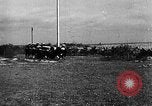
Coast Guardsmen conduct a breeches buoy drill
Coast Guardsmen in uniform wheel a beach cart containing a lyle gun and other equipment for firing a shot line to a vessel in distress. They are conducting a breeches buoy drill. They remove a lyle gun and flaking box from the cart and uncover the shot line which they place in the gun. Using a long lanyard, one guardsman fires the gun. Closeup of the shot line smoothly paying out from the flaking box. It is fired to a simulated mast (tower) on the beach. Closeup of large spools of whip line with instructions to the distressed crew about their use. After the whip line and block are set on the distressed ship's mast, the Coast Guardsmen now prepare the whip line to move large hawser line to the mast. Large spools of hawser line are seen in background. Closeup of Guardsmen pulling hawser from the spools. Guardsmen tie the hawser to the whip line for hauling aboard the distressed vessel. Closeup of the whip line pulling the hawser across the sand to the tower. Guardsmen working rapidly to accomplish this. A breeches buoy being attached to the hawser which is then propped up for elevation. View of the Breeches Buoy traveling up to the tower. A guardsmen riding the breeches buoy down from the tower. He is helped by others when he reaches the ground. Closeup of a clamp placed on the hawser to retrieve it from the vessel. The hawser being retrieved.
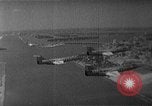
U.S. Air Force Tactical Air Command prepares in the United States during the Cuban Missile Crisis of October 1962.
Events held in the United States during the Cuban Missile Crisis of October, 1962 when the United States and the Soviet Union confronted each other with nuclear destruction. USAF (United States Air Force) F-100 Super Sabre jet fighters in flight. A sign reads 'NAS KEY WEST'. A USAF F-104 Starfighter supersonic interceptor aircraft makes a landing. USAF F-105 Thunderchief supersonic fighter-bombers are armed by airmen at an airfield. Aerial view of a base in Florida showing USAF airplanes in place. Aerial view of air evacuation equipment at a field. Surface to air missiles are readied at a beach. A radar in operation. Barbed wire obstacles are set up along a beach by U.S. troops. A USAF RB-66 Destroyer reconnaissance aircraft takes off from an airstrip. U.S. Marines reach U.S. Navy Guantanamo Bay Naval Base in Cuba. Americans are evacuated from Guantanamo as a precautionary measure. View of a long touchdown run in a college football game between Northwestern and Ohio State teams.
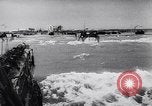
Canadian and U.S. Army troops disembark from landing crafts and move ashore in France during D-Day Invasion
View from Canadian landing craft as Canadian troops of the North Shore Regiment (3rd Canadian Division) land at the Nan sector of Juno beach on D-Day. View on the beach shortly after the landing. Scene shifts to American troops disembarking from a landing craft LST elsewhere at Normandy on D-Day. U.S. Soldiers move ashore in a long line through the water to reach the shore as an explosion occurs in the background. (World War II period).
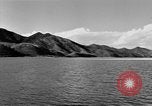
French military operations along rivers during war in Indochina.
French river boats in operation. One tows several Vietnamese boats. A group of French soldiers aboard a wooden sail boat that they propel with long poles. The boat moves towards a beach area. The troops get off the boat and wade to the beach. They search the area and seize several Vietnamese prisoners. French troops search areas along the river bank.
CRITICALPAST.COM: About Us | Contact Us | FAQs - How to Order | License Agreement | My Account | My Lightboxes | Shopping Cart | Advanced Search | Featured Collections | Website Terms & Conditions | Privacy Policy ©2026 CriticalPast LLC.
License Agreement |
Terms & Conditions |
Privacy Policy
©2026 CriticalPast LLC.