


 Francais
 Deutsch
 Italiano
Refine Your Search
Long Beach California USA 1960 stock footage and images
- Showing 3187 to 3192 of 27665 results more
more Hide
Hide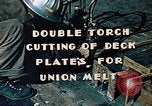
Deck Plates being trimmed with double acetylene torches during construction of Liberty ship in World War II
Workers at shipyard in California, during World War 2, use a set of double acetylene torches to trim steel deck plates for a Liberty ship. The device maintains parallel cuts in adjoining deck plates, preparing for union melt. (Note: May include scenes from Kaiser Shipyard in Richmond, California as well as Hunters Point Naval Shipyard in San Francisco.)
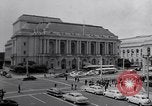
Primer Mr Shigeru Yoshida addresses and signs peace treaty with representatives of other countries in San Francisco, CA
San Francisco Peace Treaty conference with Japan, in San Francisco, California. Beginning shows the War Memorial Opera House and Van Ness Avenue. U.S. President Harry S Truman steps to a podium, at the Opera House, to address delegates at the conference. With him on the stage are Dr. Warren Kelchner, Temporary Chairperson of the Japanese Peace Treaty Conference, Governor Earl Warren of California, and Secretary of State Dean Acheson. Next, Dean Acheson is seen seated at the center of a table with Dr. Kelchner, at his right, as Soviet representative Andrei A. Gromyko steps to the microphone and speaks. (Narrator says he raises complaint about rules of procedure.) Dean Acheson removes his translating headset in frustration. Next, a representative of Poland comes to the microphone, and calls for delays. View of delegates in the audience. New Zealand representative, Sir Carl August Berendsen, takes the stand to renounce delaying tactics. Audience members applaud. Carlos P. Rómulo, of the Philippines, speaks in support of the treaty. John foster Dulles, of the United States, steps to the podium to speak for the treaty. Next, Japanese Premier, Shigeru Yoshida, referring to notes in a roll of paper, endorses the treaty. Audience applauds. Secretary of State Acheson is seen signing the treaty for the United States, followed by representatives of: Australia; Cambodia; Great Britain; Ceylon; France; Indonesia; Philippines; and Pakistan. Next, the Japanese delegation comes forward, and Prime Minster Shingera Yoshida, signs the historic document. Closeups of ordinary Japanese from all walks of life. Japanese people commuting to work.

Burlesque dancer Sally Rand performing the Bubble Dance with her troupe at the San Diego Expo of 1935-1936
Burlesque dancer Sally Rand (Hattie Helen Gould Beck) and her dance troupe perform the Bubble Dance at the San Diego Expo (the California Pacific International Exposition) in Balboa Park in 1935. Ms. Rand and her dancers perform at a fountain of the Plaza del Pacifico, with the California State Building in the background (which became the San Diego Automotive Museum in 1988)
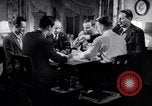
British factory worker and his American counterpart on an international exchange visit to the Lockheed aircraft plant in Los Angeles (WW2)
A British guest on labor exchange program visit to the U.S. is staying as a house guest of his counterpart American in Los Angeles, California. We see him with several friends of his host, who also work at the Lockheed aircraft plant. They are teaching him the card game of poker. The leave to attend a meeting of District Lodge 727, International Association of Machinists and Aerospace Workers, AFL-CIO (Lockheed-California Company). There the British guest is allowed to ask questions of the union. He and his American counterpart are seen at a podium as the Briton asks about the strength of the union inside the Lockheed plant. The local union Secretary responds that they have 45 thousand members in the Lockheed plant and, noting that the British man was a shop steward back in England, mentioned that the local also had 3000 shop stewards in the Lockheed factory. The British visitor asked how the union would be affected after the war, when labor requirements would be reduced. A member answers that the first action would be to return to a 40 hour work week (from the wartime 50 hour week). He states that some workers would return to pre-war work and jobs. Finally, he says they expect Lockheed to expand the scope of its manufacturing to include consumer goods. The union is asked about accommodating workers returning from the military and answers that it is covered in the union contract, which calls for their seniority to continue to accrue while in service. The union also provides for war injured handicapped workers to return to work, and sponsored legislation to provide post-service education opportunities for all returning veterans. Asked about women now employed in the plants, one woman union member stated that many would return to their homes. But the immediate need is to employ more women to the help the Allied forces win World War II as soon as possible. Regarding the prospect of post-war employment, one union member noted the national need to convert from wartime production to the manufacture of consumer goods. The union members favored the idea of continuing labor union exchange visits between the Allied countries in the future.
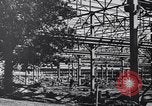
Military Aircraft being produced by Vultee and Lockheed Aircraft companies during World War II
Film begins showing steel framework for a new war plant under construction during World War 2. Next, workers are seen painting aircraft parts at the Vultee aircraft plant in Downey California. A crane at the plant moves an aircraft tail section to mate with the forward fuselage of an airplane. Cranes move wing segments through the plant. Workers, including a woman, lower a radial engine into place at the front of a BT-13 Valiant training airplane. A line of such aircraft is seen behind the one the camera is focused on. Scene shifts to the Lockheed aircraft plant in Burbank, California, where bodies of Lockheed Model 14 Super Electra passenger planes are seen covering the factory floor. A glimpse of Lockheed B-24 Liberator bombers in an assembly line next to men working engines of a partially assembled Electra 14 aircraft. Lockheed P-38 lightning fighter planes being assembled at another part of the plant. A P-38 taxis past a line of parked Lockheed Hudson light bombers and takes off on a test flight. View from below of gleaming aluminum P-38 climbing out. Aerial view from above of P-38 flying over land near some mountains.
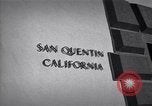
International Longshoreman's Union President, Harry Bridges, is released from prison to appear before the U.S. District Court in San Francisco
Final attempts by Department of Justice, to deport International Longshoreman Union President Harry Bridges for labor organizing and alleged subversive activities. Film begins showing sign reading: "Department of Corrections,California State Prison, San Quentin." An automobile is seen driving toward the camera, out the gate of the prison. Guards open and close iron gates of the prison twice, as if for benefit of the camera. Distant view of front gates closed. Scene shifts to co-counsel of Harry Bridges legal defense team parking his car and stepping out carrying some legal papers. He walks to office at the entrance of San Quentin prison and speaks with guards. Scene shifts abruptly to Harry Bridges' lead defense attorney, Carol Weiss King, surrounded by reporters and others in the hall of the United States District Court for the Northern District of California, in San Francisco. Next a car is seen driving down a ramp to enter the court building parking garage. Harry Bridges steps from the car and is escorted by two uniformed guards and other persons. They all enter an elevator. Camera focuses on a room identified as "Number 203, U.S. Marshal, Criminal Dep't." Two men come out and join others escorting Harry Bridgers in the Court building hall. Closeup of Bridgers as he passes the camera. Photographers are busy taking pictures. Officials thoroughly search Bridgers, and then they all enter a room.
CRITICALPAST.COM: About Us | Contact Us | FAQs - How to Order | License Agreement | My Account | My Lightboxes | Shopping Cart | Advanced Search | Featured Collections | Website Terms & Conditions | Privacy Policy ©2026 CriticalPast LLC.
License Agreement |
Terms & Conditions |
Privacy Policy
©2026 CriticalPast LLC.