


 Francais
 Deutsch
 Italiano
Refine Your Search
Long Beach California USA 1960 stock footage and images
- Showing 3727 to 3732 of 27665 results more
more Hide
Hide
United States 3rd Battalion, 19th Infantry Regiment troops bombard a shoreline in Leyte, Philippines.
The Philippine Operations in Leyte, Philippines. United States 3rd Battalion, 19th Infantry Regiment troops advance in landing crafts. The landing crafts are en route to Red Beach. The ships bombard a shoreline. A wounded soldier being carried on a stretcher. (World War II period).
Bulldozers are lowered from a U.S. ship during the Philippine Operations in Philippines.
The Philippine Operations in Philippines. A United States ship at a harbor. A bulldozer moves down the ramp of the ship and advances towards beach area. United States soldiers aboard the bulldozer. Another bulldozer is lowered into water. (World War II period).

Scenes of ocean waves crashing against shore and rocks. Ships, ports, ocean-going commerce and dirt and smoke
Ocean waves crashing against rocky shores. Ships underway at sea. Water splashes around a ship. Sea gulls fly above water surface. Commercial sea-going freighters clustered in port. An unkempt western man wearing a cap, sits at a table with six children. He eats and feeds the smallest child, while a woman stands behind him watching. A western woman (streetwalker?) stands alone on a deserted street in a port town. Numerous ships emit smoke and operate in a port. A ship unloads cargo in a tropical port. A crocodile leaves a beach and attacks prey in the water.
Film contrasting traditional views of Japan with modern Japan in the 20th Century.
Film begins showing a calm beach and Mount Fuji in Japan. Japanese women in traditional kimonos are seen strolling in orchard of cherry trees in bloom and water gardens. Geisha girls dance with fans. Peasants harvest rice by hand. Modern buildings in a city with automobiles, trams, and pedestrians dressed mostly in Western fashions. View of a large baseball stadium, filled with spectators. The baseball teams march into the stadium accompanied by a brass band. The teams assemble in formation and collectively move a rope to raise their national flag over the stadium. A nationalistic announcer speaks to the audience while flags of various kinds are held by men standing behind him. Next, players are seen during a baseball game.
Montage of scenes related to role of 101st and 82nd Airborne Divisions and 9th Troop Carrier Command before D-day, World War II
U.S. soldiers wade ashore at Omaha Fox Green Beach on D-Day, from landing craft of USS Samuel Chase (APA 25). during the Invasion of France. An idyllic English village on June 5, 1944. C-47 aircraft towing a Waco CG-4 glider over shelters made of wooden shipping containers. "Shanty Town" written atop one tall structure. Glider being pulled out a shipping container. Soldiers moving into empty shipping container. Glimpse of their homemade barrack. soldiers eating a meal inside a shipping container shelter. Soldiers at barber shop. German defenses of the Atlantic Wall on the French coast. German gun crews drilling. German rail gun. Animated map of German fortifications of the Atlantic Wall. Allied officers, including U.S. Major General Lewis Hyde Brereton, Commander, 9th Air Force and British Air Marshal Arthur Coningham, Commander, 2nd Tactical Air Force, in D-day planning. Airborne troops board buses and arrive at restricted airfields. Troops playing in jazz band; exercising on field; and playing volleyball. Paratroopers reading mail. Airmen painting invasion stripes for D-day on C-47 aircraft. French francs issued to paratroopers. Troopers sharpen knives and bayonets. Chaplains conduct religious services. General Dwight D. Eisenhower visiting 101st Airborne troopers. Airborne Pathfinders. Paratroopers march to C-47s, and don parachutes. Troopers of the 101st Airborne,506th Parachute Infantry Regiment, Headquarters Company Demolition Section ("Filthy 13") in their Mohawk Indian haircuts. Clarence Ware puts war paint on Charles Plaudo, using still-wet paint from their C-47's D-day stripes. Heavily laden paratrooper help one another board airplanes. Pathfinder C-47s taking off at dusk, followed by all others, on June 5, 1944. formations of C-47s. Closeup of several planes. Paratroopers exiting C-47s. Formation of towed gliders. Gliders landing in field. Troops from gliders engaging in fire fights. Naval gun barrage.
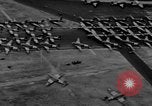
British and American C-47 tow planes and gliders during Allied invasion of Normandy in World War II
Aerial view of many USAAF Troop Carrier Command C-47 aircraft,together with gliders, parked on a field in England. The aircraft and gliders are all painted in D-Day stripes. Views on ground of C-47s taking off towing gliders behind. Formation of C-47s and gliders overhead. Views from an aircraft in a formation. Below, the Portland Bill lighthouse & directional beacon (code-named Flatbush) is seen as the formation departs the English coast. (Note: film view of Portland Bill light is reversed. Roundabout should appear to right of the lighthouse.) Closeup of a glider in the formation. View from a ship, in the English Channel, as an airplane crashes and explodes on the French coast. Aerial view of landing craft on the Normandy beach, as the formation passes overhead. View of French fields flooded by the Germans. Aerial view of parachutes from U.S. Army paratroopers who had dropped into France the night before (June 5th), but no sign of the troops themselves. Masses of gliders on the ground. View inside a glider as it cuts loose from its C-47 tow plane. View from ground as gliders cut loose and maneuver for landing. View of a glider that crashed into a German Headquarters building, and view of another landing in water. Allied gliders destroyed (some burning) and damaged by German gunfire and passive defenses (15 foot poles planted closely in landing zones). A German artillery piece concealed at the edge of a landing zone. American troops, from the gliders, marching into Saint Marcouf, France. Montage of Allied advances and gunfire. Road sign pointing to Sainte Marie-du Mont and Carentan. U.S. troops moving through French town of Sainte Marie-du Monte. U.S. troops riding in a captured German Ketenkrad tracked motorcycle.
CRITICALPAST.COM: About Us | Contact Us | FAQs - How to Order | License Agreement | My Account | My Lightboxes | Shopping Cart | Advanced Search | Featured Collections | Website Terms & Conditions | Privacy Policy ©2026 CriticalPast LLC.
License Agreement |
Terms & Conditions |
Privacy Policy
©2026 CriticalPast LLC.