


 Francais
 Deutsch
 Italiano
Refine Your Search
Long Beach California USA 1960 stock footage and images
- Showing 4165 to 4170 of 27665 results more
more Hide
Hide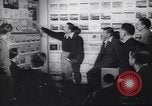
Walt Disney reviews military aircraft training storyboards with artists at Walt Disney Animation Studios in Burbank
Walt Disney Animation Studios in Burbank, California, during World War 2. Walter Elias Disney, the Founder of Walt Disney Animation Studios is seen pointing at a story board on a wall for a U.S. military training film for aviators dealing with various weather conditions. Walt Disney points to various drawings that are depicting weather patterns and military aircraft behaviors in different weather conditions. Story board sequence with title "The Warm Front" is seen. Walt Disney talks to the group of artists and editors seated and standing in the room. Portions of storyboard are seen for sequence entitled "Flight Problems." Artists and and at least one uniformed U.S. Navy officer gather to look at the storyboard and discuss.
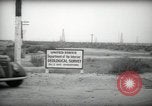
Engineering staff work on Naval Reserve Survey in headquarters of Geological Survey, U.S. Department of Interior in Taft.
Office of Geological Survey, U.S. Department of Interior in Taft, California. Sign reads 'US Department of Interior - Geological Survey - Oil and Gas Operations'. Engineer at chart. Engineer looks at U.S. Naval Reserve chart and takes down notes. Draftsman at board work on Survey chart.
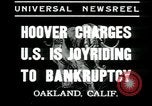
Former U.S. President Hoover speaks out against Franklin Roosevelt's New Deal and new taxation
Former U.S. President Herbert Clark Hoover addresses people in Oakland, California during the Great Depression. He speaks out in favor of a balanced budget and against the new spending and taxation proposals of the New Deal under President Franklin D. Roosevelt. He says, "The cost of the New Deal threatens to exceed that of the Great War...We have seen the creation of a most gigantic spending bureaucracy. That is not only a reduction of your standard of living, but of your freedom and your hopes. Here is where common sense cries out to be hear. The folly and waste must be cut out of this expenditure, and the federal government budget balanced, or we shall see one of three horsemen ravage this land: Taxation, or repudiation, or inflation...these issues transcend any group or individual. They represent the fate of the nation."
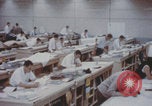
Engineers and scientists working on development work during the construction of the Sodium Reactor Experiment
Atomics International engineers working on test and development work on reactor components during the construction of the Sodium Reactor Experiment nuclear power plant at the Santa Susana Field Laboratory in California, United States. A scientist studies the weight of a metal tube. Scientists study mockup fuel elements irradiated in the thermal column of a research reactor. A hydraulic loop was used to simulate sodium flow conditions on top of a tower. Scientist inserts a hydraulic loop. Sodium flowing as seen from the hydraulic loop experiment. Full scale mockup of the fuel handling system was checked mechanically. A prototype coolant pump being studied using a temperature sodium loop. A scientist pushes some buttons of a machine. Machine gauge measures temperature in Fahrenheit. A scientist in protective suit turns a wheel. Scientists lower heavy tube.
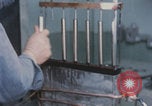
Scientists conduct safety tests ensure the durability of the Sodium Reactor Experiment (SRE) nuclear power plant
Scenes in Brandeis California at the Sodium Reactor Experiment site. A man removes and washes solid uranium slugs contained in rod clusters. The slugs are put on paper towel to dry. Men inspect the rod clusters. A man inserts the slug into the rod. A thin-walled stainless steel jacket encloses the slugs. Chemical compounds travel through glass tubes. Chemicals pour into a retort flask. Sodium potassium medium is used for heat transfer from the fuel slug to the jacket. The bonding material were admitted under an inert atmosphere. A jacket is sealed on each end by a welded stainless-steel plug. Scientists employ ultrasonic inspection. A scientist takes off welding mask. The six outside rods are spirally wrapped with stainless steel wire to prevent the fuel rods from touching each other or the coolant channel. Scientist pulls out a rod wrapped in stainless steel wire. The rod is inserted into the sodium cooler. A man in white inspects the moderator assemblies. Reactor grade graphite is machined into a hexagonal shape before being sealed into the zirconium cans. A machine presses panels of zirconium before the panels are machined into the specified width. A Heliarc welding is used for longitudinal welding. Scientists pull out the filler rod so the seams could fuse together. They carry the rod away. Scientist leak test a moderator can. A scientist inserts a well into an x-ray to check for porosity and contamination. They insert three graphite blocks to comprise the moderator element for each can. Short sections of moderator cans are tested for durability of welded head assemblies. Scientists conduct further safety tests to ensure the durability of the Sodium Reactor Experiment (SRE) nuclear power plant. A scientist uses a wrench. A stainless-steel grid plate near the bottom of the core tank supports and locates the moderator assemblies. The holes space the lower ends of the moderator cans and fuel elements on a triangular lattice. Stainless steel core tank contains the core. A welder welding bottom head. The side of the tank with 3 ring section. The animation shows the layers of the core tank of the Sodium Reactor Experiment. Casting of low carbon steel to form seven rings that comprise the thermal shield. View of the thermal shield of the sodium reactor core tank. Animation shows the rotatable top shield on top of the core tank. Man installs moderator assembly on top of the rotatable top shield. The top shield is filled with dense concrete. Man with sodium pump or modified hot oil pumps. The pump rotates.
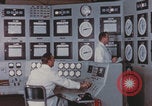
Scientists study and change fuel elements in core reactor of the Sodium Reactor Experiment nuclear power plant
Scientists working in control room of Sodium Reactor Experiment nuclear power plant at the Santa Susana Field Laboratory in Southern California. Fuel elements made from special uranium alloys, thorium uranium, and high temperature ceramic fuels. A scientist in white protective suit rides and operates bridge train. Fuel elements are removed from the core by the shielded fuel handling cast. The operator positions the cast in the general area over the used fuel element to be withdrawn. An indexing mechanism guides the cast to a preset position. Pneumatic mechanism forces an LED radiation shield down onto the surface of the loading face. Animation depicts a pickup device within the cast is lowered to engage the shielding plug of the used fuel element, with the shielding plug hanger rod and radioactive fuel element as one complete unit. Revolving fuel support plate at the top of the cast rotates to position new fuel element over empty fuel channel. The new fuel element is lowered into the core and shielding mechanisms are raised. The used fuel element is taken to underground cleaning cells where it is washed in a water bath. The fuel element is transferred into a storage cell after cleaning to permit reprocessing. Scientists use the hot cells for disassembly and study of experimental fuel elements. A scientist uses robotic arms to handle irradiated material in another room.
CRITICALPAST.COM: About Us | Contact Us | FAQs - How to Order | License Agreement | My Account | My Lightboxes | Shopping Cart | Advanced Search | Featured Collections | Website Terms & Conditions | Privacy Policy ©2026 CriticalPast LLC.
License Agreement |
Terms & Conditions |
Privacy Policy
©2026 CriticalPast LLC.