


 Francais
 Deutsch
 Italiano
Refine Your Search
Long Beach California USA 1960 stock footage and images
- Showing 4189 to 4194 of 27665 results more
more Hide
Hide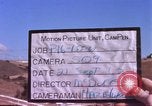
Retired famous Marine Corps horse, Sergeant Reckless, decorated for combat service during the Korean War.
Camera from hilltop, pans over an outdoor corral and collection of buildings (some quonset style) at U.S. Marine Corps Camp Pendleton, California. In the middle background, what appears to be a firing range, can be seen. Other buildings sit atop hills in the far background. Scene shifts to close view of a chestnut mare, in a private stable. A sign on the gate reads "Reckless." The mare wears a blanket displaying a staff sergeant's stripes and service ribbons. The words "Sgt. Reckless 1st Mar. Div." also appear on it. Sgt. Reckless is contentedly eating from a trough of hay set up in the pen. Closeup of her horse blanket. (Note: Sgt. Reckless is seen here in retirement. She was bought by U.S. Marines in Korea, in 1952, during the Korean war, and trained to be a pack horse for the Recoilless Rifle Platoon, Anti-Tank Company, 5th Marine Regiment, 1st Marine Division. Her decorations include: Purple Heart w/ 1 award star; Navy Presidential Unit Citation w/ 1 service star; Navy Unit Commendation; Marine Corps Good Conduct Medal; National Defense Service Medal; Korean Service Medal w/ 3 bronze service stars; Korean Presidential Unit Citation; United Nations Korea Medal; and French Fourragère. Sergeant Reckless died in 1968.)
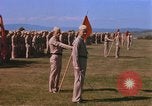
Members of the 5th Division of USMC (United States Marine Corps ) marching.
Members of the 5th Division of USMC (United States Marine Corps ) march during the change of command of Major General Kyle to General Sawyer. The Marine Corps marching lead by a band at the Parade ground of Camp Pendleton, California, United States. Marines give a display of M-14 rifles and others with USMC flags.
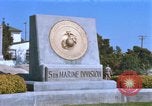
The 5th Marine Division of USMC march during change of command of Major General Kyle to General Sawyer.
Stone plaque reads '5th Marine Division' and has USMC (United States Marine Corps) emblem at Camp Pendleton, California, United States. Marine Corps load and fire gun salute during change of command of Major General Kyle to General Sawyer. Major General Kyle and General Sawyer with other marine corps salute. General Sawyer gives a speech while photographer takes pictures. Marine Corps march with M-14 rifles and USMC flags in hand.
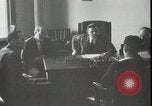
Los Angeles County Relief Administration officials meet, and views of a relief administration community garden
Frank McLaughlin, director of the State Emergency Relief Administration (SERA), and Roy W. Pilling, Director of the Los Angeles County Relief Administration (LACRA), and other state and county officials in meetings at the Los County Headquarters on Flower Street to discuss the LACRA in Los Angeles, California. Relief workers and citizens during the Great Depression tend a State Emergency Relief Administration (SERA) community garden. They till the soil and plant seeds. Workers dig an irrigation ditch and hand weed the garden rows. Two men eat turnips grown in the field. Men load vegetables onto cart to be taken to the food division of the Surplus Commodities Warehouse for free distribution to hungry families.
Boys work and play at a Juvenile Delinquency Prevention Camp sponsored by the LACRA during the Great Depression.
Los Angeles County Relief Administration (LACRA) work with Sheriff's probation officers in enlisting youth for work during the Great Depression in the United States. A juvenile offender undergoes interview with probation officers. Young men work at the Juvenile Delinquency Prevention Camp near San Bernardino, California, digging into rock and gravel and dirt piles as they build new roads. Boy workers seated at a table eat food. They are shown seated receiving school lectures, and playing baseball and boxing. The American flag is lowered outside the camp barracks (operating similar to a CCC or Civilian Conservation Corps camp).
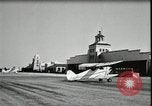
Los Angeles County Relief Administration (LACRA) workers construct two runways at airfield in Los Angeles
Aircraft parked at a Los Angeles, California airport that is undergoing expansion. Horse pulled earth-moving carts carve new runways. Los Angeles County Relief Administration (LACRA) workers construct two runways at the airfield.
CRITICALPAST.COM: About Us | Contact Us | FAQs - How to Order | License Agreement | My Account | My Lightboxes | Shopping Cart | Advanced Search | Featured Collections | Website Terms & Conditions | Privacy Policy ©2026 CriticalPast LLC.
License Agreement |
Terms & Conditions |
Privacy Policy
©2026 CriticalPast LLC.