


 Francais
 Deutsch
 Italiano
Refine Your Search
Long Beach California USA 1960 stock footage and images
- Showing 5017 to 5022 of 27665 results more
more Hide
Hide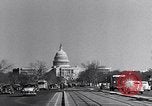
Japanese representatives at the UN Assembly, UN and UNESCO in United States and Paris.
Japanese diplomats in the United States. Car and bus traffic of 1950s cars on street in Washington Dc with the United States Capitol building in the background. Elected Japanese representatives climb up stairs of the U.S. assembly. The U.S. Vice President Allen W Barkley and Secretary David Rice Atchison receives Japanese representatives and shake hands with them. They pose. Building of the United Nations (The temporary United Nations Headquarters building in Lake Success, Long Island, New York, in the Sperry Gyroscope Corp building.) Japanese representatives go in the building. Warren Austin, a U.S. delegate stands and shakes hands with the representatives. They sit in hall, wear headphones and listen to the translated discussions. Scene changes to Paris, with car traffic on street and Arc de Triomphe in background. Building of the UNESCO (United Nations Educational Scientific and Cultural Organization). Japanese representatives get in the building. Meeting in session. Representatives of Japan, Laos, Vietnam and Cambodia. Japanese representative addresses and shakes hands with the UNESCO president and other members.
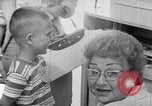
Children from the Head Start program learn and play in United States.
Operation Head Start in United States. A volunteer at Head Start Pre-school, takes child with her. She pins name tag on the child's shirt. Two children walk towards their home in Manchester. Children play at church yard. Teacher reads aloud to children. A mother and her child watch from window of a house near church. Volunteers teach small groups of children. A child stands and watches others clown and play. An African American boy tosses a ball. Children dance. Boy plays with a bat. Children play on stairs out side a building. A little girl walks on long wooden board. Boy tries to balance on square wooden board. Children play on playground equipment such as jungle gym at outdoor playground.
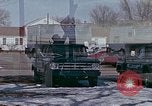
Strategic Air Command (SAC) Minutemen Missile Security Police. Camper Alert teams
Camper Alert Team vehicles of the SAC Minutemen Missile Security Police are parked in a llne at Francis E. Warren Air Force Base, Cheyenne, Wyoming. They are ready to be dispatched with Security Police teams to protect missile launch sites, for as long as necessary. Launch Facility topside with security forces member seen from outside the fence with launcher closure in foreground. Interiors of camper van. Sleeping bed, refrigerator and stove in van. (Note: Narrated by Kemal Amen "Casey" Kasem)

U.S. Navy training film about escape from ditched modern jet fighters that sink faster than the old propeller airplanes
An F6F Hellcat ditches in the sea. It floats long enough to allow pilot to abandon it before sinking. Next an A-4 Skyhawk ditches. Narrator remarks about the short time for escape from such aircraft on the surface of the water. Views of tests conducted by the U.S. Navy to test the sink rates of jet aircraft from various heights and attitudes. A dummy is placed in the cockpit of a derelict F9F Panther, which is lifted by a crane and is dropped into water from a low height. It is seen floating. (Narrator states that even with no structural damage, it sinks in less than a minute.) Next an FJ-2 Fury is dropped from about 55 feet. Due to structural damage, narrator states such an aircraft may sink in a few seconds, and generally between zero to 55 seconds. View of crane operator and then of an airplane sinking rapidly. Scene shifts to James F. Roth of U.S. Navy Attack Squadron 42,(VA-42) the "Green Pawns," in the closed cockpit of a Navy jet airplane. Next, an F-4 phantom jet is seen being catapulted from an aircraft carrier. Animation shows that the airplane falling into the sea right after takeoff will sink ballistically and can descend as deep as 100 feet in 10 seconds.
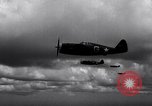
Air Defense of the United States, during World War II.
P-47 aircraft in flight over United States. U.S.Air Defense area operation board room and officers in the room. Men and women work to detect and locate the position of enemy aircraft. Fighters and antiaircraft artillery are coordinated in the Area Operations Center. Officer talks to a soldier through telephone. Antiaircraft artillery on the field. Soldiers stand nearby the artillery. Officer gives information to the soldiers on phone about the enemy positions. Long range radar in operation. Men and women display locations of enemy and friendly aircraft on the area board.
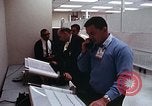
National Aeronautics and Space Administration (NASA) investigation of Apollo 1 disaster in United States.
NASA investigators pore over data related to the Apollo 1 command module fire on January 27, 1967. They discuss computer printouts showing graphical depictions of conditions during the event. Document control practice is shown with persons logging them in and out with a custodian. Engineers place long computer printouts on a white board. Many make notes and annotate documents.
CRITICALPAST.COM: About Us | Contact Us | FAQs - How to Order | License Agreement | My Account | My Lightboxes | Shopping Cart | Advanced Search | Featured Collections | Website Terms & Conditions | Privacy Policy ©2026 CriticalPast LLC.
License Agreement |
Terms & Conditions |
Privacy Policy
©2026 CriticalPast LLC.