


 Francais
 Deutsch
 Italiano
Refine Your Search
Long Beach California USA 1960 stock footage and images
- Showing 5041 to 5046 of 27665 results more
more Hide
Hide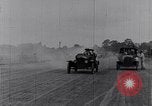
Parade of Ford cars and Fordson tractors at a race track in the United States.
A Ford Model -T roadster driven by a woman, with two women passengers in the rear seat, drives in the center of a race track. It lurches up and down over rough section of the track. Another Ford Model-T hastens to join in behind the women. It also bounces and jerks over the same section of track. At the inside edge of the track, a long line of Fordson Tractors moves by on parade, along with a large early steam roller. Edge of the spectator grandstand just visible.
Parade of 1926 model Ford cars, trucks, and buses at a race track
A motorcycle policemen leads a parade of new (1926 models) Ford motor vehicles, on a race track. A long line of Ford cars, trucks, and buses follow slowly on the race track. A man in one of the first vehicles is speaking toward the the camera and spectators, with a large megaphone.

Space research about the ionosphere from the ground by the National Bureau of Standards.
Film entitled 'Scatter Radar', from The National Bureau of Standards, United States Department of Commerce. Depicts space research from the ground. The globe rotating. A satellite antenna moves into position. Radio instruments. Red optical instruments used to study the sun. Clouds in the upper atmosphere. Animation: Ionosphere reflects radio waves to the planet. A smoke of cloud rises during the launching of a rocket. An artists' conception of the Van Allen Radiation Belt above the Earth's ionosphere discovered by Explorer I and Pioneer III. A satellite orbits the globe. Men watch as a rocket is erected and fired. A scientist at the National Bureau of Standards works on a formula. A man at the controls of a scatter radar fro space research. Animation: Ionized and neutral particles as well as free electrons that permit long distance communication. free electrons reflect radio energy. Radio waves penetrate the ionosphere. A scientist at the Ionosonde model C4 to measure electron density variations. Electron density model on the monitor. Two Oxygen atoms. An electron detaches and becomes a free electron. Radio waves pass by, the electron and waves oscillate and scatter energy. Animation: Need to excite electrons sufficiently so that their energy radiated can be detected from the ground. The process requires a powerful transmitter, large antenna, and a sensitive receiver.
Trucks and vans used as fire engines, delivery vans, transportation for troops, water and milk tankers in the United States.
Growth of suburban areas caused by inter-development of the automobile and the public road system (1897-1927). Trucks used to save time and for long hauls. Horse carriages carry goods. A fire engine leaves the fire station. A delivery van delivers baked goods. A water tanker moves alongside a car. A delivery truck for horses. Troops transported in trucks. Truckloads of soldiers driven in the countryside. A truck at a gas station. Simpson's milk tankers on their way.
Steps in rolling a finished steel product (WW2)
Steel production in the United States during World War II. Overhead crane lifts steel ingot and places it into carrier that discharges it onto bed of blooming mill, where it is shuttled back and forth between different segments of water-cooled rollers until it is finally converted into a long steel bar. The steel bar is then rolled through a continuous bar mill, where it is reduced in thickness as it passes successive stations of the mill. At the end, the bar is cut into uniform lengths.

Metal sheets being rolled, shaped and workers weigh pistons at the Ford River Rouge Complex in Dearborn, Michigan.
Activities at the Ford River Rouge Complex in Dearborn, Michigan. A crane removes hot ingot from a soaking pit and places it on the conveyor to a rolling mill. An operator's hand on the machinery controls. The ingot tipping into the rolling machinery . It is being rolled and shaped. It is moved from one machine to another until a long thin sheet of metal emerges. A worker examines a thin sheet of metal as it passes him. The rolling machinery in operation. An aerial view of the plant. A line moving to the motor building center. A piston polishing machinery in operation. Workers finish and weigh pistons. The pistons on an overhead conveyor. The workers assemble sets for motors.
CRITICALPAST.COM: About Us | Contact Us | FAQs - How to Order | License Agreement | My Account | My Lightboxes | Shopping Cart | Advanced Search | Featured Collections | Website Terms & Conditions | Privacy Policy ©2026 CriticalPast LLC.
License Agreement |
Terms & Conditions |
Privacy Policy
©2026 CriticalPast LLC.