


 Francais
 Deutsch
 Italiano
Refine Your Search
Long Beach California USA 1960 stock footage and images
- Showing 5215 to 5220 of 27665 results more
more Hide
Hide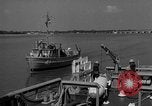
Crewmen operate mine sweeping equipment and hand tools aboard a Minesweeping Boat underway off the shore of the U.S.
Characteristics of a Minesweeping Boat (MSB) underway off the shore of the United States. MSB characteristics include: operates on a daily basis, 57 feet long, beam of 15 feet, draft of 5 feet, effective speed, can be lifted by larger ship, crew consists of 7 men and a chief officer, armaments consists of small arms, constructed from wood and non magnetic material, non magnetic engine and gear. A crewman operates mine sweeping equipment and hand tools. Other man at the control device. The United States flag flutters in wind from the mast of the ship.
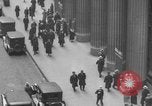
Man exchanges guitar for basket of fruits in the barter system after inauguration of Franklin D Roosevelt in Washington DC.
Great Depression footage after the inauguration of Franklin D Roosevelt as the President of the U.S. in Washington D.C. in 1933. During a bank holiday two day after the inauguration of Franklin D Roosevelt as the President of the US, vehicles move on the streets. Long lines of civilians move on the streets. Man makes a genuine hand made "depression dollar." which is made out of rubber. He demonstrates how it can grow for inflation by stretching. He displays the dollar designed for inflation. Other man stretches the dollar. Man approaches a merchant. He exchanges his guitar for basket of fruits under the barter system which was common in the depression. Footage is from a 1958 newsreel recounting events 25 years earlier.

A man secures stabilizer to ring tail,covers with drag ring,adjusts valve before the release of torpedo in United States.
New techniques in aerial torpedo attack, United States. An aircraft in flight over a sea. The aircraft releases torpedo in water. Torpedo moves. Men haul trolley loaded with the torpedo. The shroud ring or ring tail is in conjunction with the drag ring on nose of the torpedo. Using ring tail and drag ring with wooden stabilizer results in successful test drops. A man secures the stabilizer to ring tail with wooden dowels. The man covers the torpedo with a drag ring which helps to stabilize the torpedo during air travel, and seals the ring. The man adjusts the water trip delay valve which prevents the torpedo from burning up during long travels. Depth setting is done. (World War II period).

A man explains graphical presentation of the proper speed and altitude combination for torpedo release in United States.
New techniques in aerial torpedo attack, United States. A man explains the graphical presentation of the proper speed and altitude combination for torpedo release. An aircraft in flight releases torpedo in water. The torpedo moves in water. The torpedo launching guide. In double entry type graph, the combination of 2 coordinates gives the third coordinate. Dropping speed and dropping altitude data is entered in the chart. It gives the entrance angle. The man explains the concept of point of release to the point of hitting target using the graph. The cross wind effect on torpedo drop is explained. Time column on graph gives time of fall of torpedo. Release of torpedo with proper range is necessary. Radar ranging requires teamwork between the pilot and the radio man. Demerits of long and short range is explained. (World War II period).
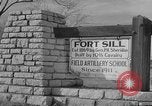
U.S. Army officers receive training at Ft. Sill, Oklahoma; Ft. Scott, Kansas; and Ft. Bliss, and White Sands, New Mexico
Officers training at artillery school in the United States. View of the Fort Sill Field artillery school, Oklahoma. Officers look through binoculars during their gunnery training class. They learn service and firing techniques on field. They learn techniques of rocket bombardment. They learn to fly aircraft and phenomenon of meteorology. They release weather balloons. At Fort Scott, Kansas, officers load coastal guns and are trained about destroying sea borne assets. At Fort Bliss, Texas, officers learn antiaircraft techniques. Long range rocket is launched at the White Sands Proving Grounds.
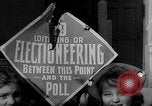
The 1944 U.S. Presidential election in World War II
On Election Day, November 7, 1944, in World War 2, Americans are seen waiting patiently to vote. They stand in a long line extending down a city sidewalk next to brick and stone buildings. Views of several persons in the line. Scene shifts in flashback to the election of Woodrow Wilson, in 1912. Four men on horseback arrive at a polling place. Another travels to vote, in his 1910 Ford Model T truck. Change of time and place shows farmer arriving by horse-drawn wagon and walking to polling place past 1930s car and truck. A fully laden truck stops at a rural gasoline station, temporarily serving as polling place. American town residential street scene in the 1930s. Citizens gathering to vote at a polling place set up at a laundry shop, in the Bronx Borough of New York City. Views of various places in the United States, serving as polling places. Americans seen waiting to vote at various places, in the 1944 national election. Among the sites shown is Bridgeport Central High School, built in 1916, (which later became Bridgeport City Hall), at 45 Lyon Terrace in Bridgeport, Connecticut. Persons in various places, registering to vote, including actor Lewis Stone, actress Esther Williams, and USO entertainer, Bob Hope. Voter closing curtain behind him as he votes in a voting booth. Views of voters' feet, below curtains, as they vote. Various types of boxes. Newspaper headline speaks of the large voter turnout in millions during the 1944 election. Shipyard workers at end of their shift, are seen heading to the polls to vote.
CRITICALPAST.COM: About Us | Contact Us | FAQs - How to Order | License Agreement | My Account | My Lightboxes | Shopping Cart | Advanced Search | Featured Collections | Website Terms & Conditions | Privacy Policy ©2026 CriticalPast LLC.
License Agreement |
Terms & Conditions |
Privacy Policy
©2026 CriticalPast LLC.