


 Francais
 Deutsch
 Italiano
Refine Your Search
Long Beach California USA 1960 stock footage and images
- Showing 5389 to 5394 of 27665 results more
more Hide
Hide
The SPARS complete a five months radio course to be radio operators during their training in Atlantic City, New Jersey.
The United States Coast Guard Women's Reserve (SPARS) working in the Atlantic City, New Jersey. Long lines of women seated in chairs inside a building during radio training. They complete a five months radio course to be radio operators during World War 2, freeing more men for duty on the war front. Women marching outside Coast Guard buildings. A board on a building reads: 'US Coast Guard Training Station'. The women receive radio operator certificates, awarded by Commander Dorothy Stratton during a ceremony. Women SPARS in Coast Guard uniforms smiling after receiving their certificates.
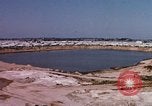
Life style at Levittown in Bucks County, Pennsylvania, United States.
Life style at Levittown in Bucks County, Pennsylvania, United States. Scene of lake with houses in the background. People at night gather around a fire to grill hot dogs on long forks or sticks. They sit there and eat food. People come out of a building. Two women and men stand and talk. Scenes of Good Shepard Lutheran Church.
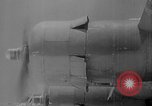
B-24s of U.S. 5th Bombardment Group operating from Munda Point airfield, New Georgia Island, in World War II.
A B-24 Liberator bomber with nose art painted name "Laden Maiden,"of the USAAF 5th Bombardment Group, sits with engines running,on Munda Point airfield, New Georgia Island, preparing to take off to bomb Japanese shipping near Truk, during World War 2. Broader view shows two squadrons of B-24s preparing for the mission as a rain storm sweeps the island. The aircraft begin taxiing for takeoff. One with nose art name "Tim-ber," shows 25 bombs, for missions, painted on its fuselage. One departing B-24 is seen to use a long takeoff run. Narrator describes difficulties encountered by one B-24 that had to ditch during the mission. Sequence shifts to post-mission scenes the day after the planes returned to Munda.Injured crew members from the ditched B-24, who had been rescued by a Navy PBY, are being transferred to a C-47 aircraft for evacuation to a medical facility. A B-24 is seen taking off on a new mission to bomb Japanese Naval base at Rabaul. View of control tower with several B-24s in formation overhead.
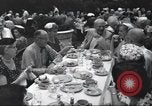
Centennial of George Eastman's birth celebrated at his home in Rochester, New York
Opening scene shows numerous guests seated at an outdoor luncheon in the gerden of George Eastman's house in Rochester, New York. The occasion is the 100th Anniversary of Gorge Eastman's birth. Views of the house where Eastman was born. It has been moved from Waterville, New York to its present location in the gardens of his last home in Rochester, New York. Two little girls stand with parents. One holds a Kodak camera. Closeup of a woman taking a photograph and another of a young man photographing with a compact motion picture camera. A man using a historic motion picture camra on a tripod. People gather around the porch of the Eastman birthplace house where Officials of the George Eastman House, including Dr. C. E. Kenneth Mees, President, Mr. James E. Gleason, Chairman of the Board, and Mr. Charles Hutchison, Vice Presi-dent, are seated. One of them is seen speaking at a podium. Mrs. Robert Ranlett, Eastman's long time friend, uncovers a commemorative plaque on the porch. Next are scenes photographed in July 1928, when George Eastman gave a garden party to introduce Kodakcolor to notable guests. He stands with Thomas Edison in the garden. Closeup of Eastman on that occasion. Cover of book holding George Eastman commemorative postage stamps. A sheet of the new stamps signed at the bottom by Postmaster General, Arthur E. Summerfield. Closeup of the stamps. Guards placing wreaths at a sculptured planter in the center of the Eastman House garden. Men gathered with hats removed for the commemoration.
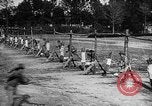
U.S. Marines training in bayonet tactics at key West, Florida, during World War I
A group of U.S. Marines in bayonet training, at Key West Florida, during World War 1. A long line of marines crouch near bayonet cloth training dummies, suspended from crossbars. These marines are able to move the dummies and parry bayonet thrusts, by means of attached padded control sticks. A line of marines wielding rifles with bayonets, charge the target the targets, while the controllers parry their bayonet thrusts. Closeup of a marine with bayonet dueling with a controller who parries his thrusts. Scene shifts to armed marines jumping over obstacle wall, bayoneting a dummy on the ground, and moving on. A body of water and some tents are seen in background. (World War I; World War 1; WWI; WW1)
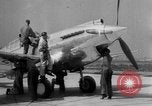
Pilots perform acceptance test flights on new P-40 aircraft at Curtiss Aircraft facility in Buffalo, NY during World War II
Pilots test fly a P-40 airplane at a Curtiss Company facility at Buffalo, NY (the Buffalo municipal airport) during World War II. Curtiss company employees giving a final cleanup and polish to a shiny P-40 airplane. parked on the ramp. Two pilots are suited up to fly: H. Lloyd Child, Curtiss’ chief test pilot (at left), and a U.S. Army Air Force major (at right), are dressed in flight suits, helmets, goggles, and wearing seat-pack parachutes. They stand beside a well-worn P-40 airplane that has a pilot/technician in its cockpit, checking controls. H. Lloyd Child (at left), points to a clipboard on his leg with information on it and discusses it with another pilot (the USAAF major). Next, a pilot is seen taxiing the shiny P-40 at fairly high speed, with the canopy open. He taxis past parked aircraft in front of a hangar, including a Curtiss SBC Helldiver; a Stinson Gullwing; and a Spartan Executive airplane. The P-40 taxis out to the runway where the pilot makes a long takeoff roll before breaking ground. Then he pulls the P-40 into a fairly steep climb, leveling off at about traffic pattern altitude, without retracting his landing gear.
CRITICALPAST.COM: About Us | Contact Us | FAQs - How to Order | License Agreement | My Account | My Lightboxes | Shopping Cart | Advanced Search | Featured Collections | Website Terms & Conditions | Privacy Policy ©2026 CriticalPast LLC.
License Agreement |
Terms & Conditions |
Privacy Policy
©2026 CriticalPast LLC.