


 Francais
 Deutsch
 Italiano
Refine Your Search
Long Beach California USA 1960 stock footage and images
- Showing 5569 to 5574 of 27665 results more
more Hide
Hide
German occupation of Bromberg (Bydgoszcz) Poland, and environs, during World War 2
View from German airplane flying over Bromberg (Bydgoszcz) Poland, during World War 2 (September, 1939) highlighting numerous bridges destroyed by the German bombing campaign during invasion of Poland. Polish civilians sit on bank of a river, next to destroyed bridge, awaiting boats to ferry them across. Makeshift ferry operations are seen. Women and children throw flowers at German troops passing in military vehicles. German troops engaged in cleanup of bomb damage and helping free a stuck military vehicle, transporting a long barrel artillery gun. Animated map shows shrinking perimeter of Polish military resistance during September, 1939. Polish Army prisoners of war marching along a road.
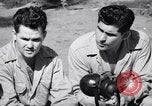
An escaped and then rescued American prisoner of war describes the Japanese death march to San Fernando
A representative of Prisoners War Branch (a MIS-X officer) interviews American soldiers who had escaped from the Japanese 10-A prison camp in Palawan, Philippines, and had then been rescued. Private first class Albert D Pacheco and Edwin A Petry share their experiences before they reached the World War 2 Japanese prison camp at Puerta Princessa, Palawan and the conditions there. Petry describes the famous five days long death march to San Fernando, where war prisoners were not given any food.
First Allied convoy reaches Kunming, China, over the Ledo Road, during World War II
U.S. military trucks, part of a convoy of 113 vehicles, led by Brigadier General Lewis Andrew Pick, are seen traversing the Ledo Road (aka the Stilwell Road) approaching their final destination of Kunming, China, on February 4, 1945, during World War 2. (They departed Ledo, India, on January 12, 1945, traveling a distance of 1,079 miles.) (Narrator gives distance as 1,044 miles.) View from an overflying airplane shows the long column of trucks on the road below. View from the ground, of the convoy reaching the city gates, where it halts as General Pick and his staff proceed through the gates to a speaker's platform set up in a covered pavilion displaying American and Chinese flags, and pictures of U.S. President Franklin D. Roosevelt and Chinese Generalissimo Chiang Kai-shek. General Pick and staff are introduced by Chinese General J.L. Wong who, speaking in English, celebrates this first convoy over the Ledo Road, and points to a banner containing four Chinese characters that spell out "The Road to Victory." General Pick takes the podium, shakes hands with General Wong, and accepts the banner from him. Camera shows the area completely filled with Chinese troops, witnessing the ceremony, including many sitting atop a nearby roof. General Pick speaks briefly, accepting the banner on behalf of the convoy members. He then leaves accompanied by the Governor of Yunnan Province, China. Officers cut a ceremonial ribbon across the road at the West Gate of the city, and the convoy is led into the city by two Chinese soldiers on motorcycles. Chinese spectators line the way and celebrate with firecrackers and cheers, as General Pick passes, standing in a jeep, displaying the Amercan flag and with the Chinese "Road to Victory" banner in its back seat. views of the convoy trucks proceeding through the city. Closeup of one, with a painting of the road, and snow capped mountains, and "First Convoy over the Ledo Road" and "Pick's Pike Life Line from India to China" painted on its canvas cover. A sign over one of the shops along the road reads in Chinese and English, "Welcome First Stilwell Highway Convoy." Views of troops waving from the trucks and Chinese citizen spectators crowding the sides of the road to watch.
Units of United states 14th Corps capture Clark Field as they advance toward Manila, Philippines, during World War II
American troops in their drive toward Manila, in 1945, during World War 2, pass several knocked out and burning Japanese Type 89 Chi-Ro tanks. A dead Japanese soldier, shot dead while trying to commit suicide, lies on the ground with an undetonated hand grenade in his mouth. U.S. M4A2 sherman III tanks and infantry of the XIV Corps moving on the Lingayen Plains Philippines, leading to the capital, Manila. U.S. armor towing artillery ford a stream, as they pass beneath framework of an apparently unusable bridge. A battery of U.S. M101 105mm Howitzer artillery pieces is set up and bombards the Clark Field area. One striking shell produces an explosion, fire and column of black smoke. U.S. troops ride forward atop tanks. Glimpse of one soldier with flamethrower tanks on his back. American tanks firing their guns. Destroyed Japanese aircraft on the ground. A soldier using a mine detector to sweep the area. He signals to another soldier who comes to probe the area with a long knife. Next a soldier is seen standing in a hole dug around a bomb Placed nose up under the ground by the Japanese. Soldiers pull it from the hole, using a rope. U.S. soldiers walk in area full of similar holes and bombs pulled from them. General Douglas MacArthur is seen, on January 26, 1945, walking among remains of Japanese aircraft at Clark Field. He visits the Filipino cemetery at Camp O'Donnell, which was a prisoner of war camp, considered the terminating point of the Bataan Death March, where some 20 thousand Filipinos and almost 2 thousand Americans died during the Japanese occupation of the Philippines. MacArthur is seen standing by a large Christian Cross monument, and walks among untended graves marked with small wooden crosses. The Mount Pinatubo volcano is seen on the horizon in the background. MacArthur and those accompanying him walk around a large monument containing a placard written in tagolog. U.S. soldiers start a mortar barrage against Japanese forces dug in on "Hill 70." Infantrymen move through trees and brush to flush out the entrenched enemy. Glimpse of type of improvised device made of explosives and gasoline, that U.S. soldiers are using to drive Japanese troops out of their fortifications. As a soldier watches with binoculars, the camera records several of these devices exploding with great force. Glimpse of a dead Japanese soldier on the ground. U.S. troops ride atop an M18 Gun motor carriage of the 637th Tank Destroyer Battalion, as it crosses a river. American tanks and infantry moving cautiously across a bridge as shells explode ahead of them. Tanks firing at Japanese troops entrenched in hillside above a road. Large numbers of American infantry marching along a road accompanied by tanks. Areas around them burning from fires set by retreating Japanese forces.
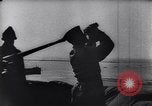
German forces engage American aircraft over skies of Germany during World War 2
German soldier looks through binoculars at American aircraft flying overhead in Germany, during World War II. German Army soldiers receive call about incoming aircraft from within their underground bunker and run, quickly mobilizing out from their bunkers to man their artillery guns. German anti-aircraft long range artillery guns firing at planes of U.S. Army Air Force. Nazi Luftwaffe fighter planes take off and attack United States B-24 and B-17 bombers. Large number off incoming U.S. aircraft in formation. Aerial gun camera views of dogfights between German aircraft and U.S. Bomber aircraft from view of German aircraft, including close-range air combat. United States B-24 is shot by Germans, suffers explosions in mid-air and crashes to the ground.
United States Marine Sergeant supervises refueling of helicopters in Vietnam
A gas truck and crew at the edge of a runway in Vietnam. United States Marine Sergeant checks papers as a South Vietnamese stands before him. Marine hooks up a hose to gas truck and turns on the fuel pump. A crew member fills gas in helicopter as a long line of HUS-1 helicopters is seen on gas line. Helicopters taxi as they take off from the line. A man in tower talks to pilots of helicopters over a wireless.
CRITICALPAST.COM: About Us | Contact Us | FAQs - How to Order | License Agreement | My Account | My Lightboxes | Shopping Cart | Advanced Search | Featured Collections | Website Terms & Conditions | Privacy Policy ©2026 CriticalPast LLC.
License Agreement |
Terms & Conditions |
Privacy Policy
©2026 CriticalPast LLC.