


 Francais
 Deutsch
 Italiano
Refine Your Search
Long Beach California USA 1960 stock footage and images
- Showing 5821 to 5826 of 27665 results more
more Hide
Hide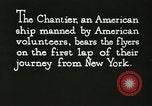
The first Polar expedition led by Richard Byrd, in 1926, leaves New York, bound for King's Bay, Spitsbergen, Norway..
United States Navy Lieutenant Commander, Richard Evelyn Byrd's arctic expedition to fly an airplane over the North Pole. U.S. Freighter Chantier docked in New York harbor. A Tug boat pushes the SS Chantier away from her pier in New York Harbor. Lt.Cmdr. Byrd, pilot Floyd Bennett, and two other members of the expedition, consult charts to plan their flight, during the cruise from New York to Norway. View from the ship's deck as they traverse sea covered with floating ice floes. closeups of the ice floes. View from the deck, as the SS Chantier approaches land, in King's Bay, Spitsbergen, Norway. A Norwegian gunboat is docked at the only pier. Snow and ice-covered mountains rise in the background. Several buildings, including a hangar, for the airship, Norge, are seen at the Norwegian camp. The Harbor master comes out to the Chantier, with three other men, in a dingy. They struggle through the ice floes, using long poles to help them maneuver.
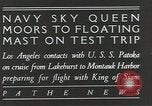
United States Navy's dirigible Los Angeles being moored on the mast of USS Patoka in the North Atlantic Ocean.
United States Navy's dirigible Los Angeles moored to 'USS Patoka' for a test trip from Lakehurst, New Jersey to Montauk Harbor, Long Island. Dirigible Los Angeles being moored on the mast of USS Patoka in the North Atlantic Ocean. Crew members walk out of the dirigible. A United States aircraft dives.
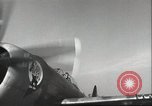
Tactics of U.S. 8th Air Force fighters for escorting bombers over Germany during World War II.
U.S.Army Air Corps P-47s with engines running, taxiing our for takeoff. Army personnel in Runway control unit with signal light.(Few seconds of film reversed.) Among the aircraft seen is P-47D, number 42-28543 named “Pat” piloted by Capt. Gordon S Stevens,of Smithfield,North Carolina, of the 63rd Fighter Squadron, 56th Fighter Group, stationed in England.(He was killed in action, 18 September 1944.) Views of the P-47s enroute to join up with B-17 bomber formations. P-51s and P-38s taking off. P-51s inflight to relieve P-47s of escort duty.US pilot with mission profile inked on back of his hand. Narrator (Ronald Reagan?) describes the way successive relays of U.S. fighters relieved each other performing bomber escort duties. Scenes from captured German film shows alarm sounding and German fighter pilots scrambling in Me-109s and FW-190s to intercept the U.S. bombers. Escorting U.S. P-51s jettison their long range drop tanks preparing to meet attacking German interceptors. Gun camera footage shows many German fighters being destroyed.P-47s, P-51s and P-38s firing their guns. Several Me-109s in formation. German gun camera clip showing many B-17s being shot to pieces by 22mm gunfire and falling, often in flames.
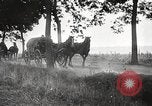
Polish Prisoners of War march on streets; Germans give food to Polish civilians; scenes during occupation of Poland
German invasion and occupation of Poland at the start of World War 2. Horse drawn covered wagons driven by German soldiers advance on roads in Poland. Captive Polish soldiers POW (Prisoners of War) under German guard march in front of Polish citizens on streets in a city in Poland. Prisoners drink soup standing in line and rest on field. German soldiers give food to Polish children and their mother. Polish women and children stand in line to get food in a town square while a band plays music. Polish elderly women, elderly men, and children receive soup on various bowls and pitchers in soup line. They drink soup seated at long tables. German soldiers march into city of Chorzow (German name Konigshutte), bordering Germany, as Polish residents there cheer their arrival enthusiastically and raise their hands in Nazi salute. (Many residents there identified as "Volksdeutsch" with German heritage. Clip ends with brief scene of military honors funeral, showing German troops in Saarbrücken burying two French pilots, Lieutenant Jean Sueur and Captain Jacques Rosignol of 2 Escadrille de Reconnaissance 551, who were shot down September 11, 1939.
United States Marine Corps 1st Marine Division soldiers march on a dirt road in Talasea,New Britain during World War II.
United States Marines of 5th Regiment, 1st Marine Division, invade Talasea, New Britain, Papua New Guinea in World War 2. A Marine digs on the ground with a knife and uncovers a Japanese Model 93 ("Tape-measure") mine. He picks it up and scrapes mud from around the cover of the detonator. Marines walk on dirt road carrying equipment. Marines firing M2 60mm light mortar. Long line of heavily laden Marines slogging along jungle path.
Repatriated American prisoners of war pose for pictures and German civilians evacuate the area in final days of World War II in Europe.
United States troops in Germany during World War 2. Group of repatriated United States soldiers pose for a photograph. They are sitting on a fuselage of a German Me-262 jet airplane, at the "REIMAHG-A" underground aircraft factory on the Walpersberg sandstone mesa, near Kahla, in Thuringia, Germany. Some repatriated soldiers pose seated on a tank. In change of scene, a long line of German civilians is seen evacuating the area. The refugees carry household and personal belongings in wagons pulled by oxen. Closeup of one wagon with children riding atop it. German women walk beside the wagons. More views of the evacuating civilians. Some use bicycles to carry their goods. An old woman tries to budge a sitting goat to take him along with her. She succeeds and leads him away on a tether. More views of evacuating families with their wagons and animals.
CRITICALPAST.COM: About Us | Contact Us | FAQs - How to Order | License Agreement | My Account | My Lightboxes | Shopping Cart | Advanced Search | Featured Collections | Website Terms & Conditions | Privacy Policy ©2026 CriticalPast LLC.
License Agreement |
Terms & Conditions |
Privacy Policy
©2026 CriticalPast LLC.