


 Francais
 Deutsch
 Italiano
Refine Your Search
Long Binh Vietnam 1967 stock footage and images
- Showing 877 to 882 of 5995 results more
more Hide
Hide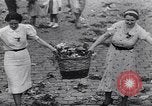
Contrasting views of German civilians in Berlin before and after Soviet takeover in 1945 Battle of Berlin.
Film opens showing two German women holding a basket of flowers, and scattering them on pavement in advance of a German military parade of Panzer III tanks, through a residential area of Berlin, Germany in World War 2. German civilian spectators line both sides of the road. Women throw flowers at the passing tanks, each of which has a German soldier standing in it dressed in a special uniform with a sash, and holding a flag. Brief closeup of older man and woman standing by a German soldier in uniform. Crowd occupies a town square and watch as the tanks pass them. Closeup of an old man watching the tanks. Camera pans to an open windows of a building where many very young children watch the parade. View from high vantage point showing long line of tanks and sidewalks filled with enthusiastic spectators. Closeup of the crowd rendering the Nazi salute. Adolf Hitler seen standing hatless, with arms crossed, in an open vehicle with two guards and a flag behind him. Another closeup of arms being raised in Nazi salute by everyone in the crowd. Abrupt change of scene to Berlin after its capture by Soviet forces late in World War 2 following the Battle of Berlin. View from high above of German civilians massed in a crowd where Soviet soldiers are distributing loaves of bread to German citiznes. Closeup of German civilians struggling to get some. A Soviet woman soldier taking bread from a truck for distribution. German civilians standing on a sidewalk next to a Soviet army truck. Closeup of a Soviet army woman soldier distributing blocks of food from the truck to civilians in food relief effort. Another Soviet woman officer stands overlooking the crowd. Closeup of German woman holding a soft straw shopping bag. Soup kitchen or soup line scene where a Soviet soldier is using a large, long handled ladle to put soup from a large pail into an old woman's pot. An old woman walking slowly along a street, where fires are burning
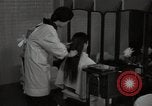
Japanese women get their hair styled in a Japanese beauty salon.
A Japanese karyūkai hairstylist styling women’s hair into traditional Nihongami hair. A hairstylist straightens a woman’s long hair using comb. Hairstylist combs the hair at the back of the head to create a long loop underneath the topknot. Hairstylist combing the sides of a woman’s hair. Hairstylist creates the topknot while woman holds a metal frame in her head. Hairstylist adds a clip on the back of a woman’s hair. Japanese woman looks into a hand mirror to admire herself.

Harvesting and processing of Manila Hemp in Davao, the Philippines during Japanese occupation period in World War II
At start of film, Camera pans over a field of Manila Hemp plants in the Philippines during occupation by the Japanese in World War 2. Camera shows views along path in the fields with hemp plants towering on either side. Filipino workers use cutters on long poles to harvest the tall plants. They cut large ones at their bases and slice strips of their barks into long thin pieces. Glimpse of a Japanese soldier observing the work. Next, Filipino workers transport the hemp in a wagon to a processing shed. Filipino workers further process the hemp into longer thinner strands and place them on horizontal poles to dry. Closeup of a man separating strands of hemp. Next, workers are seen shaking the strands outside a building. View of workers moving bales of hemp on hand carts to a scale where they are weighed and labeled. Closeup of a labeled bale.

U.S. recruits being classified for assignments and being informed about the progress of World War II and why they fight.
New U.S. army recruits seated at benches in the classification center, taking notes, as an instructor at a blackboard tells them how to fill out their classification questionnaires, during World War 2. View of machines processing the questionnaires. Hollerith 88 column punch cards being sorted by machine. Newspaper article about the Air Force efforts to improve classification and assignments of new airmen. A recruit being counseled. An Airmen in barracks, filling out a post card form to complain about his assignment. Servicemen working with sewing machines and at long cobbler's benches repairing shoes. U.S. soldiers in pith helmets, laying communications cable from a truck. A soldier recording information about a shipment of supplies. Soldiers filling 5-gallon "jerry cans" with fuel from a hose. Others serving at a communications center in woods. A soldier fastening a cable to a tank. Soldier standing on a truck. Large group of soldiers gathered to listen to a lecture about explosives. Army draftsmen at their work tables. Soldiers using information and training materials.(Narrator states these materials are often ignored.) An army newsmap for Monday, August 31, 1942 posted on an Army office wall. A sergeant points to July, 1943, on a current calendar next to it, illustrating that the newsmap is long out-of-date. View of another news map and narrator notes they are produced weekly. An officer speaking to an auditorium of soldiers. A soldier arranging his personal gear. Infantry on field maneuvers, firing rifles as they advance across a field. Soldiers firing a Browning water-cooled machine gun; a mortar; and a 105mm M101A1 howitzer. The sergeant using a newsmap to brief his staff about the progress of the war. Opening frames of a War Department Film Bulletin, and soldiers in a theater, watching the film. Opening frames of the film,"Why We Fight," that goes on to show animated map of the German advance across Europe in World War 2. Scenes of German forces on the move, towing artillery, riding on tanks, and entering towns as they invade countries of Europe. Women and children running in streets under bombardment, and civilians fleeing from their homes during aerial bombing. A Bombed out city and civilian corpses lying on the ground. Women in Poland, identifying their dead and grieving over them. German Heinkel He 111 aircraft dropping bombs. Norwegians evacuating the city in trucks, and other vehicles and on foot, during the German invasion. A squadron of German Messerschmitt Bf-109 aircraft in flight. German Ju-87, Stuka dive bombers diving on targets. Civilians rushing to a bomb shelter, and other refugees boarding a truck to evacuate. More He-111 bombers dropping bombs. A Ju-52 trimotor transport (type used to transport German paratroopers). Buildings ablaze in a town. Large formations of German aircraft of various types flying overhead. Building destroyed and burning from bombing. Ju-87s flying close past the camera.
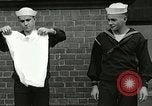
Sailors hold their uniforms at the U.S. Naval Training Center in Great Lakes, Illinois.
The U.S. Naval Training Center in Great Lakes, Illinois. Two sailors stand holding different clothes. One of the sailor holds up a pair of shorts, under shirts, one long and one short sleeved. He also holds long under pants, pajama pants, a parka, a sweater, puttees, a dark cap, a white cap and a stocking cap.
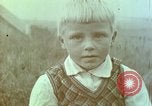
Views of Norway and its people in 1939
Norwegian boy and girl in farm field in Norway. Other girls are seen. The girls hold dead puffin sea birds. Norwegian men and women walk toward a town in the mist. Norwegian man and woman standing at the back of their house. Two women walking along a road toward the town. Various houses and fields. Man leading a pony pulling a two-wheeled cart. Laundry on a line hung out to dry. Norwegian boy smiling. Norwegian boys pose in a yard.Two girls and a smaller boy pose. A man next to a canvas covered boat. A boy stands beside a pony. A friend comes up to steady the animal as the boy jumps on the horse with no saddle. He quickly slides back down again. One of Eva Braun's sisters pets the pony. Local people walking toward their waterfront. Buildings on stilts. A fishing boat nearby. Several boats and scenery at the waterfront. Eva Braun's mother, Franziska, and one of Eva's sisters, standing near a taxi cab. Camera focuses on the car. Scene shifts to a waterfront open market with Norwegian people gathered near a long line of tanks from which steam is rising. The tanks are covered with concave semicircular gratings. Men with long poles tend to the contents. (Film shot by Eva Braun during a trip on the ship MS Milwaukee in July 1939.)
CRITICALPAST.COM: About Us | Contact Us | FAQs - How to Order | License Agreement | My Account | My Lightboxes | Shopping Cart | Advanced Search | Featured Collections | Website Terms & Conditions | Privacy Policy ©2026 CriticalPast LLC.
License Agreement |
Terms & Conditions |
Privacy Policy
©2026 CriticalPast LLC.