


 Francais
 Deutsch
 Italiano

Refine Your Search
Long Binh Vietnam 1967 stock footage and images
- Showing 1687 to 1692 of 6005 results more
 Hide
Color Sound

Coal mining operations for the Ford Motor Company in Kentucky.
Open rail hopper cars of coal at a mine in Kentucky. (Ford coal was mined at the Banner Fork Coal Corporation at Wallins Creek, Kentucky and the Pond Creek Coal Company at Stone, Kentucky.) View inside the mine, where a miner is riding a bucket as it slides down a slope. Next, a miner is seen at a coal cutting machine in operation. Miners riding atop rail cars full of coal as they arrive at the surface. Mining cars being emptied at a tipple, where the coal is moved on a conveyor and loaded into open hopper cars. A steam locomotive pulling a long train of coal hopper cars, each displaying the Ford Company Logo. A train of coal cars arriving at the River Rouge Plant.

A Ford Motor Company iron ore mine. And various operations at the Rouge plant in Michigan.
View of a Ford Motor Company iron ore mine during winter. Snow covers the ground. Closeup of a ore car running up the Tiple. View from up on the Tiple as a iron ore car reaches reaches the top. Scene shifts to a bulk carrier freighter docked at pier. High above are a line of railroad open hopper cars. the next scene shows a large bulk carrier ship steaming away. Scene shifts to the Ford River Rouge Plant in Dearborn, Michigan, where huge cranes and clamshell buckets are raising iron ore raw material into the plant. Closeup of an operator inside a compartment low in the crane, controlling the bucket. Another view of the cranes at work. A huge pile of iron ore at the River Rouge Plant. A dragline bucket being moved through an ore pile. Iron ore in a container moving along a conveyor. Hot Molten slag being poured into a special crucible on rails, beneath a steel furnace. A long line (a train) of slag-filled crucibles. Slag being dumped from a crucible onto the slag heap for use in road building and making cement. A steam shovel being used to load slag into a large railroad car. Men with shovels cleaning up areas of the plant. Tractors pulling wagons in the yard. More piles of raw materials for making cement are seen next to factory and railroad tracks where 2,000 barrels of cement are made daily.

Steel making at the Ford Motor Company River Rouge Plant in Michigan
An Open Hearth furnace at the Ford Motor Company River Rouge Plant is being tapped and molten steel runs through troughs in the floor. View of the furnace opening. The scene brightly illuminated by the light of the molten metal. Hot molten steel flowing into crucibles on rails, just outside the plant. Activity in the plant yard is seen in the background. Molten steel begins pouring into another crucible. Next, the huge crucibles are seen outside the plant being pulled by a steam locomotive, along a railroad in the plant yard. View shifts to inside a building where molten steel is being guided by men with long poles as it flows towards a pair of conveyors for making of pig iron. Closeup of the pig iron being transported upwards on two conveyors. Glimpse of a quenching operation. Then, a huge crucible is seen moving by overhead crane and pouring its contents into another container. Fire and smoke are generated. More views of steel being poured from the crucible, and then of the receiving container being moved on a rail.
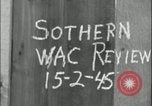
African American WACS of the 6888th Central Postal Directory Battalion march in formation after arrival in Birmingham England.
African American women soldiers of the 6888th Central Postal Directory Battalion, nicknamed “Six Triple Eight", Women's Army Corps (WACS), march in formation on February 15, 1945, during World War 2. Location is Birmingham, England, United Kingdom, at the time of the unit's arrival in Birmingham. A military band of male soldiers precedes the group of marching WACS. The long column of African American WACS, marching 4 deep, is led by commanding officer Major Charity Adams. Close up views of the women marching. WACS in front of the unit carry the American flag in the procession.
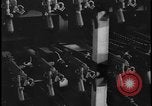
German weapons and munitions inside bunker storage; German soldiers aim artillery through pillbox and march at Siegfried Line fortification.
Various weapons and ammunition found inside a bunker in the Siegfried Line in Nazi Germany. Camera shows neatly-arranged rifles, artillery, artillery shells, and cannons inside a bunker. Long lines of light infantry artillery in storage including Pak 36 (Panzerabwehrkanone 36) is a 3.7 cm caliber German anti-tank guns and German le IG G18 75mm infantry support guns. Rows of cannons in storage and many shells. Sign says “Sechsscharten Turm” (German: “Six-slot tower”). German solders pull chains to lift armament up from storage. Soldier push a rail cart full of artillery shells into an elevator after track signal changes to indicate entrance clear. German soldiers aim artillery with cannon in foreground inside bunker. POV aiming cannon from inside German bunker through pillbox embrasure to outside. Various German artillery pieces moving into aiming position through embrasure as seen from outside bunker pillboxes. German soldiers marching into a bunker. View of Dragon's teeth tank barriers arranged on the Siegfried Line.

Various bunkers, water filled trenches, and tank obstacles found along Siegfried Line in western Nazi Germany prior to WWII.
View of a bunker overlooking a river in Germany, likely the Saar river, before World War 2. A ship can be seen sailing in the river. Many other pillboxes along the river. Low angle view of “Dragon’s teeth” tank barriers found in the Siegfried Line, the defense fortification line in western Nazi Germany use during WWII. Aerial view of long water filled trench on the Siegfried Line running through forest and farmland.
CRITICALPAST.COM: About Us | Contact Us | FAQs - How to Order | License Agreement | My Account | My Lightboxes | Shopping Cart | Advanced Search | Featured Collections | Website Terms & Conditions | Privacy Policy ©2026 CriticalPast LLC.
License Agreement |
Terms & Conditions |
Privacy Policy
©2026 CriticalPast LLC.