


 Francais
 Deutsch
 Italiano
Refine Your Search
Long Binh Vietnam 1967 stock footage and images
- Showing 2257 to 2262 of 5994 results more
more Hide
Hide
U.S. Signal Corps officers and soldiers use mine detectors, modern radars, and meteorological equipment during World War II.
The role and contribution of the U.S. Army Signal Corps in combat and war. U.S. shuttle ships loaded with signal communication supplies for U.S. and Allied troops in the European Theater make their way in the Atlantic ocean. The Squier Laboratory at Camp Alfred Vail in Fort Monmouth, New Jersey. A technician works on signal communication equipment in the laboratory. U.S. soldiers use mine detectors in the European Theater during World War II. The mine detectors detect metallic, non-metallic mines, wooden box mines, and mines in glass containers. Artillery soldiers bury large microphones into the ground in advance zones. The microphones relay back information on enemy artillery. Soldiers receive the information on radio sets. U.S. aircraft on a training flight simulating real combat situation: The aircraft lost in heavy rain and rough weather, looking for the location of Boston. The pilot switches on a modern advanced radar. The radar waves pierce thick clouds, are reflected by Earth's surface and display an image on the scope. The image shows the clear location of Boston harbor directly under the aircraft. U.S. bombers attack over the Channel coast on D-Day (6 June, 1944). U.S. soldiers employ meteorological equipment for long range weather forecast in the European Theater during World War II. Soldiers release a hydrogen balloon into the sky. Another soldier uses an apparatus to take readings of atmospheric conditions behind enemy lines. An aircraft drops an automatic weather station called SCM-18-TI by parachute into enemy territory. The timed mechanism sends out weather data in codes. The interior of the automatic weather station lying open in a field.

Hitler Youth members, old men and women dig trenches on the Russian front during World War II.
Nazi Germany during World War II. Members of the Nazi paramilitary unit Hitler Youth train. An officer blows a whistle and supervizes the exercises. The youth at attention hold flags while they sing an anthem. Hitler Youth march. German troops cycle to the front. Hitler Youth members, old men and women dig trenches on the Russian front. The diggers with tools. An aerial view of the long trench.
German tanks, trucks, and motorized infantry roll into Narbonne and Marseille during World War II.
German troops in France during World War 2. A map depicts Frankreich (France). A sign at a line of demarcation reads 'Demarkationslinie'. A soldier checks the time in his watch. German tanks, trucks, and motorized infantry enter the former "Zone libre," effectively ending its free status and militarily occupying it. They roll through French villages toward the South Coast of France. The convoy crosses a check post. The convoy on a long winding road through hills. German forces enter the city of Narbonne. Soldiers and tanks on the city streets. Shops on a sidewalk. Civilians including children watch the Germans. Soldiers sit, read and rest. Military vehicles on a tree flanked path. Children look around. Soldiers seated in a line on a railing. Military equipment in rail carriages. A sign for Marseille. The convoy enters the city. Civilians watch the convoy. Tanks on the streets. Soldiers on tanks as they cross the triumphal arch Porte d'Aix (Porte Royale) in the city.
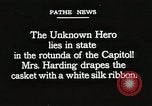
President Harding and others pay last respects to the American Unknown Soldier of World War I, lying in state at U.S. Capitol
The American Unknown Soldier of World War I lying in State at the U.S. Capitol before burial at the Tomb of the Unknowns in Arlington National Cemetery. The Unknown Hero lies in the rotunda of the U.S. Capitol (First St SE, Washington, DC 20004, United States), Washington DC. U.S. First Lady Florence Harding drapes the casket with a white silk ribbon as an official helps her. Officials and officers around the coffin as President Warren G. Harding places a wreath on the coffin. U.S. Vice President Calvin Coolidge and Supreme Court Chief Justice William Howard Taft lay a wreath on the coffin. General John J. Pershing lays a wreath and salutes. The Unknown Soldier in the Capitol dome. Wreath and flower placed over the casket . People pour in to pay respects and view the body. A long line outside the Capitol as people arrive to pa tribute to the Unknown Hero. Casket of the Unknown soldier inside the Capitol. Animation depicts the sacrifices made by American soldiers in the past including the American revolution, War of 1812, and the American-Spanish War of 1898.
Allied airmen in the European Theater toward end of World War II.
Allied airmen and U.S. war correspondents in the European Theater near end of World War II. A poster in French shows a man erecting a wall and the slogan "Protege La France." A French boy wearing a beret stands beside it. Another poster reads 'Its a long way to Rome' and shows British and American flags superimposed over the city of Rome on a map of Italy. A U.S. Army Air Force airman poses near a small Army Air Force aircraft. A photographer and press correspondent talk to the airman. Another Allied airman wearing sun glasses. He removes his glasses and smiles.
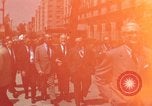
President Nixon meets with former war correspondents before they travel to Europe for D-Day 25th anniversary
World War II war correspondents gather in Washington DC before returning to Europe for ceremonies commemorating the 25th anniversary of the Allied invasion of France. War correspondents walking on the streets of Washington DC. They pass a long painted mural wall depicting scenes from American life. They stop at guard station of a White House entrance gate and then enter gates at the White House grounds as a White House officer checks them in. President Richard Nixon meeting with the correspondents. The President and a correspondent hold a document and pose for a picture. The correspondents pose with President Nixon on the White House lawn. President Nixon poses with the document, as the correspondents stand near him. Nixon talks to the men and picks up and pets the White House dog named Pasha, who was Trish Nixon's Yorkshire terrier.
CRITICALPAST.COM: About Us | Contact Us | FAQs - How to Order | License Agreement | My Account | My Lightboxes | Shopping Cart | Advanced Search | Featured Collections | Website Terms & Conditions | Privacy Policy ©2026 CriticalPast LLC.
License Agreement |
Terms & Conditions |
Privacy Policy
©2026 CriticalPast LLC.