


 Francais
 Deutsch
 Italiano
Refine Your Search
Long Binh Vietnam 1967 stock footage and images
- Showing 2311 to 2316 of 5994 results more
more Hide
Hide
Activity of Japanese troops and Emperor Hirohito observes drills and a parade in Japan.
A Japanese militaristic propaganda film on the material and spiritual strength of Japan. Narration by General of the Imperial Japanese Army Baron Sadao Araki. Opening scene shows illustration of Japanese Emperor Jimmu, with sword and quiver of arrows slung from his waist. He holds a long bow. Next is a stack of history books, with pages being turned on the top one. Dramatization of combat between forces of the Tokugawa Shogunate and those supporting restoration of the Emperor to power, in 1868. A recruitment poster showing two Japanese soldiers. Recruits taking physical exams and one flexing his muscles. A parade of soldiers carrying the Japanese Rising Sun flag. Japanese sailors among spectators on a sidewalk. Recruits gathering in a field. Soldiers in uniform in a formation. Mounted Japanese officers riding in a column along a path. Some wear white arm bands, and Two carry Japanese flags. Emperor Hirohito is seen riding a white horse, in the midst of the column. He pauses and exchanges salutes with an officer with some troops in formation at the side of the path. The officer points to troops assembled in two directions. The Emperor continues on his way, followed by his entourage. Next, a large gathering of people is seen at a courtyard near the Emperial Palace in Tokyo. They Wave patriotic banners and Japanese flags, and give cheers in unison. A boy scout drum and bugle corps plays and marches. Scene shifts to Japanese soldiers marching on a large open field. A large group of them carry massed Japanese Rising Sun flags. They are reviewed by officers on horseback.
Japanese Army conducts realistic war game with live-fire exercises involving infantry, armor, artillery and aircraft.
Film opens showing a Japanese Type 89 Yi-Go tank heading straight toward the camera. Next, mounted artillerymen ride up a hill with team of horses pulling caissons. More are seen passing trees, pulling caissons and Type 91, 105mm light field howitzers. They raise a lot of dust and they race across a barren stretch of land. Elsewhere, Several soldiers are seen with large canvases laid out on the ground. Small rolled up tents appear to be lined up on one canvas. Meanwhile, the artillerymen are starting to set up positions at various spots along the crest of a hill. Closeup of one of their horses. Next, batteries of anti-aircraft guns are seen pointing skyward, each surrounded by a team of about 10 soldiers, are seen firing. Kawasaki biwing aircraft fly overhead in formation, and the anti-aircraft guns are lowered as they pass. The guns are elevated again and resume firing. Scene shifts to the field artillery, where crews are manning the 105mm howitzers and firing them. Closeup of one of the gun crews in action. Shells are seen bursting on a sandy area near a shoreline in the distance. Some field artillery under camouflage nets. An army telegrapher sends messages with his key. Several soldiers at a field communications center also send messages. Two high wing monoplanes fly overhead. Closeup from behind Japanese artillery crew firing their field piece. More views of shells striking in distance. The guns under camouflage nets are seen firing. A huge explosion nearby throws large amounts of earth into the air. Views of the antiaircraft guns and crews dissolves into views of shells exploding. Two soldiers crawl along the ground, dragging a long pole with them. Soldiers jump up and abandon their position just before a big explosion occurs there. In final scene, several soldiers are running and shouting.
Japanese army conducts military exercises that involve inflatable rafts and pontoon bridges
Japanese Army conducts military exercise. Artillery shells explode in the distance. Some raise white smoke, while others create craters and throw large amounts of earth into the air. Japanese soldiers run carrying rolled up canvases. From them they remove and inflate rubber rafts that they carry up over a hill and down to a shoreline. They jump into the rafts and paddle furiously toward an opposite shore. The national red ball flag (sun-mark flag) is displayed on one raft. Closeup of occupants in one raft. Machine gun fire is heard in the background. The rafts reach the opposite shore where the troops jump out and charge up a hill in smoke. View from camera located at defensive obstacle as the troops arrive there. They place sections of pontoon bridges over the obstacles and cross over them. Then they carry bridge sections down a steep embankment to another shoreline where they place them end-to-end in the water to form a serpentine floating bridge. Soldiers on each section maneuver them with long poles into position spanning the water to the next shore. Next, armed troops are seen running across the new pontoon bridge. Two of them carry a version of a Hotchkiss machine gun (licensed by Japan as their Type 3 Heavy Machine Gun). One of the last few soldiers crossing the bridge, carries the sun-mark flag.
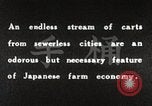
Use of human waste in Japan
Sewage treatment in Japan. Sewage consisting of human waste is brought from Japanese cities in carts to remote villages. Oxcarts carry barrels containing human waste. Farmers process raw sewage. Raw sewage is spread out in the field before it is compacted and treated with powder. A young child slips and falls into the edge of the sewage treatment pool and is rescued by a slightly older boy, who escorts the crying child in soiled clothing away from the pit. A man wears strapped-on long boards to mash the waste which is eventually to be used for farm fertilizer.
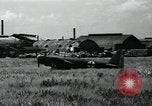
Japanese planes parked in airfield of Tokyo Municipal Airport after WW2
An assortment of Japanese planes scattered all over in the grass at Tokyo municipal airport. Included are a Japanese "Shiragiku" plane with green cross on side. A helicopter flying by. A 2PA-B3 plane built by Seversky corporation (based on the P35 fighter, purchased pre-war as a long-range escort fighter but sold off for civil use). Japanese "hickory" plane. Scrapped Douglas DC5 transport . Several DC-3s and other unidentified aircraft are also seen. Salvaged Japanese planes from World War II. Hangars and airfield. An American C-47 and small high wing monoplane with radial engine (possibly a UC-81).Transport ship on bay and a Japanese Mitsubishi C5M "Babs" reconnaissance aircraft.
Second Sino-Japanese War
Opening scene shows formation of Japanese Mitsubishi G3M bombers in flight. View of bombardier at bomb sight inside a bomber. Bombs falling from the aircraft, upon the Chinese city of Shanghai, on a day in September, 1937. Ground level view of bomb exploding and Chinese civilians running for cover. A huge explosion throwing earth up. Aerial view of smoke rising from bomb strikes below. More ground views of bombs destroying structures. Chinese people fleeing across a bridge. Cluster of bombs falling from a Japanese airplane. More explosions and destruction. view from a G3M bomber, of others with bombs falling from them. View from above of civilians filling a street as they run for shelter. People on the ground rushing in all directions. Some are in horse-drawn carriages with luggage on top and other in rickshaws, apparently fleeing the city altogether. Bombing victims lying on the ground near destroyed structures. Heavy dark smoke rising from the attacks. Scene shifts to Japanese army officers entering the Yasukuni shrine in Tokyo. Behind them is A Shinto Tori (Gate) and behind that, the monument (statue) of Omura Masujiro. Scene shifts again, to view of the Temple of Heaven, an ancient Imperial Sacrificial Altar in Peking (Beijing) China. Chinese agriculture. Crowds of Chinese people. Stone statue of traditional Chinese lion. Picture of 1851 oil-on-canvas painting by the German American artist Emanuel Gottlieb Leutze, of Washington crossing the Delaware. Drawing of 15th century ship similar to one in Columbus'1492 voyage to America. Drawing of Roman Empire era building. Michelangelo’s statue of Moses. Drawing of ancient Egyptian pyramid and statue. Drawing of Chinese city and environs representing 4 thousand years ago. Extant ancient Chinese shrines and statues. Animated Relief map of China and surrounding countries of U.S.S.R., India,Burma,Thailand, Indo-China, Philippines, and Japan. Animation outlines China Proper. It also shows Manchuria and scenes from there of desolate mountainous land, with miners at work extracting raw materials. Mongolia and Sinkiang are outlined. The Gobi desert is seen with a long camel caravan crossing it. Closeup of nomads transporting animal skins by camel. The last region outlined is Tibet. The ice covered Himalayan mountains are shown. Buddhist monks praying in the courtyard of a shrine in Tibet. The Yellow, Si Kiang, and Yangtze Rivers are shown on the map. Views of Chinese sailing vessels.
CRITICALPAST.COM: About Us | Contact Us | FAQs - How to Order | License Agreement | My Account | My Lightboxes | Shopping Cart | Advanced Search | Featured Collections | Website Terms & Conditions | Privacy Policy ©2026 CriticalPast LLC.
License Agreement |
Terms & Conditions |
Privacy Policy
©2026 CriticalPast LLC.